
Shrink Packaging Films
Shrink Packaging Films
Heat-activated films that conform tightly to product shapes — delivering tamper evidence, bundle stability, and shelf impact.
How Shrink Films Work
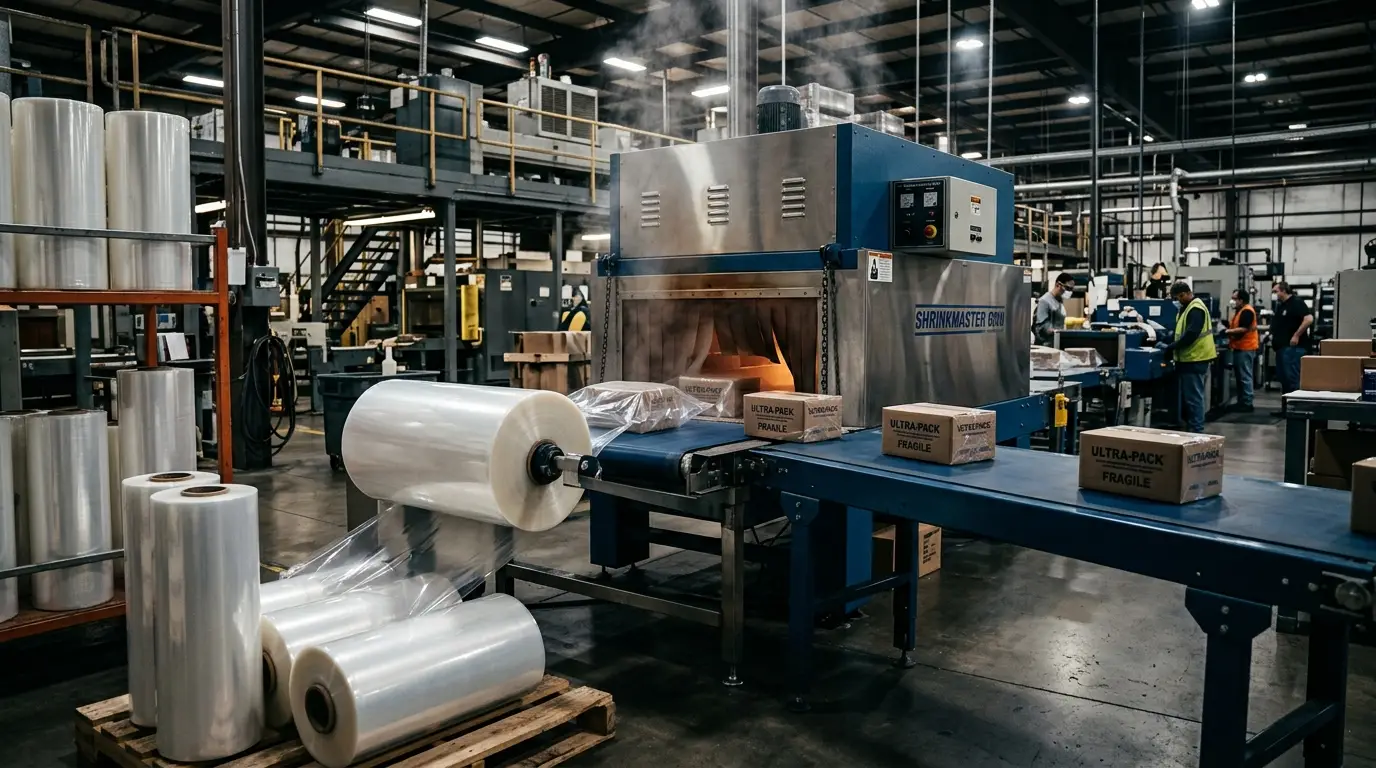
Shrink films are manufactured by extruding and then biaxially orientating polymer film above its glass transition temperature. This orientation locks molecular stress into the film. When the wrapped product passes through a heat tunnel (hot air at 120–200 °C), the film relaxes toward its original dimensions, shrinking uniformly around the product to form a tight, conforming package.
Total shrink ratio (free shrink percentage in machine and transverse directions) and shrink force are the two principal performance parameters. High shrink ratio suits contoured or irregular products; high shrink force is required for bundle stability in multi-pack applications.
Film Types Comparison
| Film | Shrink Temp (°C) | Total Shrink (%) | Clarity | Primary Application |
|---|---|---|---|---|
| PVC (rigid) | 120–150 | 40–60 | Excellent | Labels, retail sleeves |
| POF — Polyolefin | 130–170 | 50–70 | Excellent | Food, multipack, e-commerce |
| PE (centrefold) | 150–180 | 20–40 | Good | Pallet wrap, transit |
| Crosslinked POF | 120–160 | 50–75 | Excellent | Meat, poultry, premium food |
| PLA (bio-based) | 55–90 | 40–60 | Excellent | Cold labels, short shelf-life |
Polyolefin Shrink Film (POF)
Polyolefin shrink film has largely replaced PVC in food and consumer goods applications due to its superior FDA/EU food-contact compliance, absence of HCl emissions during heat sealing, and excellent optical properties. Standard POF is a co-extruded structure of EVA/LLDPE/EVA or PP/PE/PP, typically 12–25 µm thick.
Advantages of POF
High clarity and gloss, excellent seal strength, good puncture resistance, food-contact compliant without plasticiser concerns, recyclable in PE streams (PE-based POF), wide processing window on modern L-bar and continuous motion sealers.
Crosslinked POF
Electron-beam or chemical crosslinking improves hot strength, puncture resistance, and abuse resistance — critical for bone-in poultry and irregular products. Crosslinked POF typically achieves 15–30% higher shrink force than standard POF at equivalent gauge.
Equipment Compatibility
Film selection must match the sealing technology: L-bar sealers for batch retail wrapping, side-seal machines for high-speed automated lines, and sleeve applicators for full-body label shrink. Tunnel design — hot air convection vs. steam — also affects the optimal film choice. Steam tunnels provide more uniform heat distribution for irregular products but require specific film formulations with rapid shrink onset.
Frequently Asked Questions
What is the difference between POF and PVC shrink film?
POF (polyolefin) is the modern food-safe alternative to PVC. POF has no plasticisers, produces no HCl emissions when sealed, is FDA/EU food-contact compliant, and offers equal or better optical performance. PVC is still used in non-food label applications due to its lower cost and excellent clarity, but is restricted or banned for food contact in several markets.
Can shrink films be recycled?
PE-based POF films are technically recyclable in PE flexible packaging streams where infrastructure exists. PVC shrink films are not recyclable with standard polyolefin streams and can contaminate PE recycling. PLA shrink films require industrial composting conditions and should not enter plastic recycling streams.
What tunnel temperature should I use for POF?
Standard POF films require air temperatures of 130–170 °C with belt speeds adjusted to give 3–5 seconds of dwell time. Crosslinked POF typically processes at 120–155 °C. Start at the lower end and increase temperature until full shrink is achieved without holes or distortion. Steam tunnels operate at lower nominal temperatures (100–105 °C) but transfer heat more efficiently.