
Packaging Quality & Testing Methods
Packaging Quality & Testing Methods
Systematic quality testing converts process assumptions into measured evidence — the foundation of packaging that reliably reaches consumers intact.
Packaging Quality Testing Overview
Packaging quality testing encompasses all analytical and physical methods used to verify that a package meets its functional specifications throughout design, production, and distribution. Tests fall into three categories: material characterisation (verifying incoming film and tray materials meet specification), process quality (verifying the packaging process produces acceptable seals and closures), and system performance (verifying the complete package protects its contents through the intended distribution environment).
Seal Strength Testing
Seal strength is the single most important quality attribute for heat-sealed packaging. Two primary test methods are used:
Peel Test (ASTM F88 / EN ISO 11607)
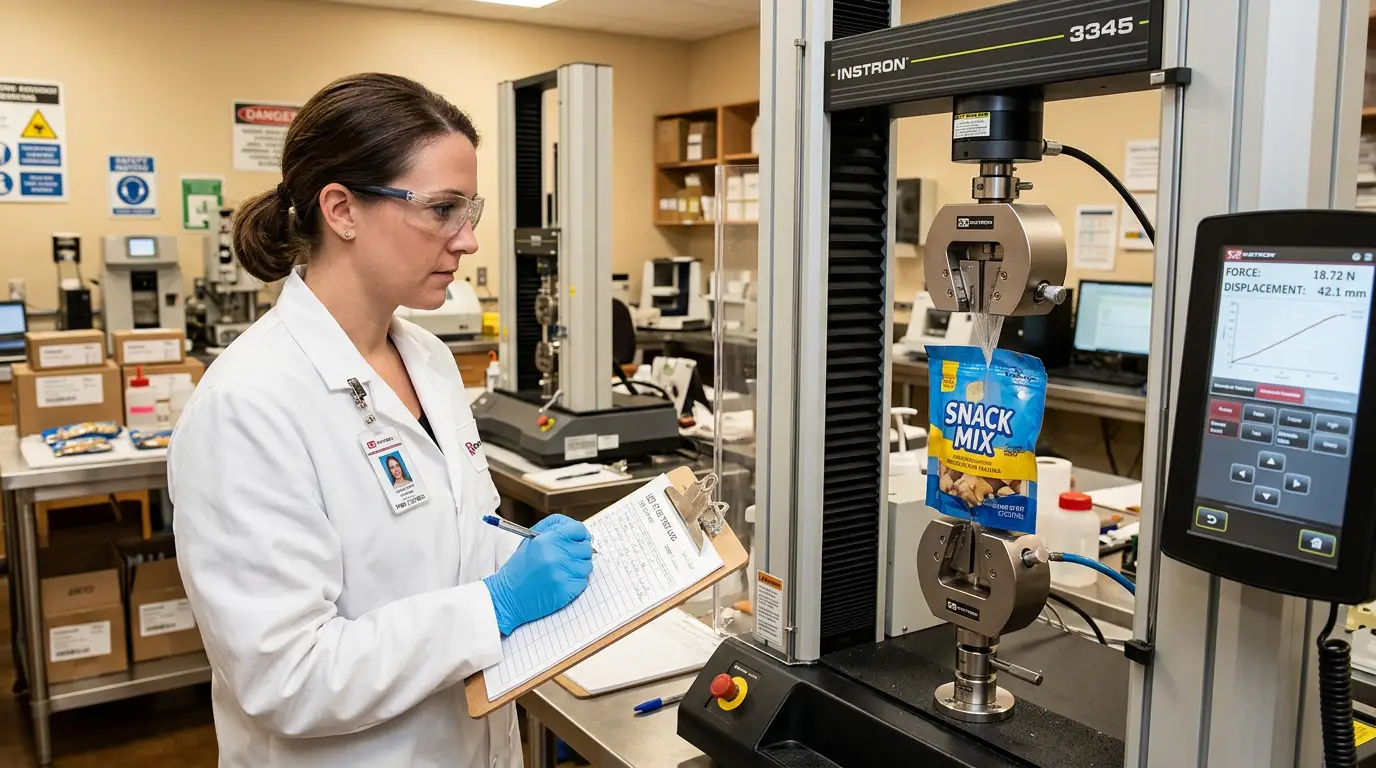
A 15 mm or 25 mm wide strip is cut from the sealed area and peeled at 90° or 180° on a tensile tester. Force-displacement data gives average peel force (N/15mm or N/25mm) and identifies seal failures (adhesive, cohesive, film fracture). Minimum peel force acceptance criteria are product-specific: typically 5–10 N/15mm for peelable seals, 15+ N/15mm for hermetic seals.
Burst / Inflation Test (ASTM F1140)
The package is pressurised internally (creep/burst or restrained plate) until failure. Burst pressure correlates to seal strength without requiring sample preparation and is fast enough for 100% in-line monitoring. Restrained plate burst tests (ASTM F2054) are particularly suitable for pouches and bags.
Package Integrity Testing
| Method | Standard | Leak Size Detected | Application |
|---|---|---|---|
| Dye penetration | ASTM F1929 | >50 µm | Flexible pouches, peelable seals |
| Vacuum decay | ASTM F2338 | >5 µm | MAP trays, rigid containers |
| CO2/O2 headspace analysis | ASTM F2714 | N/A (gas composition) | MAP packaging integrity monitoring |
| Pressure decay | ASTM F2095 | >20 µm | Bottles, rigid containers |
| Bubble emission | ASTM F2096 | >250 µm | Large leaks, quick screening |
Distribution Simulation Testing
ASTM D4169 (Performance Testing of Shipping Containers) defines a standardised series of distribution hazard simulations that represent the real-world stresses a package experiences from filling line to consumer. Standard test cycles include: compression (simulating warehouse stacking), vibration (transport resonance), drop (handling impacts at defined heights), and low pressure (air freight simulation). Passing ASTM D4169 at the appropriate distribution cycle and assurance level provides documented evidence that packaging design is adequate for its intended supply chain.
Frequently Asked Questions
How often should seal strength be tested in production?
Sampling frequency depends on risk and process stability. A common approach: test seal strength at line start-up and after every planned stop; every 30–60 minutes during steady-state production; at start and end of each film roll or material batch. Higher-risk applications (long shelf life, temperature-sensitive products) warrant higher frequency. SPC charts on seal strength data enable trend detection before failures occur — the goal is to detect process drift before product is released.
What is the difference between headspace gas analysis and package integrity testing?
Headspace gas analysis measures the composition of the gas inside a MAP package (O2, CO2, N2 percentages) to verify the gas flush was effective. It does not directly detect leaks. Package integrity testing (vacuum decay, dye penetration, bubble emission) detects physical breaches in the package seal or film, regardless of gas composition. Both are needed for a complete MAP quality programme: integrity testing confirms the seal is intact; headspace analysis confirms the gas flush equipment is performing correctly.
Can packaging be tested too much?
Yes — over-testing wastes resources and can be misleading. Destructive tests (peel, burst, dye penetration) consume product and packaging. Testing every pack on every attribute is rarely necessary or cost-effective. A risk-based sampling plan, calibrated against process capability data, achieves the same quality assurance at a fraction of the cost. Reserve 100% testing for the highest-risk attributes (integrity for MAP, sterility indicators for medical) and use statistical sampling for all others.