
Vacuum Skin Packaging (VSP)
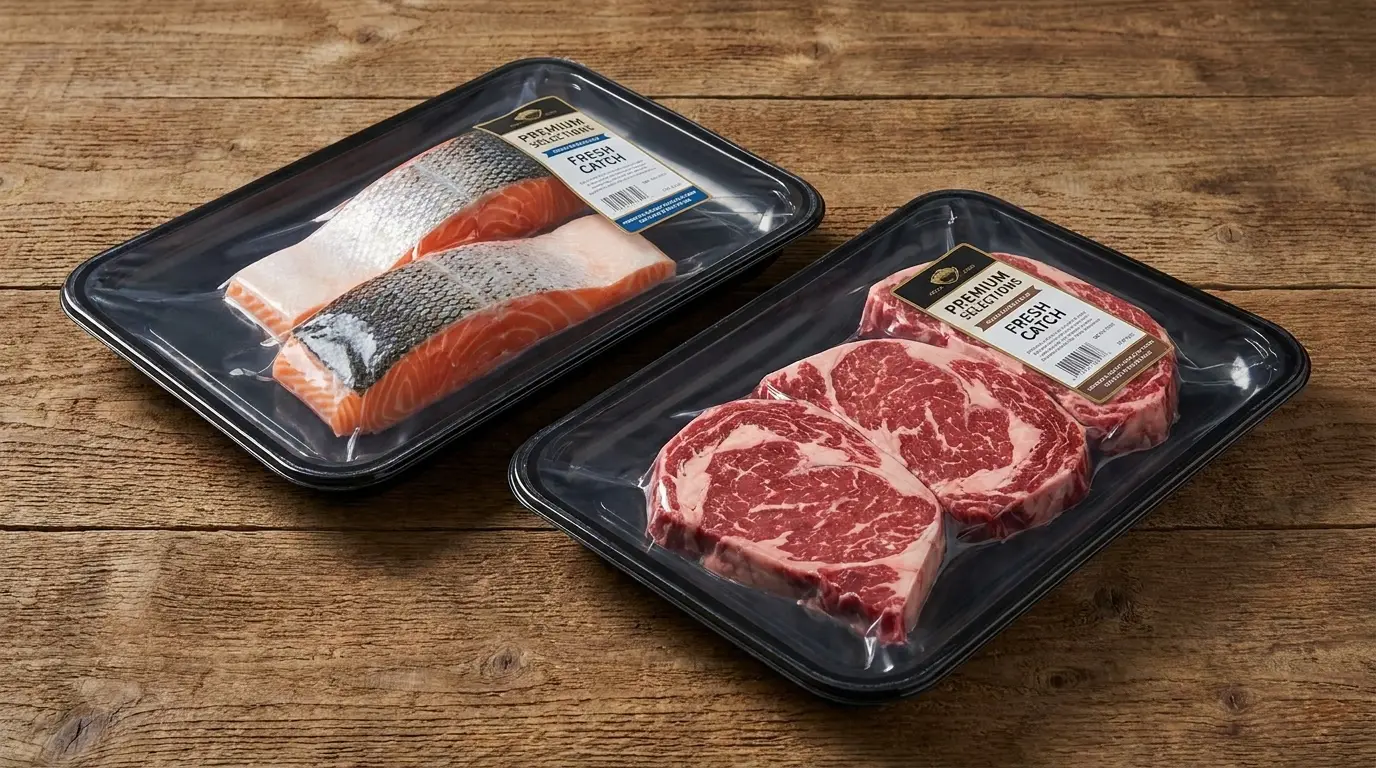
Vacuum Skin Packaging (VSP)
A second-skin film conformed under vacuum over the product, eliminating headspace, extending shelf life, and delivering premium retail presentation for fresh proteins and premium foods.
How Vacuum Skin Packaging Works
In VSP, the product is placed on a carrier (pre-formed tray or flat card) and loaded into the machine. A heated top film is drawn down by differential vacuum, conforming intimately to the product surface and the carrier substrate. Heat activates the seal coating across the entire carrier face — not just a flange — creating a second-skin package with no headspace.
The elimination of headspace removes the oxygen and atmospheric moisture that support microbial growth, extending chilled shelf life to 18–28 days for fresh red meat — approximately double the shelf life achievable with MAP tray sealing for equivalent products. Colour presentation is superior because low-oxygen atmospheres are avoided: no metmyoglobin discolouration on beef, no greyness in lamb.
VSP shelf life advantage: Fresh beef steak in VSP: 18–25 days chilled. Same product in MAP: 8–12 days. The shelf life differential justifies VSP's higher film cost for export and premium retail channels.
VSP Films and Carriers
VSP top film is a multilayer coextrusion combining a thermoformable forming layer (EVA, ionomer, or modified PE), one or more barrier layers for oxygen control, and an outer layer for abuse resistance and print compatibility. The film must be sufficiently elastic to conform to irregular product surfaces without tearing at corners or protruding bones and without fish-eye defects on smooth surfaces.
Carriers include thermoformed APET or PP trays, flat paperboard or kraft card (for retail VSP display), and heavy-duty trays for foodservice and controlled distribution. Carrier surface must be compatible with the VSP film's heat-seal coating.
VSP vs MAP Tray Sealing
The choice between VSP and MAP tray sealing involves trade-offs across shelf life, presentation, cost, and throughput. VSP provides longer shelf life, premium second-skin presentation, and avoids gas management complexity — but requires higher film cost and lower throughput than MAP. MAP is faster, lower cost per pack, and more flexible for a wider product range. For premium fresh proteins at retail — beef steaks, salmon fillets, lamb racks — VSP has become the dominant format in European grocery. MAP retains dominance in portions, processed meats, and ready meals. See the tray sealing overview for MAP comparison.
Frequently Asked Questions
VSP shelf life depends on product, initial microbial load, storage temperature, and film barrier performance. For fresh red meat (beef steak, lamb), 18–25 days chilled is achievable at 0–2°C. For fresh salmon, 14–21 days. For poultry portions, 10–16 days. These figures represent approximately a 50–100% shelf life extension versus MAP tray sealing for equivalent products. Product-specific shelf-life validation — real-time microbiological studies at defined storage conditions — must be completed for all claimed shelf lives.
VSP is best suited to products with relatively firm, irregular surfaces where the skin film can conform without pockets of trapped air that would compromise the vacuum. It is standard for whole and portion-cut fresh meat, fish fillets and steaks, smoked fish, and semi-hard cheese. It is less suitable for very soft products (minced meat, soft cheese, delicate shellfish) where the vacuum pull could deform the product. Liquid-containing products and products prone to exudate must be evaluated carefully for compatibility with the skin-tight format.
Standard vacuum packaging removes air from a pouch and seals it, creating a loose or wrinkled appearance as the film collapses around the product. VSP uses a heated skin film that is actively formed over the product under vacuum, creating an intimate second-skin contact with no wrinkles or loose film. The adhesion of the skin film to the carrier extends to the full carrier surface rather than just a pouch seal, creating a structurally superior and visually premium package.
VSP machines are typically flat-bed systems with a heated upper tool through which the skin film is tensioned and vacuum-drawn. Modern VSP machines are multi-format capable — different tray sizes and depths are handled by format parts changeover. Inline integration with portioning, checkweighing, and labelling is standard in fresh protein packing lines. Throughput is lower than MAP tray sealing (typically 3–8 trays per cycle depending on format) but is acceptable for the higher-value products VSP is designed to serve.
VSP uses more film per pack than MAP tray sealing (thicker top film, full-face adhesion). However, the shelf-life extension reduces food waste in the supply chain — a significant environmental benefit. Monomaterial VSP film structures (all-PE) are in development to improve recyclability. Rethinking the carrier from thermoformed tray to flat paperboard card reduces plastic content per pack. Life cycle assessment comparing VSP to MAP for a specific product and distribution chain is the appropriate framework for making a sustainability comparison. See the sustainable packaging overview for methodology.
VSP films, carriers, shelf life, and machinery — all in one guide.
Read the full VSP guide →