
Form Fill Seal (FFS) Packaging
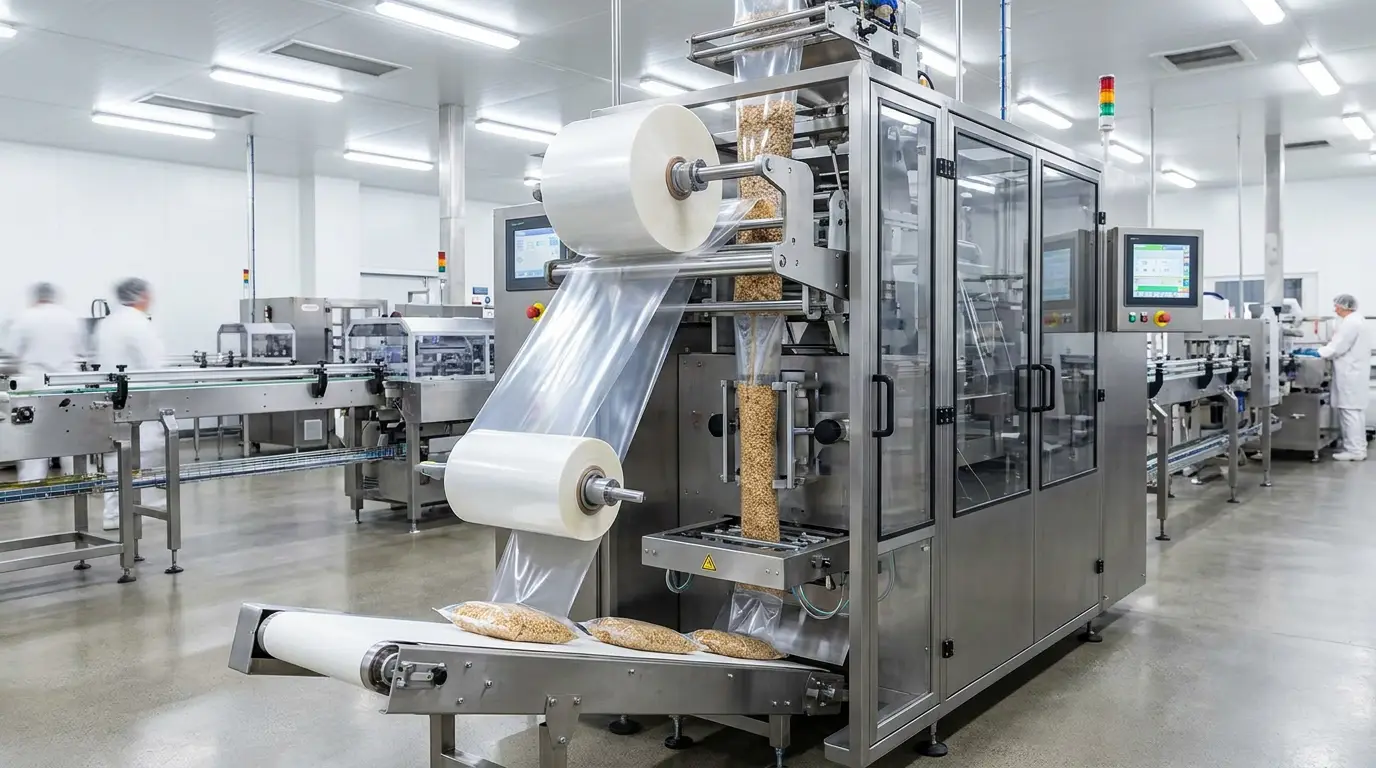
Form Fill Seal (FFS) Packaging
Continuous automated packaging forming a film web into pouches or bags, filling with product, and sealing — the dominant technology for flexible packaging at industrial volume.
Form Fill Seal: How It Works
Form fill seal (FFS) packaging integrates forming, filling, and sealing into a single continuous automated process. A flat film web is formed into a tube or pouch shape, product is introduced, and the package is sealed — all within one machine at speeds from 30 to over 200 packages per minute depending on format and product.
VFFS (vertical form fill seal) forms film into a vertical tube around a forming collar, seals the bottom, fills through the top, and seals the top — producing a completed pillow bag or block-bottom bag. Standard for granular, powder, and free-flowing products including snacks, coffee, pet food, and agricultural inputs.
HFFS (horizontal form fill seal) forms the film horizontally, producing flat pouches or pillow packs. Used for products that cannot be dropped vertically — sliced meats, cheese, produce, confectionery. MAP integration is more straightforward in horizontal orientation.
Film Requirements for FFS
FFS film must satisfy forming, sealing, barrier, and machinability requirements simultaneously. Multilayer coextruded or laminated structures combine PE or PP sealing layers with EVOH, PVDC, or aluminium barrier layers. Stiffness and tracking performance on the forming collar, heat-seal initiation temperature, and hot-tack strength (resistance to reopening immediately after sealing) are machine-critical parameters evaluated during film qualification.
Monomaterial all-PE and all-PP FFS films are increasingly available as recyclable alternatives to conventional multi-polymer laminates, responding to EU PPWR recyclability requirements. Sustainable film options →
MAP Integration in FFS
Modified atmosphere packaging is routinely integrated into HFFS lines via gas flush nozzles displacing air in the pouch before the cross-seal jaw closes. Residual oxygen is monitored inline using optical sensors. Common gas mixtures: N₂/CO₂ for fresh meat; 100% N₂ for bakery and snack; elevated CO₂ for poultry. See the InnovaPax MAP guide for gas composition selection by product category. Reference: EN 13485 (MAP equipment) · ECMA standards.
Frequently Asked Questions
VFFS (vertical FFS) orients the forming, filling, and sealing operations vertically — product drops into the forming tube from above. It is standard for free-flowing granular and powder products (coffee, snacks, seeds, pet food) at high speed. HFFS (horizontal FFS) operates horizontally, enabling filling of products that cannot be drop-filled — sliced meats, cheese, fish, and portion-controlled items. HFFS is also the standard for MAP integration in chilled food applications.
The most critical film properties for FFS machinability are coefficient of friction (CoF) — affecting film tracking and consistent bag geometry — heat-seal initiation temperature and sealing window width (the range over which a good seal is formed), hot-tack strength (resistance to reopening immediately after sealing before the seal cools), and stiffness (for consistent forming collar behaviour). Static charge management is also important in dry packaging environments where film-to-metal attraction causes tracking problems.
VFFS throughput ranges from around 30 bags per minute for large-format or complex filling applications to over 200 bags per minute for simple granular products on high-speed equipment. HFFS throughput is typically lower, reflecting the more complex product handling required. Multihead combination weighers feeding VFFS lines can achieve 200+ weighments per minute on small products, limiting factor being the weigher rather than the bagger.
Yes — HFFS is the standard FFS format for MAP applications in chilled food. Gas flushing is integrated into the HFFS machine immediately before the cross-seal, displacing headspace air with the target gas mix. VFFS MAP is also possible for some products using a gas injection nozzle or snorkel inside the forming tube, but the vertical orientation makes consistent flushing more challenging. See the full MAP guide for detail.
The primary sustainable FFS film development is monomaterial structures — all-PE and all-PP multilayer coextrusions that provide comparable barrier to conventional laminates while being recyclable in established polyolefin streams. PCR-content PE films are available for non-barrier applications. Bio-based PE from sugarcane ethanol is chemically identical to fossil PE and recyclable in PE streams. All sustainable alternatives require qualification on existing FFS equipment for tracking, sealing, and machinability performance. See the sustainable packaging overview.
VFFS vs HFFS — which is right for your line?The InnovaPax FFS guide compares both formats with equipment selection criteria.
Read the full guide →