

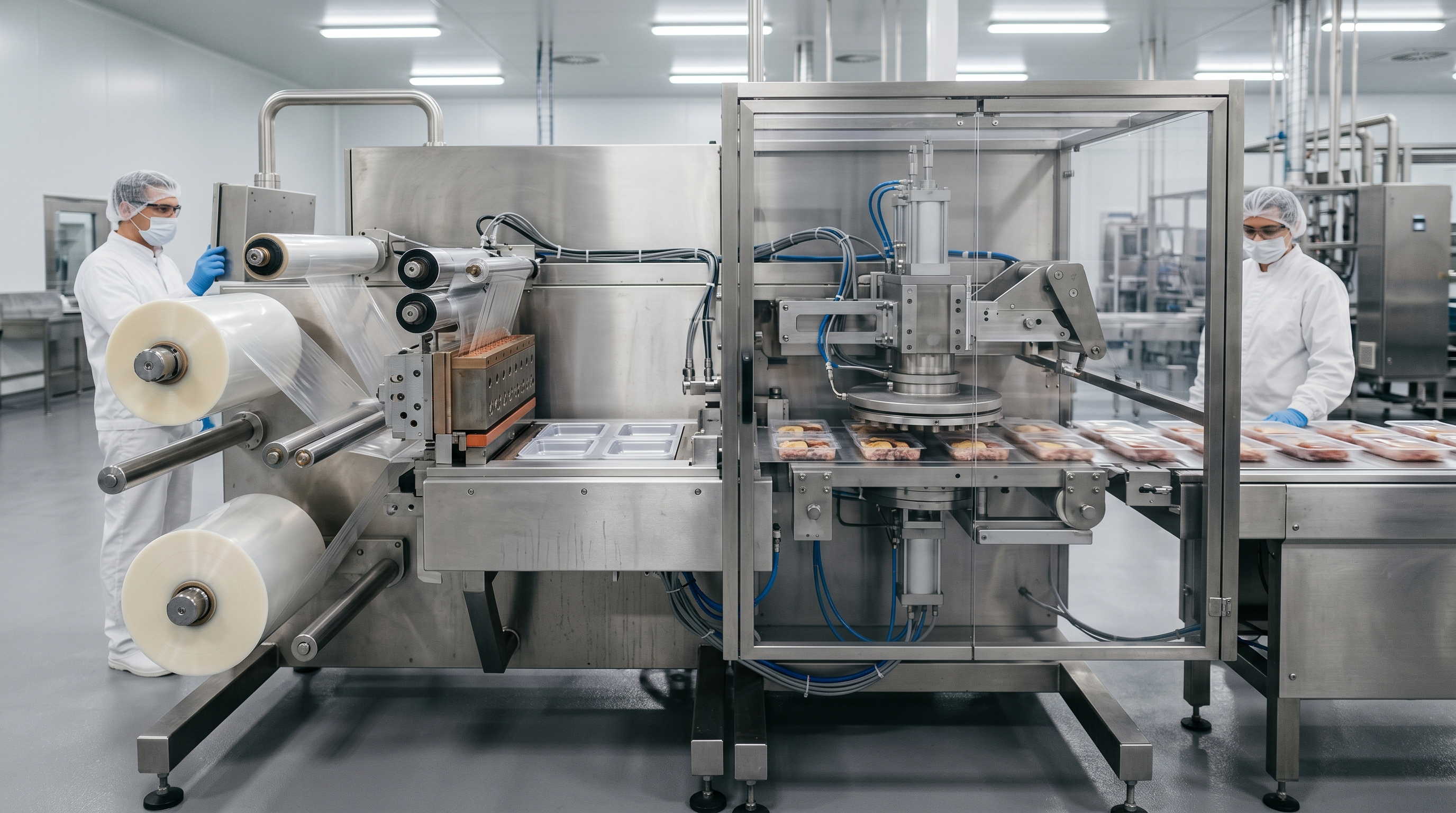
- A thermoforming machine heats a plastic web, forms it into a cavity, fills it with product, and seals it under vacuum or modified atmosphere — all in one continuous, automated line.
- Machines are classified by function (vacuum, MAP, and vacuum skin packaging) and by output segment (compact, mid-range, and high-output roll-fed systems running 10–70+ cycles per minute).
- Forming depth, web width, film gauge, tooling change-over time, and gas-flushing accuracy are the specifications that most directly affect throughput and pack quality.
- The global thermoformer market is projected to grow from about USD 526 million in 2024 to USD 761 million by 2031 (CAGR ~5.5%), driven by automation and material-saving heating systems.
- Selecting the right machine starts with the pack format and shelf-life target, not the headline cycle speed.
A thermoforming machine is the workhorse of modern food, medical, and industrial packaging — a single integrated system that turns a flat roll of plastic film into a finished, sealed pack. Where a tray sealer relies on pre-made trays, a thermoforming machine forms the bottom web in-line, which lowers per-pack material cost and unlocks fully custom cavity shapes. This guide explains how thermoforming machines work, the main machine types, the technical specifications that matter, and how to match a system to your production needs.
Table of Contents
- What is a thermoforming machine?
- How a thermoforming machine works
- Thermoforming machine types
- Choosing a thermoforming machine
- Technical specifications
- Industry insight
- Frequently asked questions
What is a thermoforming machine?
A thermoforming machine is an automated packaging system that heats a thermoplastic sheet until pliable, shapes it into a cavity using vacuum and/or air pressure against a mould, fills the cavity with product, applies a top film, and seals the pack — often under vacuum or a protective gas atmosphere. Because the lower web is formed from a continuous roll rather than supplied as a finished tray, thermoforming (also called form-fill-seal thermoforming, or FFS thermoforming) is the most material-efficient route to high-volume rigid and semi-rigid packs.
Thermoformed packaging is everywhere: sliced meat and cheese, fresh pasta, ready meals, medical-device clamshells, and pharmaceutical blisters are all produced on thermoforming lines. The process pairs naturally with the preservation techniques covered in our modified atmosphere packaging guide and our vacuum skin packaging guide.
How a thermoforming machine works
Every thermoforming line follows the same fundamental sequence, repeated in time with the machine's indexing cycle:
1. Web unwind and heating
The bottom (forming) film is drawn from a reel and advanced into a heating station. Contact or radiant heaters raise the film to its forming temperature — typically between 120 °C and 180 °C depending on the polymer. Uniform heating is critical: cold spots cause thin walls and pinholes, while overheating distorts the web.
2. Forming
The softened film moves into the forming station, where vacuum (and on deeper packs, compressed air and a plug-assist) press it into the mould cavity. Forming depth, draw ratio, and cooling determine wall-thickness distribution and the pack's mechanical strength.
3. Loading
Formed cavities advance to the loading area, where product is placed manually or by automated pick-and-place and feeding systems integrated upstream.
4. Sealing under vacuum or gas
The top web is laid over the filled cavities. In the sealing station, the machine evacuates air and, for modified atmosphere packs, flushes a controlled gas mixture before heat-sealing the films together. Sealing accuracy governs both shelf life and pack integrity.
5. Cutting and discharge
Cross and longitudinal cutting tools separate the web into individual packs, which are then conveyed to downstream labelling, inspection, and case-packing. Choosing the right top and bottom films — discussed in our food packaging films guide — is as important as the machine itself.
Thermoforming machine types
Thermoforming machines are grouped both by the preservation function they perform and by their production segment.
Vacuum thermoforming machines
These form a cavity and remove air before sealing, minimising oxygen contact. Vacuum packs are ideal for primal cuts, cheese blocks, and products where a tight, oxygen-free environment extends shelf life without a gas atmosphere.
MAP thermoforming machines
Modified-atmosphere thermoformers evacuate the cavity and replace the air with a tailored blend of nitrogen, carbon dioxide, and sometimes oxygen. This protects colour and texture in sliced meats, poultry, bakery, and fresh produce. The same gas-control principles apply whether you run a thermoformer or a dedicated MAP tray sealer.
Vacuum skin packaging (VSP) thermoformers
VSP-capable machines drape a heated top film tightly over the product like a second skin, eliminating headspace and drip. This premium format is popular for retail-display meat and fish — see our skin packaging for meat and fresh food guide for application detail.
Output segments
By capacity, thermoformers range from compact machines for start-ups and small batches, through mid-range systems for established producers, to high-output roll-fed lines that run 60–70+ cycles per minute and produce thousands of packs per hour. Medical and pharmaceutical thermoformers add cleanroom compatibility and validated, traceable processes.
- You run medium-to-high volumes and want the lowest per-pack material cost.
- You need custom cavity shapes, variable pack depths, or multi-cavity layouts.
- You want vacuum, MAP, and VSP capability on a single platform.
- You are scaling and need a line that integrates with upstream feeding and downstream inspection.
Prefer a tray sealer machine when you use pre-made trays, run lower volumes, or need fast format flexibility without tooling changes.
Technical specifications
When comparing thermoforming machines, evaluate these parameters against your actual pack format rather than the headline speed alone.
| Specification | Typical range | Why it matters |
|---|---|---|
| Forming depth | 20–150 mm | Limits product height and wall strength |
| Web width | 320–560 mm | Determines packs-per-cycle layout |
| Cycle speed | 10–70+ cycles/min | Drives total hourly output |
| Forming film gauge | 0.1–0.8 mm | Affects rigidity and material cost |
| Tool change-over | 10–45 min | Impacts flexibility for short runs |
| Residual O₂ (MAP) | <1% | Defines achievable shelf life |
Comparison of machine functions:
| Function | Headspace | Best for |
|---|---|---|
| Vacuum | None | Primal cuts, cheese, bulk |
| MAP | Gas-filled | Sliced meat, poultry, bakery |
| VSP | None (skin) | Premium retail meat & fish |
Choosing a thermoforming machine
Begin with the finished pack, then work backwards to the machine. Define the pack format (size, depth, cavities per cycle), the preservation method (vacuum, MAP, or VSP), the film structure, and the target shelf life. Validate gas mixes and seal integrity against your actual product, because microbial behaviour depends on composition, starting load, and temperature history. Only then size the machine for your current volume plus realistic growth, so the line does not become a bottleneck within a year. Finally, account for total cost of ownership: film usage, energy, change-over time, spare parts, and operator training — not just the purchase price.
Frequently asked questions
What is the difference between a thermoforming machine and a tray sealer?
A thermoforming machine forms the bottom tray in-line from a roll of film, while a tray sealer uses pre-made trays. Thermoformers lower per-pack material cost at higher volumes; tray sealers offer faster format flexibility at lower volumes.
How fast is a thermoforming packaging machine?
Cycle speeds typically range from about 10 cycles per minute on compact machines to over 70 on high-output roll-fed lines, equating to thousands of packs per hour depending on the cavity layout.
What materials can a thermoforming machine use?
Common thermoformable films include PET, PP, PE, PVC, and PETG, plus a growing range of recyclable mono-material and bio-based structures. Material choice affects forming temperature, rigidity, and recyclability.
Can one thermoforming machine do vacuum, MAP, and skin packaging?
Yes. Many modern thermoformers are configurable for vacuum, modified atmosphere, and vacuum skin packaging, allowing producers to switch formats with the appropriate tooling and film.
How much does a thermoforming machine cost?
Pricing spans a very wide range — from a few thousand for benchtop vacuum formers to several hundred thousand for high-speed inline roll-fed production lines — depending on output, automation, and validation requirements.
Is thermoforming suitable for medical and pharmaceutical packaging?
Yes. Dedicated medical thermoformers support cleanroom operation and validated, traceable processes for sterile-barrier packaging, as covered in our pharmaceutical blister packaging guide.
What film gauge should I use?
Gauge depends on pack depth and required rigidity — deeper or heavier packs need thicker forming film, while shallow retail packs can run thinner gauges to save material. Validate wall thickness after forming, not just the incoming film spec.
For the broader process context behind these machines, see our complete thermoforming packaging guide. Authoritative external references on thermoforming technology and equipment trends are available from Packaging World and Packaging Digest.
Share:
Food Processing Lines: Stages, Slicing & Integration Guide
Biopolymer Packaging Materials: PLA, PHA & Bio-Based Alternatives