

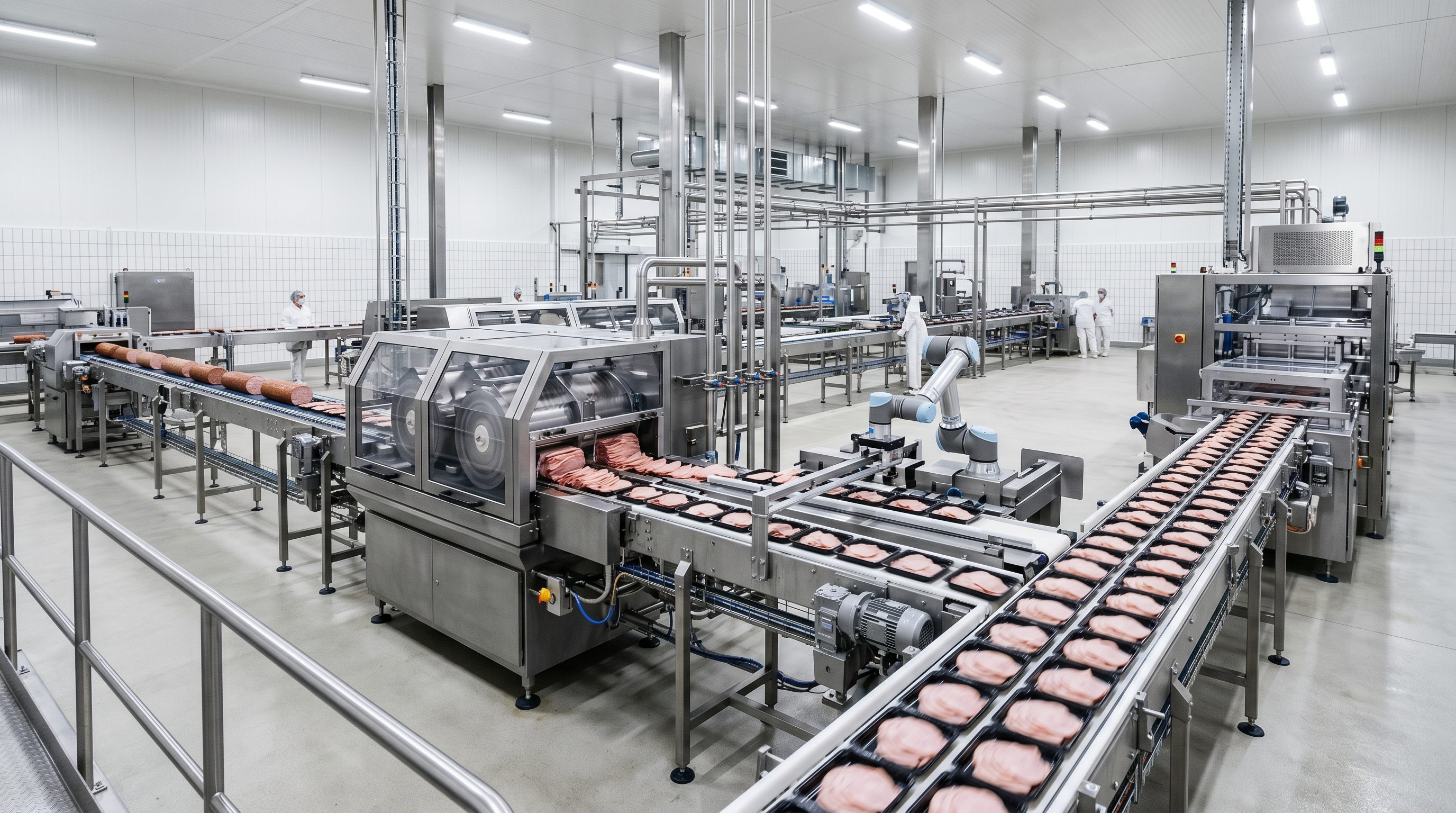
- A food processing line is an integrated sequence of machines that transforms raw ingredients into prepared, portioned, and packaged products with minimal manual handling.
- Core stages include preparation, slicing and portioning, conveying and weighing, packaging, and inspection — each engineered to hand off cleanly to the next.
- Modern slicers can produce up to 2,000 cuts per minute, and AI-driven portioning systems optimise yield by trimming to exact target weights.
- The global food and beverage processing equipment market is projected to grow from about USD 76.4 billion in 2026 to USD 107.7 billion by 2033 (CAGR ~5.9%).
- Line design should start from the finished pack and target throughput, then balance every upstream stage to avoid bottlenecks.
A food processing line is the backbone of any modern food factory — a coordinated chain of equipment that takes raw material at one end and delivers a finished, packaged product at the other. Well-designed food processing lines raise throughput, improve consistency, protect hygiene, and reduce labour and waste. This guide breaks down the stages of a typical line, the slicing and portioning technology at its heart, and the principles that keep an integrated line running without bottlenecks.
Table of Contents
- What is a food processing line?
- Stages of a food processing line
- Slicing and portioning technology
- Integrating processing with packaging
- Design considerations
- Industry insight
- Frequently asked questions
What is a food processing line?
A food processing line is an integrated production system in which raw ingredients move through a defined sequence of automated stations — preparation, transformation, portioning, packaging, and inspection — to become a finished product. The defining feature is integration: each machine is timed and balanced to feed the next, so material flows continuously rather than being moved by hand between isolated steps. This continuous flow is what delivers the consistency, hygiene, and output volume that retail and food-service supply chains demand.
Food processing lines exist for every category — meat, poultry, seafood, cheese, bakery, ready meals, and produce — but they share the same architecture. The final, and arguably most critical, stage is packaging, where the product is protected and given its shelf life.
Stages of a food processing line
A representative food processing line moves through five connected stages.
1. Preparation
Raw material is received, cleaned, graded, and prepared. Depending on the product this includes washing, trimming, deboning, mixing, or cooking. Hygiene and temperature control are paramount, as this stage sets the microbial baseline for everything downstream.
2. Slicing and portioning
Product is cut to size and divided into target weights or counts. This is the precision heart of the line, where yield and giveaway are won or lost.
3. Conveying and weighing
Conveyors, distribution systems, and checkweighers move portioned product to the packaging station while verifying weight and rejecting out-of-spec units. Multihead weighers combine portions to hit exact pack weights with minimal overfill.
4. Packaging
The product is placed into its primary pack and sealed — often under vacuum or modified atmosphere to extend shelf life. Common end-of-line formats include tray sealing, thermoforming, and flow wrapping.
5. Inspection and end-of-line
Metal detection, X-ray, vision inspection, labelling, and case packing complete the line. Inspection protects both the consumer and the brand, catching contamination and pack defects before dispatch.
Slicing and portioning technology
Slicing and portioning is where modern food processing lines have advanced fastest. High-speed slicers for meat and cheese can now produce up to 2,000 cuts per minute, while advanced techniques such as ultrasonic cutting and crust-freezing deliver clean, precise portions in delicate products. Portion-cutting systems use scanning and computer control to cut each piece to an exact target weight, dramatically reducing giveaway — the costly over-delivery of product beyond the labelled weight.
Fixed-weight portioning
Scanning systems measure each incoming piece and calculate the optimal cut pattern to maximise the number of on-target portions from every unit, improving raw-material yield.
Intelligent slicing
Connected slicers feed data on speed, yield, and downtime to production software, enabling remote programming, real-time monitoring, and continuous optimisation across the line.
- Giveaway is eroding margin on a high-value raw material.
- Manual portioning cannot keep pace with packaging throughput.
- You need consistent, traceable portion weights for retail compliance.
- Labour availability or hygiene risk makes manual handling impractical.
Hygiene and food safety by design
Hygienic design runs through every stage of a modern food processing line. Equipment built to sanitary standards uses smooth, crevice-free stainless surfaces, sloped drainage, and tool-free disassembly so the line can be cleaned quickly and verified between runs. Because the line is continuous, a hygiene failure at one station can contaminate everything downstream, which is why cleanability and rapid sanitation are now treated as throughput factors in their own right — every minute saved on cleaning is a minute of available production.
Integrating processing with packaging
The most common bottleneck in a food processing line is the hand-off between processing and packaging. If a slicer outpaces the sealer — or vice versa — the line stalls and yield suffers. Effective integration means matching the throughput of the packaging stage to the processing stage, and choosing a packaging format that suits the product. Sliced retail meats and cheeses typically flow into thermoforming lines or tray sealing systems, while snacks and bakery items suit flow wrapping. Shelf life is then set by the preservation method — most often modified atmosphere packaging for fresh chilled products.
Traceability is the other thread tying the line together: portion-level weight data, inspection results, and batch records feed quality systems that protect the brand and satisfy retailer audits.
Design considerations
Compare and design food processing lines around the factors that govern throughput, hygiene, and cost.
| Factor | What to evaluate | Why it matters |
|---|---|---|
| Throughput balance | Stage-by-stage capacity | Prevents bottlenecks and stalls |
| Hygienic design | Cleanability, materials | Protects food safety |
| Yield / giveaway | Portioning accuracy | Directly affects margin |
| Flexibility | Change-over time | Supports multiple SKUs |
| Data integration | OEE, monitoring | Enables continuous improvement |
Typical packaging hand-off by product:
| Product | Processing focus | Packaging format |
|---|---|---|
| Sliced meat / cheese | High-speed slicing | Thermoforming / tray seal |
| Poultry portions | Fixed-weight portioning | MAP tray seal / VSP |
| Bakery / snacks | Depositing, cooling | Flow wrap / VFFS |
| Ready meals | Filling, assembly | Tray seal / thermoforming |
Building a balanced line
Design a food processing line backwards from the finished pack. Define the product, the target pack format, and the required output rate, then size each upstream stage to match — preparation, slicing and portioning, conveying and weighing, and inspection. Build in buffer capacity at the stages most prone to variability, and choose hygienic, quick-clean equipment to protect food safety and minimise downtime. Treat data integration as a core requirement rather than an add-on: a connected line that reports yield, downtime, and overall equipment effectiveness in real time is far easier to optimise than a collection of isolated machines.
Frequently asked questions
What is a food processing line?
A food processing line is an integrated sequence of machines that turns raw ingredients into a finished, packaged product through stages such as preparation, slicing, portioning, packaging, and inspection — with minimal manual handling.
What are the main stages of a food processing line?
Most lines follow five stages: preparation, slicing and portioning, conveying and weighing, packaging, and inspection or end-of-line. Each is balanced to feed the next continuously.
How fast can industrial slicers run?
High-speed industrial slicers for meat and cheese can produce up to around 2,000 cuts per minute, depending on product and slice thickness.
What is giveaway in food portioning?
Giveaway is the product delivered beyond the labelled pack weight. Automated, scan-based portioning minimises giveaway by cutting each piece to an exact target weight, protecting margin.
How does packaging fit into a food processing line?
Packaging is the final value-adding stage, where the product is sealed — often under vacuum or modified atmosphere — to set its shelf life. The packaging throughput must be matched to the processing throughput.
What is the most common bottleneck in a food processing line?
The hand-off between processing and packaging is the most frequent bottleneck. If slicing and packaging speeds are mismatched, the whole line stalls.
How big is the food processing equipment market?
The global food and beverage processing equipment market is projected to grow from roughly USD 76.4 billion in 2026 to USD 107.7 billion by 2033, a CAGR of about 5.9%.
For the packaging end of the line, start with our food packaging films guide. Authoritative external references on food-processing equipment and slicing technology are available from Food Manufacture and Packaging World.
Share:
Modified Atmosphere Packaging Machine: Complete MAP Equipment Guide
Biopolymer Packaging Materials: PLA, PHA & Bio-Based Alternatives