

Key Takeaways
- Vacuum skin packaging (VSP) machines range from manual benchtop units (5–15 cycles/hour) through semi-automatic chamber machines (30–120 cycles/hour) to fully automatic thermoform-VSP rollstock lines (500–1,500 packs/hour).
- Equipment selection is driven by throughput, product size, packaging format (rigid tray VSP vs. board-mounted VSP), vacuum requirements and integration with upstream processing.
- Key sub-systems include the vacuum pump (Busch, Edwards, Atlas Copco-class), heating system, sealing platen, lifting and clamping mechanisms, and the controls and HMI.
- VSP integrates with upstream slicing, weighing and grading equipment and with downstream labelling, X-ray inspection and case packing for a complete production line.
- Total cost of ownership over a 10-year lifetime is dominated by energy, film consumption and changeover time — not the initial capital outlay.
Table of Contents
- What is a vacuum skin packaging machine?
- Types of VSP machines and throughput ranges
- Key components and sub-systems
- Selecting the right VSP machine
- Integration into a complete production line
- Total cost of ownership and operating economics
- Maintenance, OEE and lifetime
- Frequently asked questions
What is a vacuum skin packaging machine?
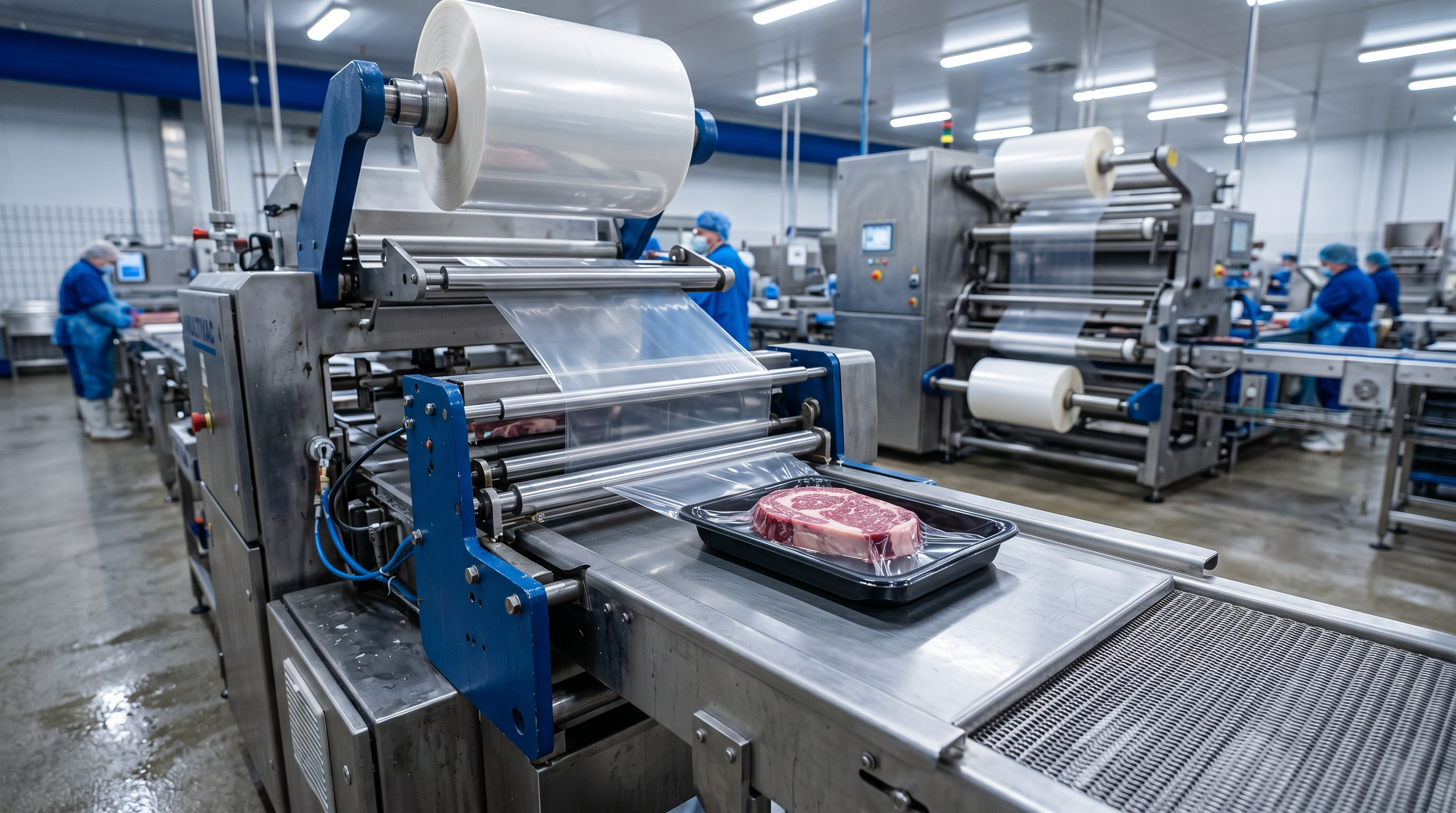
A vacuum skin packaging (VSP) machine is a packaging system that forms a high-clarity polymer film around a product placed on a rigid tray, board or pre-formed support. Heat softens the upper film, vacuum evacuates air from the package, and the film descends and conforms tightly to the product profile, sealing to the support's flange or surface. The result is a tight, transparent skin that holds the product in place, eliminates void volume, extends shelf life through vacuum and barrier film performance, and presents the product clearly to the consumer.
VSP is widely used in fresh meat, poultry, seafood, ready-to-cook meals, deli items and gourmet products where premium presentation and extended shelf life are required. The technology is also used outside food for industrial component packaging, electronics fixturing, and retail merchandising of hardware and tools where high visibility and tamper-evidence are valuable.
Machine architecture spans a wide range. Manual benchtop systems serve butcher shops, small producers and pilot plants. Semi-automatic chamber machines handle mid-volume operations from artisan producers to mid-sized food processors. Fully automatic rollstock systems integrate forming, loading, sealing, cutting and labelling for industrial-scale meat and seafood plants.
Types of VSP machines and throughput ranges
| Machine type | Typical throughput | Best suited for | Typical investment range |
|---|---|---|---|
| Manual benchtop chamber | 5–15 cycles/hour | Butchers, restaurants, R&D | Low |
| Semi-automatic single-chamber | 30–60 cycles/hour | Small producers, specialty foods | Low to medium |
| Semi-automatic double-chamber | 60–120 cycles/hour | Mid-volume processors | Medium |
| Automatic chamber belt | 200–400 packs/hour | High-mix mid-volume operations | Medium to high |
| Thermoform-VSP rollstock | 500–1,500 packs/hour | Industrial meat, poultry, seafood | High to very high |
Manual benchtop machines
Benchtop VSP machines are compact chamber units operated by a single person, suitable for low-volume processing. The operator places the loaded tray inside the chamber, closes the lid manually, and starts the cycle. The machine evacuates the chamber, heats the upper film, and presses it against the product. These machines support trial runs, small-batch artisan production and on-demand packaging in butcher counters, gourmet stores and small ready-meal kitchens.
Semi-automatic chamber machines
Semi-automatic chamber machines automate the cycle while still requiring an operator for loading and unloading. Double-chamber configurations alternate two trays so the operator can load one while the other is processing, roughly doubling effective throughput. These machines support 30–120 cycles/hour and are the standard equipment for small to mid-sized fresh meat processors, specialty seafood producers and premium ready-meal operations.
Automatic chamber belt machines
Automatic chamber belt machines use a belt feed to bring pre-loaded trays into the vacuum chamber, where the cycle runs continuously while the operator focuses on loading and packout. Throughput climbs to 200–400 packs/hour. These systems are favored by mid-volume processors with consistent product mix and limited changeover frequency.
Thermoform-VSP rollstock systems
Industrial-scale VSP runs on thermoform rollstock platforms that form the bottom tray from a roll of forming film, load the product, apply the upper skin film under vacuum and heat, cut individual packs, and discharge to downstream equipment. Throughput reaches 500–1,500 packs/hour for standard meat formats and over 2,000 packs/hour for smaller pack sizes. Major equipment vendors include Multivac, Sealpac, GEA, Ulma, Variovac and Webomatic, each with platform variations targeting different product categories.
Key components and sub-systems
Vacuum pump
The vacuum pump determines cycle time, pull-down depth and the achievable residual pressure. Rotary vane oil-sealed pumps remain the workhorse, with major suppliers including Busch, Edwards and Atlas Copco. Larger industrial machines use multi-stage roots blowers in front of the rotary vane pump to accelerate evacuation. Typical pull-down to 2–5 mbar in 4–8 seconds is the performance target. Pump sizing must match chamber volume and target cycle time; undersized pumps extend cycle time and degrade pack quality.
Heating system
Top film is heated via radiant ceramic heaters, quartz heaters, or contact platens. Even temperature distribution across the film width is essential for uniform skin formation; uneven heating creates film thinning, blistering or seal voids. Heater zones are typically PID-controlled, with infrared pyrometers used on premium machines to close the loop on actual film surface temperature.
Sealing platen
The sealing platen presses the heated film against the tray flange and forms the perimeter seal. Platen flatness, hardness and temperature uniformity determine seal integrity. PTFE or silicone rubber covers protect the platen surface and provide controlled compliance during sealing. Quick-change platen designs accelerate format changeovers for high-mix operations.
Tooling and changeover
Tooling includes the tray nest, film clamp, vacuum manifold and sealing platen. For high-mix operations, quick-change tooling reduces changeover from 60–90 minutes to 15–25 minutes. Major equipment vendors offer color-coded, no-tool change kits that operators can swap in minutes between SKUs.
Controls and HMI
Modern VSP machines use industrial PLCs with touchscreen HMIs running recipe-based parameter management. Recipe storage covers tray dimensions, vacuum target, sealing temperature, dwell time, cooling time and post-process actions. Connectivity via OPC-UA, Ethernet/IP or Profinet feeds line-level MES and OEE systems. AI-supported control loops that auto-tune sealing temperature based on film batch variations are now appearing on top-tier rollstock platforms.
Selecting the right VSP machine
Equipment selection follows a structured assessment of throughput, product mix, line integration and budget. Start with the throughput target: convert peak shift output into packs per hour, then add a 20–30% capacity margin for growth and maintenance downtime. Identify product dimensions, weights, surface conditions and packaging format. Then evaluate the changeover frequency: a single-SKU plant tolerates longer changeovers in exchange for higher unit throughput, while a contract packer with many SKUs needs quick-change tooling and recipe-based control.
Film compatibility is the next gate. VSP films are typically multilayer polymer constructions with high-barrier layers and adhesion-tuned skin contact layers. Machine sealing temperature, pressure profile and vacuum specification must match the film supplier's qualification document. Brand owners should run film qualification trials on the candidate machine before committing to capital.
Line integration is the final consideration. Industrial VSP machines integrate with upstream slicers, weighers and graders, and downstream labellers, metal detectors, X-ray inspection, case packers and palletisers. The packaging engineer should map every product flow, line speed dependency and changeover sequence before specifying the machine. Coordinated PLC architecture across the line reduces synchronisation issues that otherwise show up as throughput losses.
Selection checklist
- Peak throughput target with 20–30% margin
- Product size range, weight envelope, surface profile
- Pack format: rigid tray, board-mounted, custom thermoformed
- SKU count and changeover frequency
- Film supplier and film qualification status
- Upstream and downstream equipment integration
- Cleanroom or hygienic design requirements (e.g., USDA, IFS, BRC)
- Energy supply, compressed air, vacuum infrastructure
- Local service and spare parts support
- Maintenance staff skill level and training availability
Integration into a complete production line
A typical industrial VSP line combines several stages. Upstream, raw product is portioned to target weight on a slicer or portioning machine, then transferred to a tray loader that places product onto pre-formed or thermoformed trays. The VSP machine performs forming (if rollstock), loading, vacuum, sealing and cutting. Downstream, an in-line labeller applies primary product label, an X-ray or metal detector checks for foreign bodies, and a case packer groups packs into cases for shipping.
Modern lines run line-level MES that tracks each pack through every station, including cycle parameters and inspection results, providing full traceability for recall response and quality investigations. AI-supported defect detection on imaging stations downstream of the VSP machine catches seal voids, film tears and product misalignment that escaped the upstream sensors.
Total cost of ownership and operating economics
Over a 10-year service life, the total cost of ownership for a VSP machine breaks down approximately into capital depreciation (15–25%), film consumption (35–50%), energy (10–15%), vacuum pump maintenance (5–10%), other maintenance and spares (10–15%), and operating labor allocation. Film cost dominates because VSP uses two films — forming film and skin film — both with high-barrier specifications.
Optimising the operating economics typically focuses on three areas. Film consumption reduction through tighter forming geometry and lower film thickness saves the most operating cost over time. Energy reduction through vacuum pump rightsizing and heat recovery from the heating system reduces utility bills 5–15%. Changeover reduction through quick-change tooling and recipe-based control raises OEE 3–8 percentage points in high-mix operations.
Capacity utilisation is the silent driver of unit cost. A line running at 75% OEE produces packs at roughly 30% lower unit cost than the same line at 50% OEE. Investing in operator training, maintenance discipline and automation upgrades typically delivers higher returns than chasing nominal throughput on the machine spec sheet.
Maintenance, OEE and lifetime
VSP machines are robust industrial equipment but require disciplined maintenance to maintain throughput and pack quality. Daily checks cover film loading, vacuum pump oil level, heater integrity and seal platen condition. Weekly preventive maintenance includes vacuum pump filter inspection, sealing platen surface check and tooling alignment. Monthly checks cover full lubrication, electrical contacts and HMI calibration. Annual rebuilds typically refresh vacuum pumps, sealing platens and heating elements.
Spare parts strategy matters. A line running 4,000+ packs/hour cannot tolerate a 24-hour wait for a vacuum pump rebuild, so operators stock critical spares including rotary vane sets, heating elements, sealing platens and PLC cards. Major OEMs offer service-level agreements with guaranteed response times and remote diagnostics.
Service life of well-maintained industrial VSP machines is typically 15–25 years, with vacuum pumps refurbished or replaced 3–5 times during that period. End-of-life decisions are driven less by mechanical wear than by control system obsolescence, food safety standard updates and the availability of energy-efficient replacement platforms.
Engineering teams familiar with vacuum skin packaging applications, skin packaging for meat and thermoforming machine integration are well placed to specify VSP machinery in a complete production-line context. Reference standards include ISO 11607 for sterile barrier packaging where VSP intersects with medical applications, and FDA food contact requirements for food applications.
Frequently asked questions
What is the difference between a VSP machine and a vacuum chamber machine?
A standard vacuum chamber machine evacuates a sealed pouch around a product, while a VSP machine drapes a heated film tightly over a product on a tray or board. VSP produces the characteristic skin-tight finish with product visibility, while a chamber-vacuum pouch produces a sealed bag without the tray-mounted display format.
How does VSP throughput compare with MAP?
VSP rollstock machines run at comparable speeds to MAP rollstock machines (500–1,500 packs/hour). MAP cycles are slightly faster because they do not require film heating and skin formation, but VSP delivers a tighter pack, longer shelf life through full vacuum, and stronger premium positioning at retail.
Can a VSP machine also run MAP?
Many modern thermoform-rollstock platforms support both VSP and MAP modes with tooling and recipe changes. This dual-mode capability allows processors to flex production between formats based on retail demand without dedicating separate equipment.
What is the typical lead time for an industrial VSP machine?
Lead times for new industrial thermoform-VSP machines from leading OEMs typically run 9–18 months depending on options, tooling complexity and current order book. Refurbished or used equipment can ship in 1–3 months and is widely available through specialist brokers.
How important is the vacuum pump brand?
Vacuum pump selection is critical for cycle time, energy efficiency and reliability. Premium brands like Busch, Edwards and Atlas Copco deliver superior performance and serviceability, justifying the price premium in industrial operations. Lower-cost alternatives may suit small operations where cycle time is less critical.
What film thicknesses does a VSP machine handle?
Typical VSP forming films range 200–500 µm and skin films 80–200 µm. Machine specifications quote the supported film thickness range; running outside spec results in incomplete forming, poor skin formation or seal voids.
What facility utilities does a VSP line require?
A typical industrial VSP line requires three-phase electrical power (40–120 kW depending on size), compressed air at 6–8 bar, chilled water for the sealing platen and vacuum system, and floor space allowing for upstream and downstream equipment, operator access and maintenance clearance.
Share:
Food Processing Lines: Stages, Slicing & Integration Guide
Biopolymer Packaging Materials: PLA, PHA & Bio-Based Alternatives