
Flow Wrap Packaging: HFFS & VFFS Technology Guide
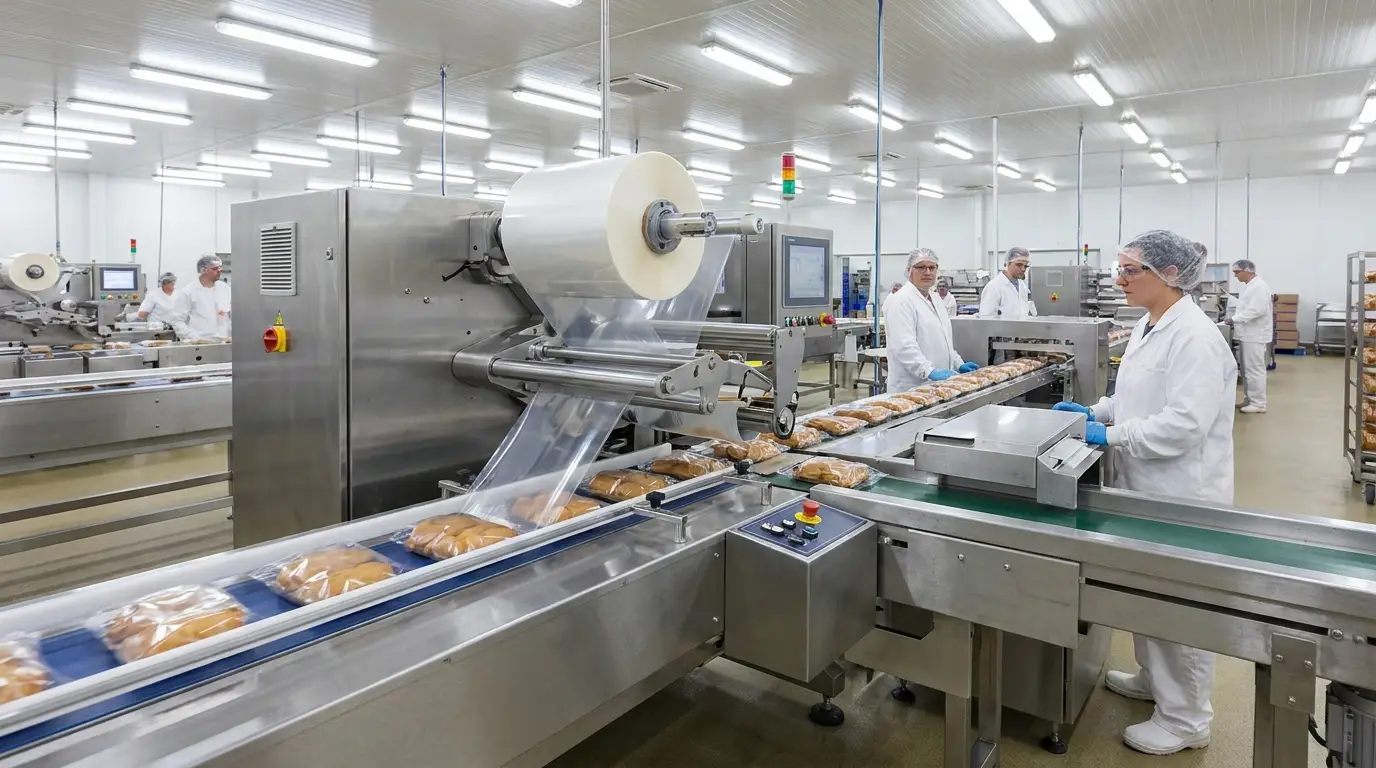
Flow Wrap Packaging: HFFS and VFFS Technology Guide
High-speed horizontal and vertical flow wrapping for food, confectionery, bakery, and industrial products — from pillow packs to three-side seal formats
What Is Flow Wrap Packaging?
Flow wrap packaging — also called flow wrapping, flowpack, or fin-seal wrapping — is a high-speed packaging process that forms a continuous tube of film around products, seals the tube longitudinally along the product's underside (the fin seal or lap seal), and cuts individual packs with transverse end seals. The result is the ubiquitous pillow pack format seen on chocolate bars, cereal bars, biscuits, bakery items, fresh produce, and thousands of other consumer products.
Flow wrapping machines are divided into two primary configurations: Horizontal Flow Wrap (HFFS) — where products travel horizontally on a conveyor into the wrapping zone — and Vertical Flow Wrap (VFFS) — where film forms a vertical tube and products are dropped in from above. HFFS is preferred for solid, pre-formed products; VFFS for flowable products (chips, coffee, frozen vegetables, liquids in sachets).
Flow wrapping offers exceptional throughput — modern HFFS machines achieve 200–1,500 packs per minute — combined with low film cost per pack, minimal waste, and compatibility with almost every flexible film structure on the market.
HFFS vs. VFFS: Choosing the Right Configuration
Horizontal Form Fill Seal (HFFS)
In HFFS flow wrapping, a flat film reel unwinds horizontally, is formed into a tube around the product using a forming collar and a longitudinal seal, then transverse jaws cut and seal individual packs. HFFS handles discrete solid items — bars, blocks, trays, medical devices, hardware — with excellent pack geometry and minimal product deformation. It is the dominant configuration in confectionery, bakery, snack bars, cheese, and manufactured goods packaging.
Key HFFS features: servo-driven axes for precise timing, integrated vision inspection for seal quality and label registration, quick-change tooling for pack format changeovers, and optional MAP gas flushing (see our MAP guide) for extended shelf life.
Vertical Form Fill Seal (VFFS)
VFFS forms a film tube vertically around a central fill tube, seals the bottom, drops product from above, then seals and cuts the top. VFFS is suited to bulk-weight products — snack chips, coffee, rice, frozen food, pet food, nuts, and liquids/pastes in pouches. The vertical orientation allows gravity-assisted filling and integration with weighers, auger fillers, and liquid dosing systems. VFFS lines regularly achieve 100–200 packs per minute for solid products and higher for liquids.
Flow Wrap Film Structures
Film selection for flow wrapping depends on the product's moisture, oxygen, and light sensitivity, required shelf life, sealing requirements, and sustainability targets:
- OPP/PE (Biaxially Oriented PP / Polyethylene): The most common food flow wrap structure — excellent clarity, good moisture barrier, heat-sealable PE layer, cost-effective. Used for biscuits, confectionery, and dry bakery.
- Metallised OPP: Adds an aluminium metallisation layer for superior oxygen and light barrier. Used for crisps, nuts, and moisture-sensitive snacks. The metallic appearance is also a common aesthetic choice.
- PA/PE (Nylon/Polyethylene): Excellent puncture resistance for sharp, irregular products and good oxygen barrier. Used for processed cheese, fresh pasta, and meat portions.
- EVOH laminates: High gas barrier for extended shelf life applications; commonly used with MAP gas flushing for fresh food.
- Paper-based flow wrap: Paper/PE or paper/metallised structures for sustainable packaging applications — gaining traction in premium confectionery and natural food brands.
Seal Quality and Pack Integrity
Flow wrap pack integrity depends on consistent seal quality across the fin seal (longitudinal) and end seals (transverse). Common seal quality issues include:
- Leaking end seals: Caused by contamination in the seal zone (product particles, oil), incorrect jaw temperature or pressure, or film tracking errors
- Fin seal voids: Result from film tension inconsistency or adhesive/hot-tack performance variation across the film reel
- Dog ears: Incompletely folded film tails at pack ends — typically a forming collar adjustment or film tension issue
Modern flow wrappers integrate 100% vision inspection systems and seal force monitoring to detect and reject defective packs at line speed. For MAP flow wrap applications, headspace gas analysis systems check residual O₂ on every pack.
Frequently Asked Questions
Flow wrapping uses flexible film formed around the product on the packaging machine — no pre-formed rigid cavity. Thermoforming creates a rigid or semi-rigid cavity from heated plastic sheet that supports the product shape. Flow wrap is faster, cheaper per pack, and uses less material for simple-geometry solid products. Thermoforming is preferred when the product needs structural support, a rigid tray for retail presentation, or a gas-tight cavity for MAP.
Yes. HFFS flow wrappers commonly incorporate gas flushing systems between the forming collar and the end seal jaws, displacing ambient air with the target gas mix before sealing. This produces MAP pillow packs. The film must have appropriate gas barrier properties to retain the modified atmosphere. VFFS can also incorporate MAP flushing for snack and fresh food applications.
Flow wrapping is used across an enormous range of products: chocolate bars and confectionery, biscuits and crackers, cereal and snack bars, fresh bakery and sandwiches, cheese portions, processed meat slices, fresh pasta, fresh produce (individual items), medical devices (non-sterile), hardware and small consumer goods, and stationery. If it can be conveyed horizontally and has a reasonably consistent profile, it can likely be flow wrapped.
A pillow pack has a central fin seal running the length of the pack underside, plus two end seals — giving three seals total but with the film folded around the product. A three-side seal (3SS) pouch is formed from a flat sheet sealed on three sides, with the fourth side being the film fold. 3SS gives a flatter, more 'pouch-like' appearance and is used for sliced deli products, flat confectionery, and medical devices. Both can be produced on HFFS platforms with appropriate tooling.
HFFS flow wrap speeds range from 50 packs/min for heavy or fragile products to over 1,500 packs/min for small, lightweight confectionery items (e.g. wrapped candies). A typical confectionery bar line runs at 200–400 packs/min; a fresh sandwich line at 60–120 packs/min. VFFS speeds vary widely by product — 50 bags/min for frozen vegetables to 200+ bags/min for coffee or snack chips.
Flow Wrap Packaging SolutionsDiscuss HFFS or VFFS line specifications, film selection, and MAP integration for your product.
Request Information →