
Flexible Packaging Films
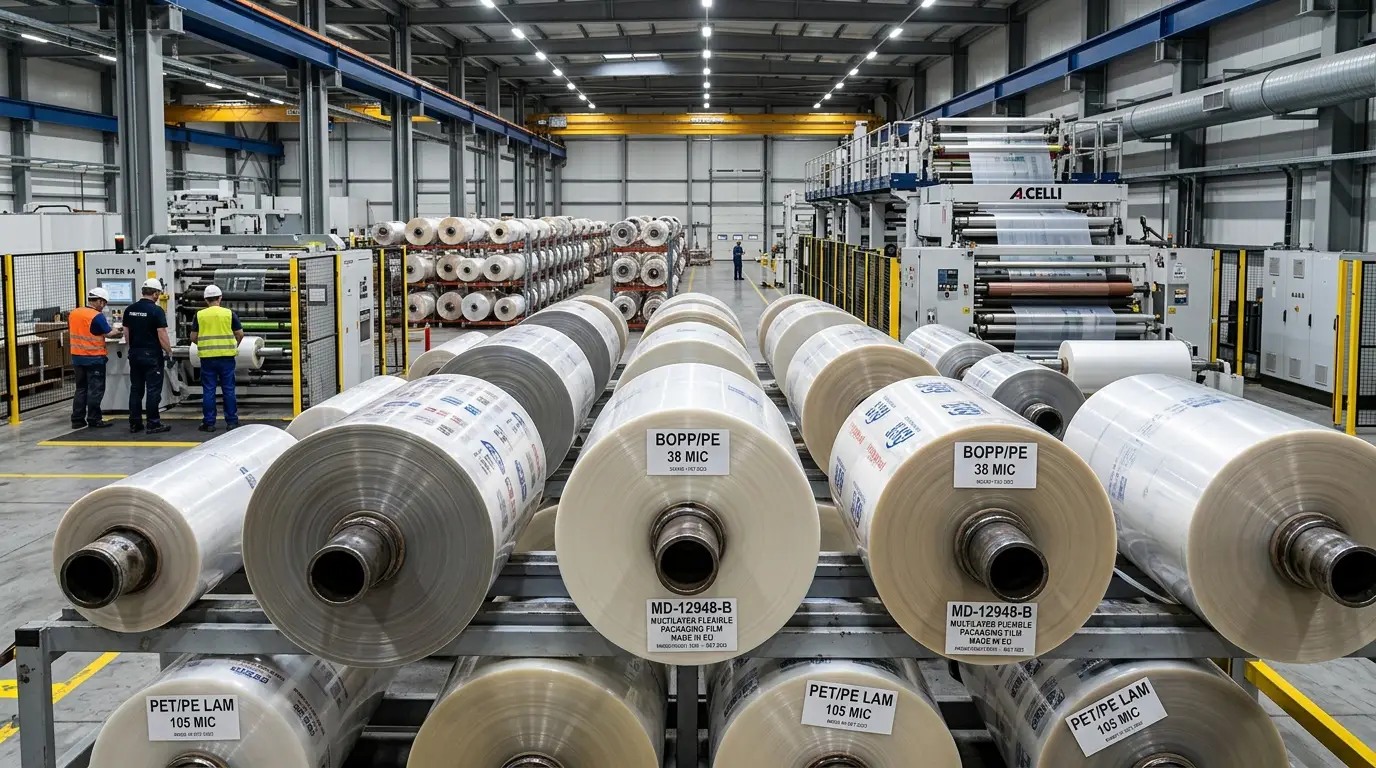
Flexible Packaging Films
From mono-layer polyethylene to high-barrier coextrusions — the building blocks of modern flexible packaging.
What Are Flexible Packaging Films?
Flexible packaging films are thin polymer substrates — typically 10–200 µm thick — that serve as the primary structural and functional layer in pouches, bags, wraps, and rollstock formats. Unlike rigid packaging, films conform to product shape, reduce material weight, and can be engineered with precise barrier, optical, sealing, and mechanical properties through monolayer or multilayer coextrusion structures.
The global flexible packaging film market exceeds $120 billion annually, driven by food, personal care, pharmaceutical, and industrial applications. Film selection directly determines shelf life, machine runnability, sustainability profile, and total packaging cost.
Major Film Families
BOPP — Biaxially Oriented Polypropylene
The workhorse of snack, confectionery, and label markets. BOPP offers excellent clarity, stiffness, and printability at low cost. Standard BOPP is heat-sealable when coated; metallised BOPP adds oxygen barrier for longer shelf life. Typical thickness: 15–30 µm.
PET — Polyethylene Terephthalate
High tensile strength, excellent temperature resistance (up to 220 °C in retort), and outstanding oxygen/moisture barrier. Used as the outer layer in laminates for hot-fill, retort, and vacuum applications. BOPET (biaxially oriented PET) combines stiffness with exceptional clarity.
PE — Polyethylene
LDPE, LLDPE, HDPE, and mLLDPE cover a wide range of sealing, toughness, and barrier needs. Polyethylene is the dominant sealant layer in multilayer structures and is central to mono-material recyclable packaging initiatives. mLLDPE delivers superior puncture resistance for frozen and sharp-edge products.
PA — Polyamide (Nylon)
Excellent oxygen barrier, puncture resistance, and formability. PA6 and PA6/66 are standard in vacuum pouches for fresh meat, cheese, and processed food. Biaxially oriented nylon (BON) combines barrier with dimensional stability for high-speed FFS lines.
PP Cast & CPP
Cast polypropylene provides superior sealability at low temperatures, high clarity, and excellent moisture barrier. CPP is the preferred sealant layer for snack and confectionery applications where BOPP is the outer layer, creating an all-PP mono-material structure.
PVdC & EVOH Coatings
Applied as thin barrier coatings or coextruded layers on PE or PET base films. EVOH delivers exceptional oxygen barrier (OTR <0.5 cc/m²/day at 50% RH) critical for MAP and vacuum applications. PVdC provides combined oxygen and moisture barrier in a single coating layer.
Film Performance Properties
| Film | OTR (cc/m²/day) | WVTR (g/m²/day) | Seal Range (°C) | Primary Use |
|---|---|---|---|---|
| LDPE 50 µm | 6000–8000 | 5–8 | 110–130 | Bread bags, produce |
| BOPP 20 µm | 1500–2500 | 2–4 | 105–125 (coated) | Snacks, confectionery |
| BOPET 12 µm | 50–80 | 1–2 | Laminated only | Outer layer, retort |
| PA6 15 µm | 30–50 | 80–120 | Laminated only | Vacuum pouches |
| EVOH 15 µm | 0.1–0.5 | 3–10 | Coextruded only | Barrier layer in MAP |
| Metallised PET | 0.5–2 | 0.2–0.5 | Laminated only | Coffee, pet food |
Mono-Material vs. Multilayer Structures
Traditional flexible packaging achieves its performance by laminating 3–5 dissimilar films — typically PET/ink/adhesive/PE or BOPP/BOPET/PE. While this delivers superior functionality, the mixed-polymer construction complicates recycling. The packaging industry is undergoing a significant transition toward mono-material structures (all-PE or all-PP) that maintain functional performance while meeting EU and national recyclability requirements.
All-PE structures using mLLDPE sealant layers, HDPE middle layers, and BOPE outer layers have achieved shelf life parity with traditional laminates in several ambient food applications. Downgauging — reducing total film thickness by 15–25% using higher-performance resins — simultaneously lowers material cost and environmental footprint.
Film Selection Criteria
Product Requirements
Moisture sensitivity, oxygen sensitivity, light sensitivity, fat content, and intended shelf life determine the minimum barrier specification. Matching barrier to actual product need — rather than over-engineering — reduces cost and improves recyclability.
Processing Conditions
Retort (121 °C), hot-fill (85 °C), boil-in-bag, frozen storage, and ambient conditions each require different heat resistance and dimensional stability profiles. Machine speed, seal jaw type, and forming depth impose mechanical demands on stiffness, COF, and anti-static properties.
Printability & Decoration
Surface tension (dyne level), corona treatment stability, and ink adhesion vary significantly across film types. Surface printing suits short runs; reverse printing in laminates provides scuff-resistance for long-shelf retail products.
Regulatory Compliance
Food-contact films must comply with EU Regulation 10/2011 (plastic FCM), FDA 21 CFR, and specific national standards. Pharmaceutical applications additionally require compliance with Ph.Eur. 3.1.x monographs and ICH Q1A stability testing protocols.
Frequently Asked Questions
What is the difference between cast and blown film?
Cast film is extruded through a flat die and quenched on a chill roll, producing excellent clarity and uniform gauge — ideal for high-clarity applications like fresh produce and deli meat. Blown film is extruded upward as a tube and cooled by air, producing stronger biaxial orientation and better puncture resistance — preferred for heavy-duty bags and agricultural film.
Can flexible films be recycled?
Recyclability depends on the structure. Mono-material PE and PP films are recyclable in dedicated streams where collection infrastructure exists. Multilayer structures combining PET, PA, PE, and EVOH are generally non-recyclable as mixed plastics. The EU Packaging and Packaging Waste Regulation (PPWR) is driving rapid adoption of recyclable mono-material designs.
What does OTR mean and why does it matter?
OTR (Oxygen Transmission Rate) measures how much oxygen permeates through a film per unit area per day, expressed as cc/m²/day at specified temperature and humidity. Lower OTR means better oxygen barrier, which extends the shelf life of oxygen-sensitive products like fresh meat, coffee, and snacks by slowing oxidation and microbial growth.
What is the minimum barrier needed for fresh MAP protein?
Modified atmosphere packaging for fresh red meat typically requires an OTR below 3–5 cc/m²/day at 23 °C/0% RH to maintain the gas flush composition throughout shelf life. Structures achieving this include PA/PE laminates, EVOH-containing coextrusions, and metallised BOPP/PE structures.