

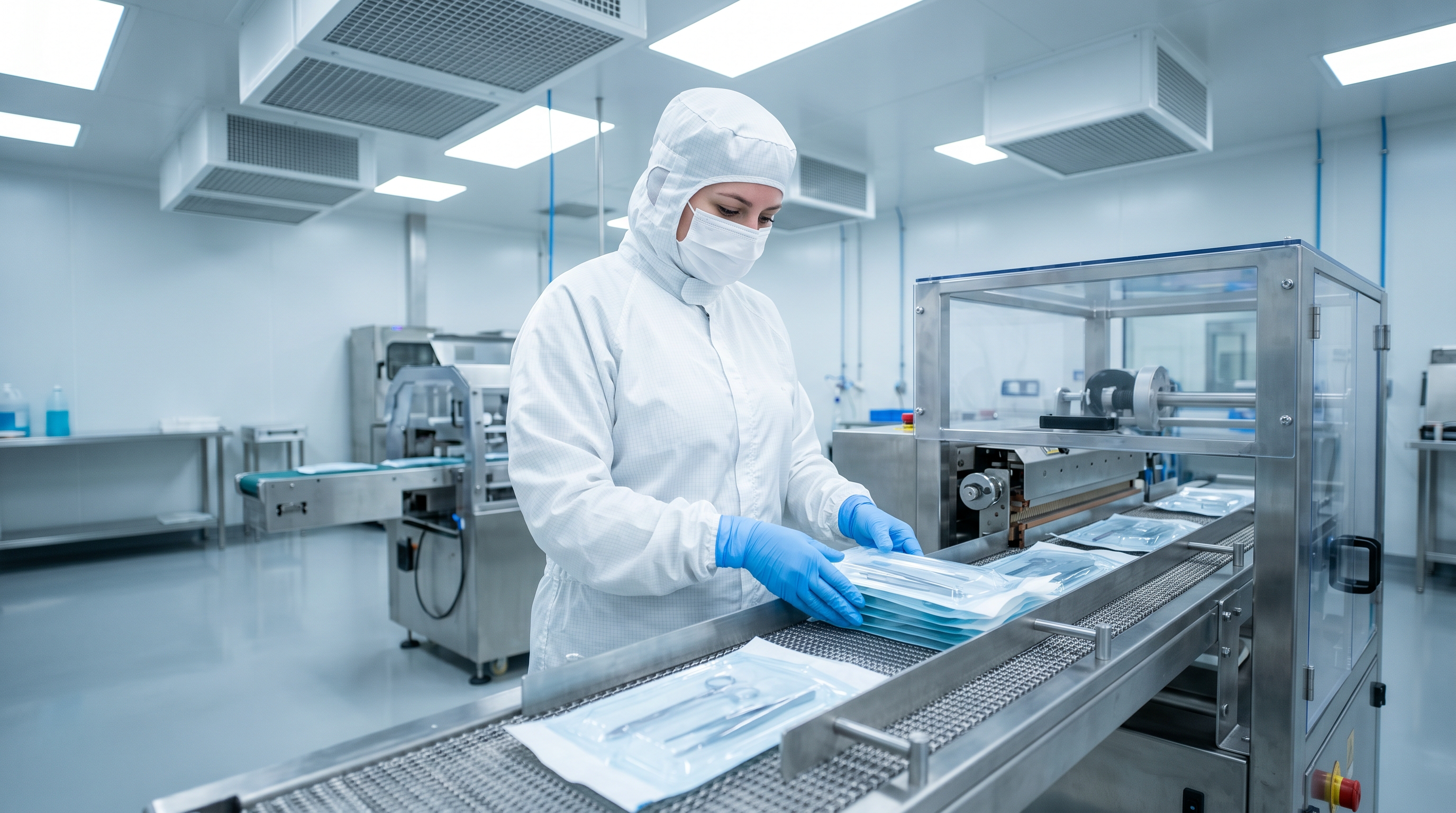
Key Takeaways
- Cleanroom medical device packaging operates under ISO 14644 cleanliness classifications, most commonly ISO Class 7 or Class 8, with Class 5 reserved for implants and the highest-risk devices.
- Sterile barrier systems (SBS) follow ISO 11607-1 and ISO 11607-2, the harmonized standards governing materials, validation and process compliance.
- Typical sterile barrier materials include Tyvek 1059B and 1073B, medical-grade paper, foil pouches, and chevron peel pouches selected by sterilisation route.
- Validation requires documented seal strength, microbial barrier, accelerated aging and real-time aging studies, with full design history file traceability for FDA and EU MDR.
- Cleanroom packaging operations require gowning protocols, particle monitoring, positive pressure differentials and routine environmental sampling to maintain compliance.
Table of Contents
- What is cleanroom medical device packaging?
- ISO cleanroom classifications for medical packaging
- Sterile barrier systems and ISO 11607
- Materials used in sterile medical packaging
- Sterilisation methods and packaging compatibility
- Validation, accelerated aging and shelf-life testing
- Cleanroom operational practices
- Frequently asked questions
What is cleanroom medical device packaging?
Cleanroom medical device packaging refers to the controlled environment, materials and processes used to package terminally sterilised medical devices in a way that maintains sterility from the manufacturer through to the point of clinical use. The system encompasses the cleanroom facility itself, the sterile barrier system surrounding the device, the protective and secondary packaging, the operators following gowning and behavioral protocols, and the validated process steps that join them together.
Cleanroom packaging is distinct from general medical packaging in that the packaging step itself must contribute to the overall sterility assurance level (SAL) of the finished device. Even with a sterilisation process providing an SAL of 10⁻⁶, an inadequately controlled packaging environment can re-introduce bioburden, particulate or microbial contamination that compromises shelf-life or risks user infection. Because the device is sealed before sterilisation, the cleanroom does not produce a sterile package — it produces a low-bioburden package that withstands the sterilisation step and remains sealed thereafter.
Regulatory frameworks worldwide require demonstrated compliance with ISO 11607 (the sterile barrier system standard), ISO 14644 (cleanroom classification), ISO 13485 (medical device quality management) and either FDA 21 CFR Part 820 in the United States or EU MDR 2017/745 in Europe. Documentation, validation and traceability are as central to the operation as the physical engineering.
ISO cleanroom classifications for medical packaging
ISO 14644-1 classifies cleanrooms by the maximum allowable particle count per cubic meter for particles 0.1 µm and larger. Higher class numbers indicate higher particle counts and therefore lower cleanliness. Medical device packaging operations almost always operate in ISO Class 7 or Class 8 environments, with Class 5 reserved for implants, sterile drug filling and the highest-risk applications.
| ISO Class | Max particles ≥0.5 µm / m³ | Typical medical application | Air changes/hour |
|---|---|---|---|
| ISO 5 | 3,520 | Implants, surgical tools, aseptic processing | 240–480 |
| ISO 6 | 35,200 | Critical wound-contact devices | 150–240 |
| ISO 7 | 352,000 | Sterile device packaging, semi-critical devices | 60–150 |
| ISO 8 | 3,520,000 | Non-critical device packaging, assembly | 10–60 |
Class 5 cleanrooms (highest cleanliness)
Class 5 environments are required for terminally sterilised implants and the aseptic processing of products that cannot undergo terminal sterilisation. Unidirectional laminar airflow at 0.36–0.54 m/s, isolators or restricted access barrier systems (RABS), and full bunny suit gowning are standard. Validation requirements include continuous particle monitoring, environmental microbial sampling and routine media-fill challenges.
Class 7 cleanrooms (typical packaging)
Class 7 environments support the majority of sterile medical device packaging operations. HEPA filtration with 99.99% efficiency at 0.3 µm, controlled positive pressure relative to surrounding spaces, and gowning protocols covering hair, beards, hands, feet and clothing form the baseline. Particle counts are monitored at regular intervals, often continuously during operation.
Class 8 cleanrooms
Class 8 supports non-critical and semi-critical device packaging, lower-risk medical device assembly, and material staging adjacent to higher-class spaces. The looser particle limits permit faster operator entry and exit, and gowning is correspondingly simpler.
Sterile barrier systems and ISO 11607
The sterile barrier system (SBS) is the minimum packaging that maintains sterility of the device from packaging through the point of use. ISO 11607-1 specifies the requirements for materials, preformed sterile barrier systems, sterile barrier systems and packaging systems, while ISO 11607-2 covers the validation of forming, sealing and assembly processes. Both standards are harmonized with EU MDR and recognized by the FDA as supporting compliance.
Core ISO 11607 requirements
ISO 11607-1 requires demonstrated material biocompatibility, microbial barrier, physical and chemical properties suitable for the sterilisation method, and shelf-life supported by accelerated and real-time aging. Seal integrity must be validated using ASTM F88 (seal strength), ASTM F1929 (dye penetration), and ASTM F1140 (burst). Process validation under ISO 11607-2 requires documented installation, operational and performance qualification (IQ/OQ/PQ) of the sealing, forming and assembly equipment.
Documentation and traceability
Each lot of sterile medical packaging carries a documented design history file linking the packaging design to the device, the validated sterilisation cycle, the seal parameters, the cleanroom environmental monitoring records, and the operator certification. Records are typically retained for ten years post-distribution per ISO 13485 and EU MDR Article 10.
Materials used in sterile medical packaging
Tyvek
Tyvek is a high-density polyethylene flash-spun nonwoven that combines a tortuous fiber matrix with a porous structure permitting EO and steam sterilisation while blocking bacterial penetration. Tyvek 1073B is the standard for terminally sterilised devices, providing excellent puncture, tear and microbial barrier. Tyvek 1059B is a lighter grade for smaller and lower-mass devices. Tyvek's clarity is opaque, so chevron peel pouches with one transparent film side provide visual device verification while the Tyvek serves as the porous breathable side enabling gas sterilisation.
Medical-grade paper
Medical-grade papers, typically 60–80 gsm bleached kraft, provide a lower-cost alternative to Tyvek for steam-sterilised devices and instrument trays. They breathe well for steam penetration but have lower tear and puncture resistance, restricting their use to lighter devices and protected packaging configurations.
Foil pouches
Aluminum foil laminates — typically PET/AL/PE constructions — deliver complete moisture and gas barrier for devices requiring inert storage atmospheres or radiation sterilisation. Foil pouches are sealed completely with no porous side and require terminal sterilisation by gamma irradiation, electron beam or X-ray.
Thermoformed rigid trays
PETG, PVC and APET thermoformed trays provide structural protection for complex devices, multi-component kits and implants. Trays are typically sealed with Tyvek or coated paper lidding via continuous heat-seal processes. Thermoformed rigid packaging integrates with automation more readily than pouches, supporting higher-throughput device manufacturing.
Chevron peel pouches
Chevron peel pouches combine a transparent film (PET, PA or PE laminate) on one face with Tyvek or paper on the other, sealed around the perimeter with a peelable adhesive. The chevron-shaped seal allows clean aseptic opening at the bedside or operating room. Peel pouches dominate single-use device packaging including syringes, catheters, masks, drapes and surgical accessories.
Sterilisation methods and packaging compatibility
| Sterilisation method | Compatible packaging | Typical SAL achieved | Common applications |
|---|---|---|---|
| Ethylene oxide (EO) | Tyvek, medical paper, breathable pouches | 10⁻⁶ | Catheters, syringes, electronics |
| Gamma irradiation | Tyvek, foil, sealed pouches | 10⁻⁶ | Single-use surgical, polymers compatible with gamma |
| Electron beam (E-beam) | Tyvek, foil, sealed pouches | 10⁻⁶ | Single-use surgical, thinner profiles |
| X-ray | Tyvek, foil, sealed pouches | 10⁻⁶ | Implants, larger packs |
| Steam autoclave | Medical paper, paper-laminate pouches | 10⁻⁶ | Reusable instruments, IFUs |
| Vaporised hydrogen peroxide (VHP) | Tyvek, specialised compatible pouches | 10⁻⁶ | Heat-sensitive devices, electronics |
EO sterilisation
Ethylene oxide is the most widely used sterilisation method for single-use polymer-based medical devices because it permits sterilisation at low temperatures and humidity. EO requires permeable packaging materials — Tyvek or medical paper — to allow gas ingress and post-sterilisation degassing. Residual EO must be reduced to safe levels by aeration before product release.
Radiation sterilisation
Gamma irradiation, electron beam and X-ray sterilisation pass through completely sealed packaging including foil pouches. Materials must be evaluated for radiation compatibility; certain polymers including PTFE, PP and PVC require special grades to withstand radiation doses without embrittlement or discoloration.
Steam autoclave
Steam is the gold standard for reusable surgical instruments and instrument trays. Medical-grade paper and paper-laminate pouches are designed to allow steam penetration and equilibration with the device. Sealed foil pouches and Tyvek-based pouches are not used because steam cannot penetrate them.
Validation, accelerated aging and shelf-life testing
ISO 11607-1 requires documented shelf-life supported by accelerated aging and confirmed by real-time aging. Accelerated aging uses Arrhenius equation modelling to predict the rate of polymer degradation at elevated temperatures, typically 55°C for accelerated study versus 23°C for real-time storage. A 12-month real-time shelf life equates to approximately 47 days at 55°C using a Q10 factor of 2. Both accelerated and real-time samples are tested for seal strength, dye penetration, burst pressure, microbial barrier and visual integrity at defined intervals.
Validation of sealing equipment follows IQ/OQ/PQ protocols. Installation qualification confirms the machine is built and installed per design. Operational qualification verifies the machine operates within specified parameter ranges. Performance qualification demonstrates consistent in-spec output across production conditions, including operator changes, material lots, and ambient variations. Each parameter — temperature, dwell time, pressure, vacuum — carries a documented operating range with control limits.
Cleanroom operational practices
Operational discipline is as important as facility design. Gowning protocols dictate the sequence and materials for entering the cleanroom: shoe covers, hair cover, beard cover (if applicable), gown, gloves and face mask. Operators move through air showers and gowning vestibules in a controlled sequence to prevent particle shedding from street clothing entering the cleanroom. Hand and equipment hygiene follows documented procedures, with sanitisation logs maintained for every shift.
Environmental monitoring includes continuous particle counting at designated locations, weekly viable air sampling, surface sampling on contact-prone surfaces, and pressure differential logging to confirm positive pressure relative to ungowned spaces. Excursions trigger documented investigations and may require batch quarantine. Routine cleanroom recertification under ISO 14644 occurs annually, with at-rest and operational testing of particle counts, airflow velocity, room pressure differentials and HEPA filter integrity.
Material flow management prevents recontamination. Incoming materials enter through pass-through chambers, often with UV or aerosolised disinfection. Finished sterile barrier packages exit through separate chambers to maintain unidirectional product flow. Waste streams are routed independently to avoid cross-contamination.
Engineering teams familiar with pharmaceutical blister packaging, thermoforming for medical applications and tray sealing will find many overlaps in materials, sealing principles and equipment qualification practices. Reference standards including ISO 11607-1:2019 and ISO 14644-1:2015 form the regulatory baseline.
Frequently asked questions
What ISO cleanroom class is required for medical device packaging?
The vast majority of sterile medical device packaging operates in ISO Class 7 or Class 8 cleanrooms. ISO Class 5 is required for implants, intravascular and intrathecal devices, and aseptic processing where the device cannot be terminally sterilised. The required class is a function of device risk class and the sterilisation method.
What is the difference between sterile barrier system and protective packaging?
The sterile barrier system (SBS) is the packaging that maintains sterility from manufacturer to point of use. Protective packaging surrounds and protects the SBS from mechanical damage during distribution but does not itself maintain sterility. Both are validated and documented under ISO 11607 as parts of the overall packaging system.
How is sterile shelf life established?
Sterile shelf life is established through real-time aging at the labelled storage condition, supported by accelerated aging using Arrhenius modelling. Both aged sample sets undergo seal strength, dye penetration, burst and microbial barrier testing at defined intervals to demonstrate continued integrity.
Can Tyvek be steam sterilised?
Tyvek is not compatible with steam autoclave sterilisation because the HDPE substrate softens and distorts at typical steam cycle temperatures. Tyvek is compatible with EO, gamma, electron beam, X-ray and VHP sterilisation methods.
What is the minimum seal strength for sterile medical packaging?
Minimum seal strength varies with package format, device weight and intended use. Common specifications include 1.5–3.0 N/15 mm for chevron peel pouches per ASTM F88, validated against the requirements of the specific device.
How are EO residuals controlled?
Post-sterilisation aeration in temperature- and humidity-controlled chambers reduces ethylene oxide, ethylene chlorohydrin and ethylene glycol residues to ISO 10993-7 limits before product release. Typical aeration cycles run 24–72 hours depending on device geometry and EO uptake.
What documentation does the FDA require for sterile medical packaging?
The FDA requires a documented design history file including material specifications, packaging validation, sterilisation validation, shelf-life data, environmental monitoring records, and process control parameters. Documentation is reviewed during pre-market submissions and routine facility inspections under 21 CFR Part 820.
Share:
IVD Packaging: Sterile Barrier Requirements and EU IVDR Compliance