

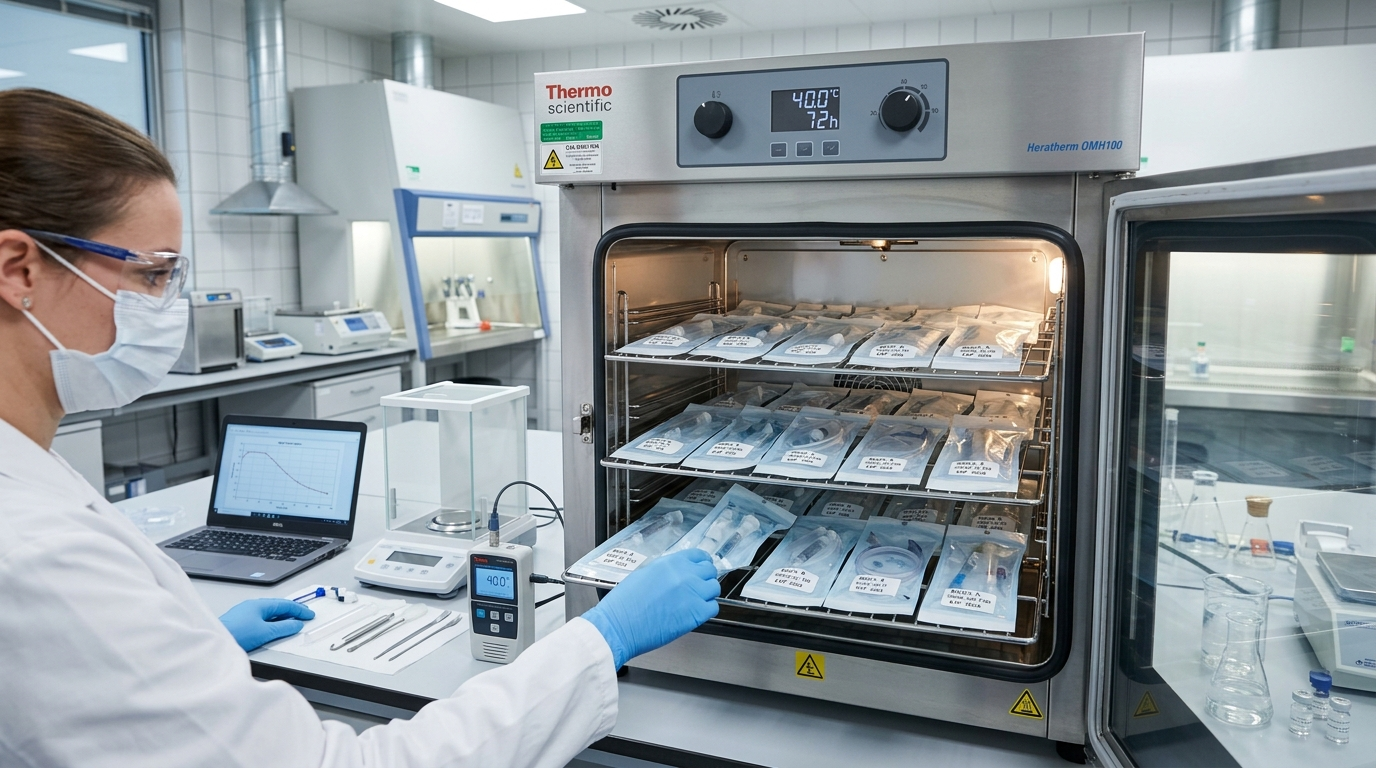
- ASTM F1980 is the standard guide for accelerated aging of sterile barrier systems, enabling manufacturers to generate shelf life data without waiting for real-time studies to complete.
- The Arrhenius equation forms the mathematical basis of ASTM F1980: a Q10 value of 2.0 (standard assumption) means every 10°C temperature increase doubles the rate of aging.
- The most common accelerated aging protocol uses 55°C, which simulates approximately 365 real-time days in approximately 40 study days at an assumed ambient storage temperature of 25°C.
- Accelerated aging data are preliminary — real-time aging studies must be conducted concurrently and used to confirm shelf life claims over the full product lifecycle.
- Humidity control during accelerated aging is now strongly recommended following the 2021 revision of ASTM F1980, recognising its effect on packaging material degradation rates.
Accelerated aging testing allows medical device manufacturers to demonstrate that their sterile packaging maintains its integrity over the full claimed shelf life — without waiting for years of real-time data before placing a product on the market. ASTM F1980, the standard guide for accelerated aging of sterile barrier systems for medical devices, provides the validated scientific framework for conducting these studies in a compressed timeframe.
For any sterile medical device with a shelf life claim — whether 2 years, 5 years, or longer — an ASTM F1980 accelerated aging study is a standard and expected component of the ISO 11607 packaging validation program. This guide explains the science behind accelerated aging, how to design a compliant study, what testing must be performed after aging, and how to interpret the results in a regulatory context.
What Is ASTM F1980 Accelerated Aging?
ASTM F1980, formally titled Standard Guide for Accelerated Aging of Sterile Barrier Systems for Medical Devices, provides a scientifically based approach to simulating the effects of time on packaging materials and systems using elevated temperature as the aging driver. The fundamental premise is that chemical and physical degradation processes that affect packaging material properties — the same processes that cause materials to embrittle, delaminate, discolour, or lose seal strength over time — proceed faster at higher temperatures than at ambient storage temperatures.
By exposing packaging specimens to a defined elevated temperature for a calculated time period, manufacturers can generate data representing the equivalent of years of real-time storage in a matter of weeks or months. The resulting specimens are then subjected to the same integrity and performance tests that would be applied to real-time aged samples to confirm that the packaging meets its acceptance criteria after the simulated storage period.
ASTM F1980 was first published in 1999 and has been revised several times. The current version is ASTM F1980-21, published in 2021, which added important guidance on humidity control during accelerated aging studies — a significant update given that humidity is now recognised as an independent variable affecting aging behaviour for certain packaging materials and adhesive systems.
The Science: Arrhenius Equation and Q10
The scientific foundation of ASTM F1980 is the Arrhenius equation, which describes the relationship between temperature and the rate of chemical reaction. In packaging aging, the relevant reactions are the degradation mechanisms — hydrolysis, oxidation, chain scission, adhesive creep — that cause packaging materials to change their properties over time.
ASTM F1980 simplifies the Arrhenius relationship into a parameter called Q10, defined as the factor by which the rate of aging increases for every 10°C increase in temperature. The standard uses a default Q10 value of 2.0, which means that packaging aged at a temperature 10°C above the ambient storage temperature ages twice as fast. This is a conservative assumption for most packaging materials — many materials degrade faster than Q10 = 2.0 at elevated temperatures — which means that ASTM F1980 studies using the default Q10 tend to underestimate real-time degradation and therefore err on the side of patient safety.
The calculation of accelerated aging time (AAT) is as follows:
AAT = Desired shelf life in days × Q10 ^ ((T_AA − T_RT) / 10)
Where:
T_AA = Accelerated aging temperature (°C)
T_RT = Ambient real-time storage temperature (°C)
Q10 = 2.0 (default assumption per ASTM F1980)
For example, to simulate a 2-year (730-day) shelf life at 55°C accelerated aging temperature with an assumed ambient storage temperature of 25°C:
AAT = 730 / (2.0 ^ ((55 − 25) / 10))
AAT = 730 / (2.0 ^ 3)
AAT = 730 / 8
AAT ≈ 91 days
Designing an Accelerated Aging Study
A well-designed ASTM F1980 accelerated aging study requires careful consideration of several variables before the study begins. Retroactively modifying the study protocol or acceptance criteria after seeing the data is a serious regulatory finding.
Selecting the Aging Temperature
The aging temperature must be high enough to generate a meaningful acceleration factor (and therefore a practical study duration), but not so high that the packaging materials experience degradation mechanisms that would not occur under ambient storage — a phenomenon known as threshold temperature exceedance. For most medical packaging materials including Tyvek, polyester, and polyethylene films, 55°C is well established as a safe and effective accelerated aging temperature. Some temperature-sensitive materials, such as certain pressure-sensitive adhesives, may require lower aging temperatures with correspondingly longer study durations.
Defining the Ambient Storage Temperature
The ambient storage temperature (T_RT) used in the ASTM F1980 calculation must reflect the worst-case real-world storage condition for the product. Using 25°C is standard for most medical device products intended for storage in controlled healthcare environments. If the product may be stored at higher ambient temperatures — for example, in non-climate-controlled facilities in tropical markets — a higher T_RT value must be used, which increases the AAT and extends the study duration. Alternatively, if the product labeling restricts storage to a specific temperature range, the maximum labelled storage temperature should be used as T_RT.
Humidity Control
ASTM F1980-21 strongly recommends monitoring and controlling relative humidity (RH) during accelerated aging studies. Humidity affects the degradation rate of moisture-sensitive materials — including paper, certain coated substrates, and some adhesive systems — and uncontrolled RH can produce artificially accelerated or decelerated aging that does not accurately represent the real-time storage environment. Most commercial aging chambers designed for ASTM F1980 studies now incorporate humidity control as standard capability. Where humidity is controlled, its target value and actual range throughout the study should be documented in the study records.
Sample Quantity
The number of samples to be included in the accelerated aging study must be sufficient to support the statistical conclusions required by the post-aging test protocols. Minimum sample sizes are typically defined by the test methods used after aging — for example, ASTM F88 peel testing requires a minimum number of replicate specimens per seal orientation, and visual inspection or non-destructive integrity testing may require sample sizes sufficient for meaningful statistical analysis. It is good practice to include extra samples to allow for damaged or lost samples during the aging study.
| Desired Shelf Life | Aging Temp (T_AA) | Ambient Temp (T_RT) | Q10 | AAT (days) |
|---|---|---|---|---|
| 1 year (365 days) | 55°C | 25°C | 2.0 | ~46 days |
| 2 years (730 days) | 55°C | 25°C | 2.0 | ~91 days |
| 3 years (1,095 days) | 55°C | 25°C | 2.0 | ~137 days |
| 5 years (1,825 days) | 55°C | 25°C | 2.0 | ~228 days |
| 5 years (1,825 days) | 60°C | 25°C | 2.0 | ~101 days |
Accelerated vs. Real-Time Aging
ASTM F1980 is explicit that accelerated aging data are a provisional substitute for real-time aging data, not a permanent replacement. The standard requires that real-time aging studies be conducted concurrently with accelerated aging studies, using the same product configuration, storage conditions, and test endpoints. Real-time aging studies run for the full duration of the claimed shelf life at the ambient storage temperature — a 5-year shelf life study runs for 5 years.
The accelerated aging results support the initial product launch and regulatory submissions. If the accelerated aging study passes, the manufacturer may place the product on the market with the shelf life claim. However, if the real-time aging study subsequently produces failing results at any time point, the shelf life claim must be revised, and affected product already on the market may need to be recalled. The concurrent conduct of real-time aging is therefore not merely a regulatory formality — it is essential protection against a post-market shelf life failure.
Under EU MDR (Regulation 2017/745), Notified Bodies reviewing technical documentation for sterile medical devices expect to see packaging shelf life data as part of the packaging validation file. Accelerated aging data per ASTM F1980 are accepted to support the initial shelf life claim, provided the study was conducted under a documented protocol with defined acceptance criteria and a concurrent real-time aging study is underway. The status of real-time aging studies is typically a recurring agenda item during Notified Body surveillance audits throughout the product lifecycle. For the full framework of EU MDR packaging requirements, see our ISO 11607 compliance guide.
Post-Aging Integrity Testing
After the accelerated aging period is complete, aged samples must be subjected to a battery of integrity and performance tests to confirm that the packaging system still meets its acceptance criteria. The specific tests required depend on the packaging design and risk assessment, but a typical post-aging test plan for a flexible sterile barrier system includes: visual inspection for gross defects, discolouration, or delamination; seal strength testing per ASTM F88; seal integrity testing per ASTM F1929 (dye penetration) or ASTM F2338 (vacuum decay); labeling legibility assessment; and microbial barrier testing if required by the risk assessment.
The acceptance criteria applied to post-aging test results must be the same as those applied to the initial (time-zero) validation data. Any result that fails to meet the acceptance criteria at any aging time point represents a shelf life failure and must be investigated under the manufacturer's non-conformance and CAPA system. For guidance on the specific seal integrity methods used in post-aging testing, see our seal integrity testing guide.
Regulatory Context: ISO 11607 and FDA Requirements
ASTM F1980 is closely linked to ISO 11607, which requires that sterile barrier systems demonstrate performance over their claimed shelf life through aging studies conducted under defined conditions. ISO 11607-1 Section 5.1.4 specifically requires evaluation of the effect of time on packaging material and SBS performance, and ASTM F1980 is the recognized method for conducting this evaluation in a compressed timeframe.
The FDA recognizes ASTM F1980 as a consensus standard. When submitting a 510(k) or PMA, FDA expects to see packaging validation data that includes shelf life studies — accelerated aging data per ASTM F1980 plus a concurrent real-time aging plan. The FDA's device packaging guidance documents and its database of recognized consensus standards both reference ASTM F1980 as the appropriate method for sterile device packaging shelf life determination.
Packaging validation reports, including accelerated aging study data, are subject to review during FDA inspections under 21 CFR Part 820.30 (Design Controls). Manufacturers must maintain complete study records — including equipment calibration records, chamber temperature logs, humidity data (for ASTM F1980-21 compliant studies), sample identification, protocol, and results — as part of their Design History File.
For packaging intended for the European market, the EU Medical Device Regulation (EU) 2017/745 and harmonized ISO 11607 both require packaging shelf life validation as a component of the technical documentation required for CE marking. The ASTM F1980 accelerated aging methodology is accepted across all major regulatory markets, making it the globally adopted approach for this aspect of packaging validation.
"The assumption behind Q10 = 2.0 is conservative by design. For packaging systems containing moisture-sensitive materials or temperature-activated adhesives, the actual degradation acceleration factor may exceed 2.0, meaning that an ASTM F1980 study using the default Q10 may underestimate the real-time degradation rate. This built-in conservatism is intentional and provides a margin of safety in the shelf life claim." — Aligned with ASTM F1980-21 commentary and industry technical review literature
Frequently Asked Questions
Can I place my product on the market before the real-time aging study is complete?
Yes, provided your accelerated aging study per ASTM F1980 has been completed successfully and all acceptance criteria have been met. ASTM F1980 and ISO 11607 both allow accelerated aging data to support the initial shelf life claim while real-time aging studies are conducted concurrently. However, if the real-time study subsequently fails, you must take corrective action — which may include revising the shelf life claim and potentially recalling product if the failure indicates a patient safety risk.
What Q10 value should I use if I know my material degrades faster than Q10 = 2.0?
ASTM F1980 allows manufacturers to use a material-specific Q10 value if they have experimental data to support a value other than 2.0. Using a higher, data-supported Q10 value would shorten the accelerated aging study duration for a given shelf life claim, but requires documented justification in the study protocol. Using a lower Q10 would be non-conservative and is not recommended without strong experimental evidence that the material degrades more slowly than the default assumption.
Does the aging temperature need to be constant throughout the study?
Yes. ASTM F1980 requires that the aging temperature be maintained within ±2°C of the target temperature throughout the study duration. Temperature excursions outside this range must be documented and assessed for their impact on the calculated equivalent aging time. Significant excursions may require extension of the study period or, in severe cases, invalidation of the study and restart with new samples. Continuous temperature data logging throughout the study is therefore essential.
What happens if my accelerated aging samples fail post-aging tests?
A post-aging test failure indicates that the packaging system does not maintain its performance characteristics over the simulated shelf life period. The failure must be investigated under the non-conformance and CAPA system. Root cause analysis typically examines packaging material quality, sealing process parameters, and aging study conditions. Depending on the root cause, corrective actions may include redesigning the packaging system, shortening the shelf life claim, or changing materials. The accelerated aging study must be repeated after corrective actions have been implemented.
Do I need to repeat accelerated aging if I change the packaging material or supplier?
A change in packaging material, film grade, or supplier is a significant design change that typically requires re-validation, including a new accelerated aging study. The new material must be characterized under the same ASTM F1980 protocol as the original, and post-aging testing must demonstrate that the new material meets the same acceptance criteria as the original. Change control documentation must capture the rationale for the material change, the scope of re-validation, and the results of the new aging study.
How does ASTM F1980 relate to distribution simulation testing?
Accelerated aging and distribution simulation testing are distinct but complementary components of a complete packaging validation program. ASTM F1980 simulates the effects of time (chemical and physical material degradation). Distribution simulation per ASTM D4169 or ISTA protocols simulates the mechanical stresses of shipping and handling (vibration, drop, compression, temperature cycling during transit). ISO 11607 requires both types of testing to demonstrate that the sterile barrier system maintains its integrity from manufacture to point of use. In some programs, distribution simulation is performed on samples that have already undergone accelerated aging — the worst-case combined stress scenario — to generate the most conservative packaging performance data.
Where can I access the full ASTM F1980 standard?
The current version, ASTM F1980-21, is available for purchase from the ASTM International website. ASTM membership provides discounts on standard purchases. The standard is also available through national standards bodies that distribute ASTM standards, including BSI (UK) and ANSI (USA). MedicoPax references the 2021 version throughout this guide.
Accelerated aging studies are commonly performed for products in blister packaging for medical devices, where maintaining sterile barrier integrity over the product shelf life is critical to ISO 11607 compliance.
Share:
ISO 11607 Explained: Complete Guide to Medical Device Packaging Compliance
ISO 11607 Explained: Complete Guide to Medical Device Packaging Compliance