
Tray Sealing Packaging
Tray Sealing Packaging
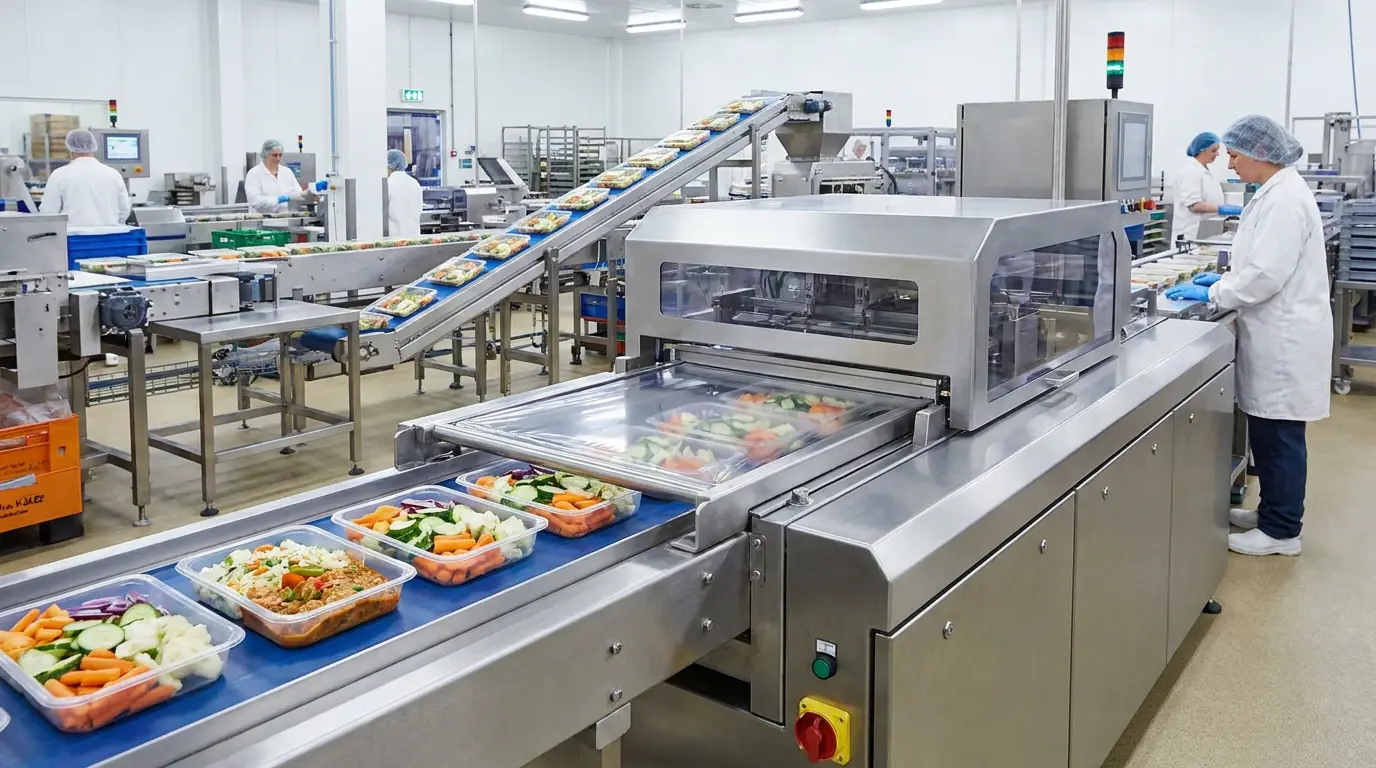
Pre-formed trays sealed with lidding film using heat and pressure — the standard format for chilled ready meals, fresh meat, fish, and MAP-extended food products across European retail.
How Tray Sealing Packaging Works
Tray sealing indexes pre-formed trays into a sealing tool, applies a lidding film web across the top, and closes heated upper and lower tool halves to create a sealed joint around the tray flange. Cycle times of 2–10 seconds support throughputs of hundreds of trays per minute on inline systems.
For MAP applications, a gas flush system displaces headspace air with the target gas mixture (CO₂/N₂ for red meat, N₂ for bakery) before the tool closes and seals. Inline vision systems and residual oxygen monitors verify pack quality at production rate.
Medical device application: Tray-and-lid systems are a primary sterile barrier system format for implants, instruments, and surgical kits under ISO 11607. See tray sealing for medical device packaging →
Tray Materials
- CPET — crystalline PET, dual ovenable (microwave + conventional oven to 220°C). Standard for ready meals. Fully recyclable in PET streams.
- APET — amorphous PET. Excellent clarity, widely used for fresh meat, produce, and premium food. Recyclable.
- PP — microwave-compatible, chemical-resistant. Used for soups, sauces, and ethnic ready meals. MAP-compatible.
- rPET — post-consumer recycled PET content. Meeting EU EPR recyclability obligations and retailer sustainability scorecards. Requires colour and odour qualification.
- Moulded fibre — growing adoption for produce and premium food where moisture resistance is manageable and sustainable positioning is a brand requirement.
Lidding Films and Seal Performance
Lidding film performance defines the package's atmosphere retention, peel behaviour, and shelf integrity. Peelable lidding is engineered for clean opening without delamination or tearing; hermetic lidding maximises seal strength for transit resistance; re-sealable formats use pressure-sensitive adhesive layers for consumer convenience. Barrier lidding incorporates EVOH or PVDC layers for MAP applications requiring low residual oxygen targets. External references: ASTM F88 · EN 1186.
Frequently Asked Questions
Peelable seals are engineered to open cleanly at a defined peel force — typically 5–15 N/15mm — allowing the consumer to remove the lidding without tearing or delamination. They rely on a controlled interface between the seal coating and the tray flange material. Hermetic seals are designed for maximum seal strength and integrity rather than consumer openability — used where transit stresses or pressure differentials require high-strength seals, such as export or pressure-sensitive products.
MAP tray sealing uses a gas flush system integrated into the tray sealer. After the tray is loaded and indexed into the sealing tool, a gas injection nozzle purges the headspace with the target gas mixture — typically high CO₂ / low O₂ for red meat, or nitrogen for bakery — before the upper tool closes and seals the lidding. Residual oxygen is measured by inline optical sensors on a sampling basis to verify MAP performance. The gas flush rate and pre-seal timing are optimised for the target residual O₂ specification.
APET and CPET trays are recyclable in established PET streams and are accepted in most European kerbside collection schemes when lidding film is removed (or when lidding meets sortable recyclability criteria). PP trays are recyclable in PP streams. rPET trays (with PCR content) further close the material loop. EPS and foam trays are generally not accepted in kerbside recycling. The EU Packaging and Packaging Waste Regulation (PPWR) sets mandatory recyclability performance criteria that will require reformulation of non-compliant formats by 2030.
Routine seal quality monitoring in tray sealing uses visual inspection (cameras checking seal appearance, wrinkles, channels), vacuum decay leak detection (non-destructive test applicable inline), dye penetration (ASTM F1929, offline destructive), and seal peel strength testing (ASTM F88, destructive). For MAP packs, headspace gas analysis (residual O₂ measurement) verifies atmosphere quality. Statistical sampling plans and control charts are standard in food safety management system (FSMS) contexts.
Tray sealing uses a pre-formed rigid or semi-rigid tray providing defined product containment, good shelf presence, and consumer familiarity — preferred for premium proteins, ready meals, and products requiring a specific tray geometry for protection or presentation. HFFS produces flexible pouches that use less material per pack and run faster, but with less structural protection and less consumer visibility of the product. Cost per pack, retailer format preferences, and distribution stresses are the primary decision criteria. See the FFS overview and VSP overview for comparison.
MAP, peelable seals, tray materials — all covered in depth.The InnovaPax tray sealing guide is the technical reference for food manufacturers.
Read the full guide →