About the material
Tyvek is not a film — it is a lid, and a very particular one. DuPont makes it by flash-spinning high-density polyethylene into a mat of extremely fine, continuous fibres, then bonding them with heat and pressure into a tough, paper-like nonwoven. It is porous enough to let sterilant gas pass through, yet a barrier to microorganisms: the fibres' tortuous, sub-microbial pathways let ethylene oxide (and steam vapour) in and out during sterilization while physically blocking bacteria from ever getting in afterward.
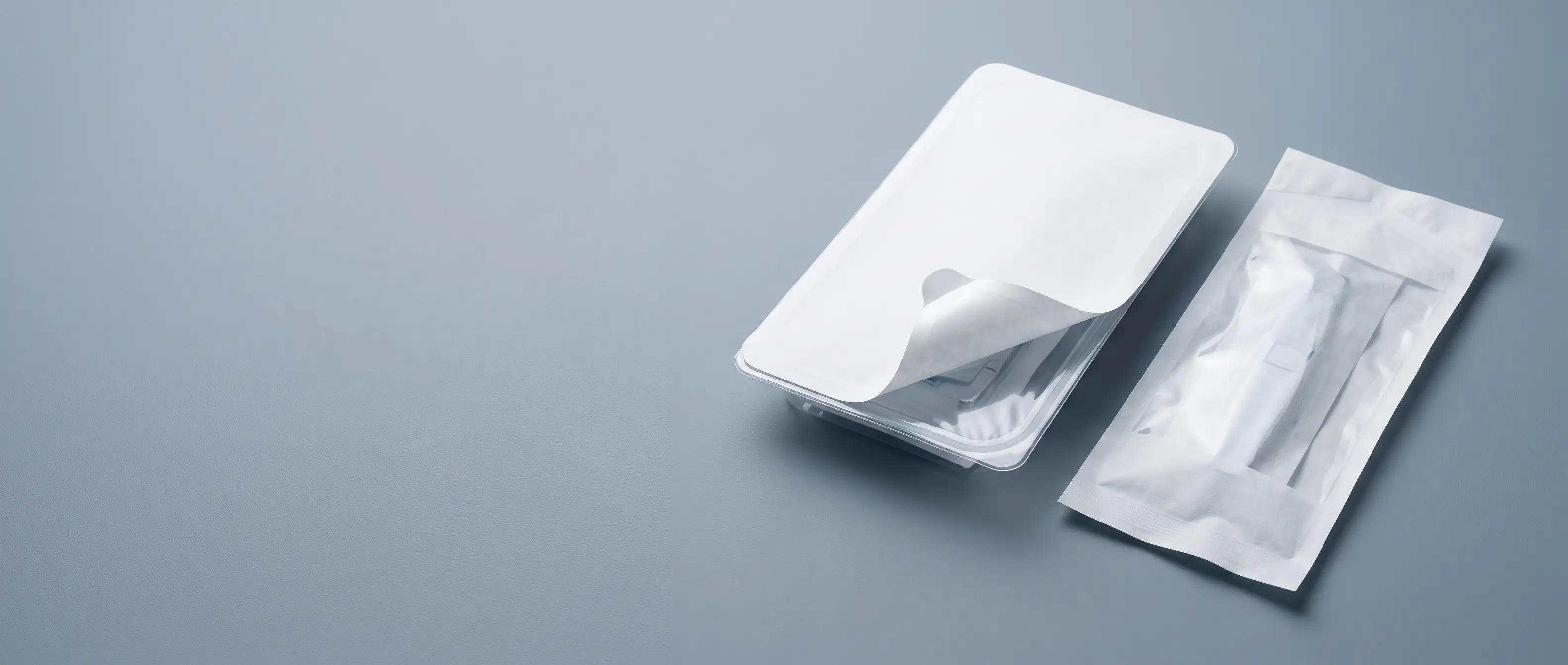
That single property is why Tyvek sits at the centre of the sterile barrier system (SBS) — the ISO 11607 concept of a package that lets a device be sterilized, keeps it sterile until use, and lets a clinician open it and present the device aseptically. A rigid device tray (usually PETG or APET) provides the cavity and barrier walls; the Tyvek lid provides the breathable, peelable top.
The second irreplaceable property is how it opens: a clean, controlled peel with no fibre tear and very low linting. Aseptic presentation — the elevated ISO 11607:2019 requirement — means a gowned clinician peels the lid and delivers the device to the sterile field without shedding fibres or tearing the barrier. Tyvek's fused continuous fibres peel away cleanly where paper would tear and shed.
Tyvek's sterilization compatibility defines its boundaries precisely. Its porosity makes it the standard for ethylene oxide (EO), and it withstands gamma and e-beam radiation well, resisting post-irradiation brittleness. What it will not do is steam autoclave: polyethylene's melting point rules out saturated-steam temperatures, so steam-sterilized products use medical papers instead. EO and radiation are Tyvek's world; steam is not.
Grades & variants
Tyvek 1073B — the heavier, tougher workhorse style, the default for demanding rigid trays, heavy or sharp devices, and applications wanting maximum puncture and tear robustness. Widely validated; the common starting point for orthopaedic and instrument trays.
Tyvek 1059B — a lighter style trading some robustness for cost and flexibility, used for lighter devices, pouches and applications where 1073B's strength exceeds the need. A frequent value-engineering choice once validation supports it.
Tyvek 2FS — a style oriented to specific sealing and processing characteristics, selected where its particular seal or handling behaviour suits the line and product.
Printed & coated variants — Tyvek supplied pre-printed (lot, device, orientation, branding) or with seal coatings matched to specific base films; the coating is often where the peelable bond is actually engineered, especially for non-standard bases.
Processing
The first thing to understand about Tyvek processing is what does not happen: Tyvek is never formed. It has no forming temperature, no draw ratio, no cavity — it unwinds flat from a reel and stays flat. All of its process discipline lives at the sealing step, where the flat lid meets a base (tray or blister) that was formed and filled elsewhere.
The peelable bond is engineered by the base, not the Tyvek. Tyvek itself is porous HDPE; it seals because the base carries a heat-seal coating (or the lid a coating matched to the base) that fuses to the Tyvek's fibre surface under heat and pressure — and crucially, fuses in a way that later peels apart cleanly without tearing the Tyvek fibres.
Base compatibility drives the recipe. Against a medical PETG tray — the industry-standard pairing — Tyvek seals in a comfortable window (broadly ~110–140 °C tool temperature as a starting point, coating-dependent); APET seals slightly cooler, PP warmer and needing a PP-compatible coating, and coated or specialty bases follow their coating's specification.
Seal quality is measured, not eyeballed. Under ISO 11607-2 the sealing process is validated (IQ/OQ/PQ) and monitored to demonstrate consistent seal strength, integrity and peelability — with peel-strength testing (ASTM F88), seal-integrity methods (dye penetration, burst) and explicit checking for fibre tear.
Applications in depth
Rigid device trays — surgical instruments, orthopaedic implants, single-use devices — are Tyvek's largest domain, and the PETG-tray-plus-Tyvek-lid pairing is close to an industry default. The tray gives the device a protective, inspectable cavity; the Tyvek gives it a sterile barrier that breathes for EO or takes radiation, then peels open cleanly in theatre.
Pre-filled syringes, catheters and single-use devices in blisters and trays use Tyvek wherever EO or radiation sterilizes the final pack. The device's own geometry — needles, sharp tips, mass — stresses the barrier, so lid toughness and seal integrity are validated against the specific device.
IVD kits and diagnostic consumables extend the same logic to diagnostics: trays and kits organising reagents, strips and devices behind a sterile, cleanly-opening barrier. Here Tyvek often shares the pack with moisture-barrier materials — a foil for moisture-sensitive contents, a Tyvek panel for sterilization breathability.
Pouches and header bags show Tyvek's flexibility literally: peel pouches with one Tyvek face, and film or foil header bags carrying a Tyvek breather panel — a porous window that lets EO sterilize a device inside an otherwise non-breathable package.
Specification
A Tyvek specification is a system specification, and it settles five things. Sterilization method first: EO mandates a porous lid (Tyvek's home); gamma and e-beam suit it well; steam rules it out entirely (specify medical paper instead). This single decision qualifies or disqualifies the material before any other choice.
Style by duty: 1073B for robust trays, heavy or sharp devices, and maximum barrier assurance; 1059B or others where the application permits value engineering — justified by validation, not assumed.
The base-and-coating pairing: the peelable bond lives in the base's seal coating against the chosen tray material (PETG standard, APET, PP-with-matched-coating), so the lid, coating and base are one specified system with one validated seal recipe. The opening performance is defined: peel-strength window, absence of fibre tear, and aseptic-presentation behaviour written as acceptance criteria under ISO 11607-2.
And the whole SBS validated as a unit: IQ/OQ/PQ on the sealing process, seal-integrity and microbial-barrier testing (ASTM F1608/F1980), accelerated aging, and change control that recognises any material substitution may trigger revalidation.
Design & tooling
Tyvek-lidded pack design is really base and seal design, since the lid is flat by nature. The formed base carries the geometry: a flat, uninterrupted seal flange sized for the sealing tool with registration tolerance, planar so the Tyvek beds evenly, and generous enough for a reliable peelable bond around the full perimeter. Flange quality is seal quality.
Design the peel from the clinician backward: a defined peel-initiation feature — a corner tab, an unsealed grip zone — so aseptic opening starts predictably and one-handed where the procedure needs it. Aseptic presentation is a design output under ISO 11607:2019, not a downstream accident.
Respect the device's assault on the barrier: sharp edges, points and mass stress the Tyvek in transit, so cavity design should immobilise and shield the device from the lid — retention features holding it away from the barrier, no sharp geometry presented at the Tyvek face.
Design for the sterilization method the pack will actually see: EO needs the breathable path unobstructed, radiation needs materials that survive the dose. Print and identify the lid deliberately — Tyvek prints well — keeping print clear of the seal area and the functional porous path.
Troubleshooting
Fibre tear on peel is the signature Tyvek defect and an aseptic-presentation failure: the lid delaminates its own fibres instead of peeling cleanly, shedding lint into the sterile field. The cause is an over-strong or wrong seal — tool too hot, dwell too long, pressure too high, or a coating mismatched to the base. Bring the seal recipe down within its validated window.
Weak seals or channel leaks are the opposite failure and a barrier breach: under-heated, under-dwelled or contaminated seals, or flange defects from the base. Audit tool temperature, pressure and dwell, then the base flange condition and cleanliness, and test integrity (dye penetration, burst) to confirm the fix.
Inconsistent peel or seal strength across the perimeter points to seal-tool or flange planarity: uneven platen temperature or pressure, or a base flange that is not coplanar. Map the seal and check flange flatness; sterile-barrier seals are validated for consistency.
Post-sterilization seal or lid changes are why the seal recipe and sterilization method are validated together. And 'Tyvek won't survive our sterilization' is usually a method error, not a material one: it means steam. Tyvek's polyethylene cannot take autoclave temperatures — that is a specification boundary, not a defect.
Barrier
Tyvek's barrier is microbial, and deliberately nothing else. Its fibre structure creates tortuous sub-microbial pathways that stop bacteria and spores cold — validated by ASTM F1608 microbial ranking — while remaining open to gas and vapour. It is, precisely, a barrier to life and a door to sterilant: the defining trade that makes a sterile-barrier system possible.
That porosity means no moisture, oxygen or light barrier whatsoever — and for sterilization that is the point, not a shortcoming. Where the device inside is moisture- or oxygen-sensitive, the pack splits the job: Tyvek provides the breathable microbial barrier for sterilization, and a separate component — a foil element, a high-barrier film — provides the environmental barrier.
The barrier's integrity is a whole-system property: the Tyvek provides microbial resistance across its face, but the sterile barrier exists only if the seal to the base is continuous and the base walls hold — which is why seal integrity, not Tyvek's intrinsic barrier, dominates validation.
Comparison
Tyvek vs medical papers is the porous-lid family's main choice: papers cost less, take print beautifully and — decisively — survive steam sterilization, which Tyvek cannot; Tyvek answers with far higher strength (wet and dry), superior puncture and tear resistance, lower linting, and better clean-peel behaviour. The sterilization method usually decides before cost does.
Tyvek vs foil lidding is the porous-versus-barrier fork: foil gives absolute moisture, oxygen and light barrier but is non-breathable, so it suits terminally radiation- or steam-sterilized products and moisture-sensitive wet devices — not EO, which needs the gas path Tyvek provides.
Tyvek vs coated-film porous lids and other nonwovens frames the alternative-porous space: various coated papers and spun materials compete on cost or specific properties, but Tyvek's decades of validation data and industry-wide change-control precedent give it a validation-gravity advantage that pure material comparison understates.
Tyvek lid vs Tyvek pouch/header-bag is a format choice within the material: rigid trays with Tyvek lids suit devices needing protective cavities; peel pouches and header bags with Tyvek panels suit flexible, lighter or awkward devices and film/foil packages needing only a breather window.
Sustainability
Tyvek's material chemistry is encouragingly simple: it is high-density polyethylene — a single, widely-recycled polymer (HDPE #2), not a laminate — and DuPont operates dedicated Tyvek recycling routes for clean, uncontaminated material. In principle, a mono-material HDPE lid is a far better circular-economy starting point than the multi-material laminates elsewhere in sterile packaging.
In practice, the medical context complicates recovery sharply: post-use sterile packaging is often contaminated, mixed, or clinical waste, and healthcare waste streams rarely capture and sort lidding for recycling — so a used clinical lid is typically not curbside-recyclable. The realistic circular opportunity is pre-use and manufacturing waste — converting offcuts, unused stock, clean take-back.
The regulatory-sustainability tension is real: sterile-barrier performance is validated and safety-critical, so material changes carry revalidation cost and risk. The EU PPWR and rising sustainability expectations push toward bio-based polyethylene and PCR-content options, but every change runs the ISO 11607 change-control gauntlet before it ships.
The honest framing: Tyvek is specified because sterility protects patients, and that function is not negotiable against packaging footprint. Within a safety-first frame, Tyvek's mono-material HDPE simplicity is a genuine, if partly latent, advantage.
What is Tyvek and why is it used for medical packaging?
Tyvek is DuPont's flash-spun high-density polyethylene nonwoven: a tough, paper-like material that is porous to sterilant gas yet a barrier to microorganisms. That combination lets a sealed package be sterilized (EO gas or radiation) and stay sterile until a clinician peels it open cleanly — the core requirement of a sterile barrier system under ISO 11607.
Is Tyvek formed like the tray?
No — Tyvek is never formed. It is a flat lid that unwinds from a reel and heat-seals to a tray or blister that was formed and filled separately. It has no forming temperature or draw ratio; all its process discipline is in the sealing step, against the base's seal coating.
What sterilization methods work with Tyvek?
EO (ethylene oxide) gas — where Tyvek's porosity is mandatory, since the gas must reach the device and residuals must escape — plus gamma and e-beam radiation, which Tyvek withstands well without post-sterilization brittleness. It does NOT survive steam autoclaving: polyethylene cannot take saturated-steam temperatures, so steam-sterilized products use medical paper instead.
What does Tyvek seal to?
To the base tray's seal coating, not to bare plastic: medical PETG is the standard pairing (with APET and PP also used), where a heat-seal coating on the tray fuses to the Tyvek fibres to give a peelable, fibre-tear-free bond. The lid, coating and base are one validated system; changing any one revalidates the seal.
Why must Tyvek peel without tearing fibres?
Because aseptic presentation depends on it: a clinician must open the pack and deliver the device to the sterile field without shedding fibres or lint. A seal that tears Tyvek's fibres on opening contaminates the field and fails an ISO 11607:2019 requirement — clean, fibre-tear-free peel is a validated acceptance criterion, not a nicety.
What is the difference between Tyvek 1073B and 1059B?
Basis weight and robustness: 1073B is the heavier, tougher workhorse for demanding rigid trays and sharp or heavy devices; 1059B is lighter, trading some strength for cost and flexibility on lighter applications. The choice is validated against the specific device and pack, not assumed — but 1073B is the common default for instruments and implants.
Does Tyvek provide a moisture or oxygen barrier?
No — and deliberately so. Its porosity, essential for sterilization, means no moisture, oxygen or light barrier at all. Moisture- or oxygen-sensitive devices use a split design: Tyvek for the breathable microbial barrier and sterilization path, plus a separate foil or high-barrier component for the environmental barrier — often as a header bag with a Tyvek breather panel.
Can Tyvek be re-sterilized?
Tyvek itself withstands re-sterilization by gas (EO) or radiation and stays flexible with an intact microbial barrier — but the device inside may not tolerate re-sterilization, which is usually the limiting factor. Re-sterilization is a device-and-pack validation question, not a Tyvek limitation; the lid is typically the robust part.
Why did my Tyvek lids tear fibres when peeled?
The seal is too strong or mismatched: tool too hot, dwell too long, excessive pressure, or a seal coating wrong for the base. Bring the recipe back within its validated window and confirm the coating-base pairing. A correct Tyvek seal peels cleanly; fibre tear means the bond beat the fibres, which is an aseptic-presentation failure to correct at the seal, not the lid.
Is Tyvek compliant with ISO 11607?
Tyvek is the most widely validated porous lidding material under ISO 11607, but compliance belongs to the whole sterile barrier system — lid, base, seal, sterilization and opening — validated via IQ/OQ/PQ under ISO 11607-2, with seal-integrity, microbial-barrier (ASTM F1608) and aging (ASTM F1980) testing. The material enables compliance; the validated system achieves it.
Is Tyvek recyclable?
Chemically yes — it is mono-material HDPE (#2), not a laminate, and DuPont runs dedicated recycling routes for clean material, which makes manufacturing offcuts and unused stock genuinely recyclable. Post-clinical-use recovery is the hard part: sterile packaging waste is often contaminated or mixed clinical waste that healthcare systems rarely sort for recycling, so a used clinical lid is typically not curbside-recyclable.
When should I choose medical paper over Tyvek?
Chiefly when the sterilization method is steam autoclave, which Tyvek cannot survive but medical papers can — and where cost and printability lead and the application does not need Tyvek's superior strength, puncture resistance, low linting and clean-peel performance. The sterilization method is usually the deciding factor, before cost.
What gauge or style is typical for medical device trays?
Tyvek 1073B is the common default for demanding rigid instrument and implant trays, where its strength and puncture resistance protect the barrier through handling and transit; 1059B is chosen for lighter devices and smaller packs once validation supports it. Style is always validated against the specific device and pack rather than assumed.
Does Tyvek need drying before sealing?
No — unlike hygroscopic forming films, Tyvek is HDPE and does not require pre-seal drying. Its discipline is at the seal itself: tool temperature, pressure and dwell tuned to the base's seal coating, kept within the validated window and stored clean and dry so the fibre surface stays fit for a fibre-tear-free bond.
Is medical Tyvek the same as the Tyvek used for envelopes or wristbands?
It is the same flash-spun HDPE technology, but not the same product. Medical grades like 1073B, 1059B and 2FS are manufactured, tested and released to controlled specifications for sterile barrier use under ISO 11607 — with microbial-barrier, seal and aging data behind them. Consumer Tyvek (envelopes, wraps, wristbands) carries none of that medical validation and must never be substituted.