Polystyrene: the easy-forming, low-cost commodity under pressure
Polystyrene has been a packaging staple for decades on the strength of three things: it is cheap, it forms exceptionally easily, and it comes in two complementary flavours — crystal-clear general-purpose PS (GPPS) for see-through blisters, and tough, opaque high-impact PS (HIPS) for trays and cups. As an amorphous polymer it softens gradually over a wide temperature range, giving it one of the most forgiving forming windows of any material and a natural fit for high-speed form-fill-seal lines such as those used for dairy.
PS has two useful technical strengths worth calling out: it forms with low scrap on fast lines, and it resists gamma and E-beam sterilization without embrittling — a genuine advantage for single-use medical trays where some other plastics degrade under irradiation. Its weaknesses are increasingly decisive, though. Polystyrene is a poor barrier to both oxygen and moisture, has low heat resistance (it softens well below boiling and cannot be used hot), and — most importantly today — carries a poor sustainability profile: resin code #6, very low recycling rates, and outright bans on foamed and single-use foodservice PS in a growing number of jurisdictions. For new food packaging, PP has been steadily displacing PS in exactly the thin-walled applications PS once owned.
Polystyrene grades: GPPS, HIPS and foamed PS
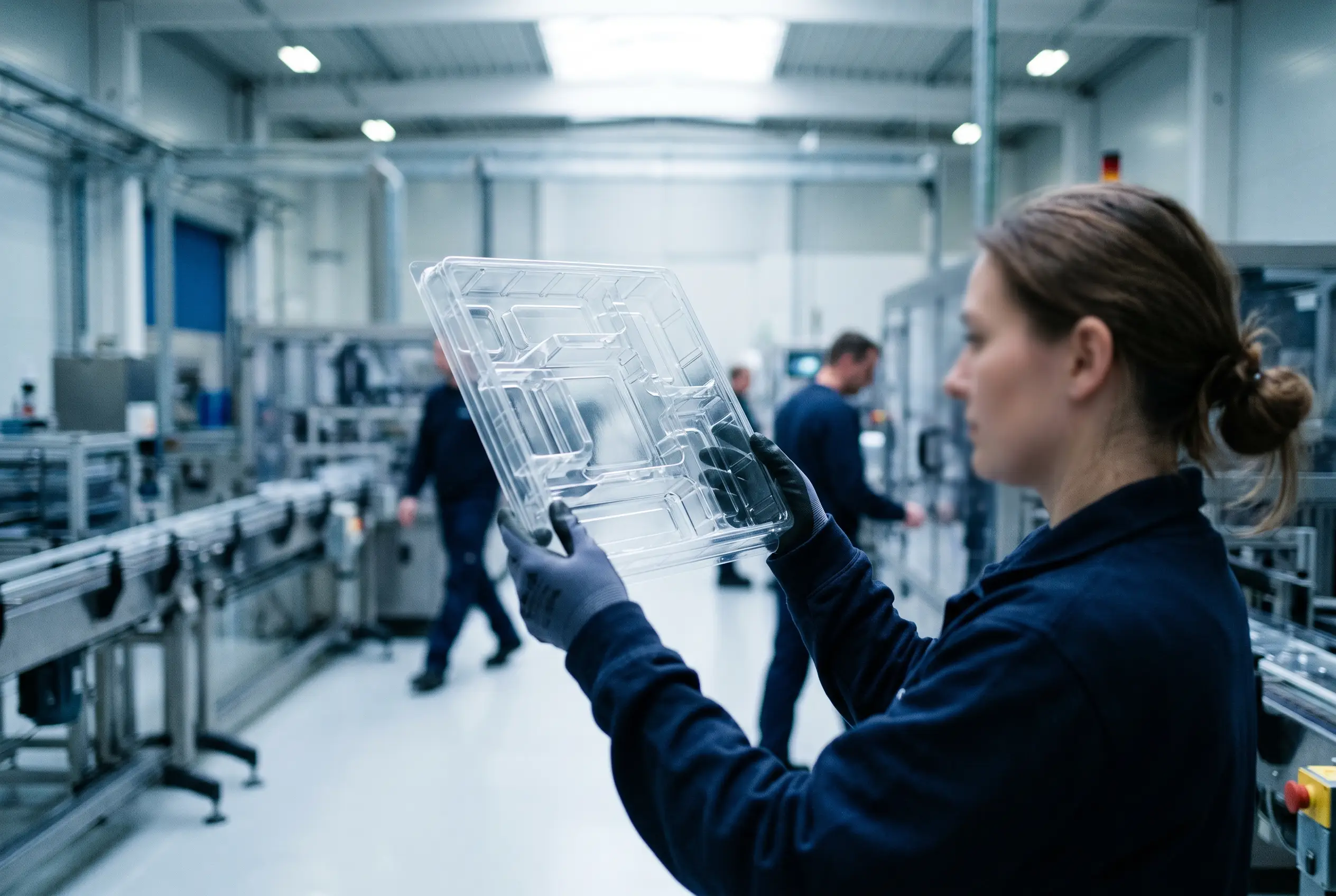
GPPS / crystal PS (general-purpose) is transparent, rigid and glossy, with clarity that suits see-through blisters, clamshells and display packaging. Its weakness is brittleness — it cracks under impact — so it is used where clarity matters more than toughness and the pack is not heavily stressed.
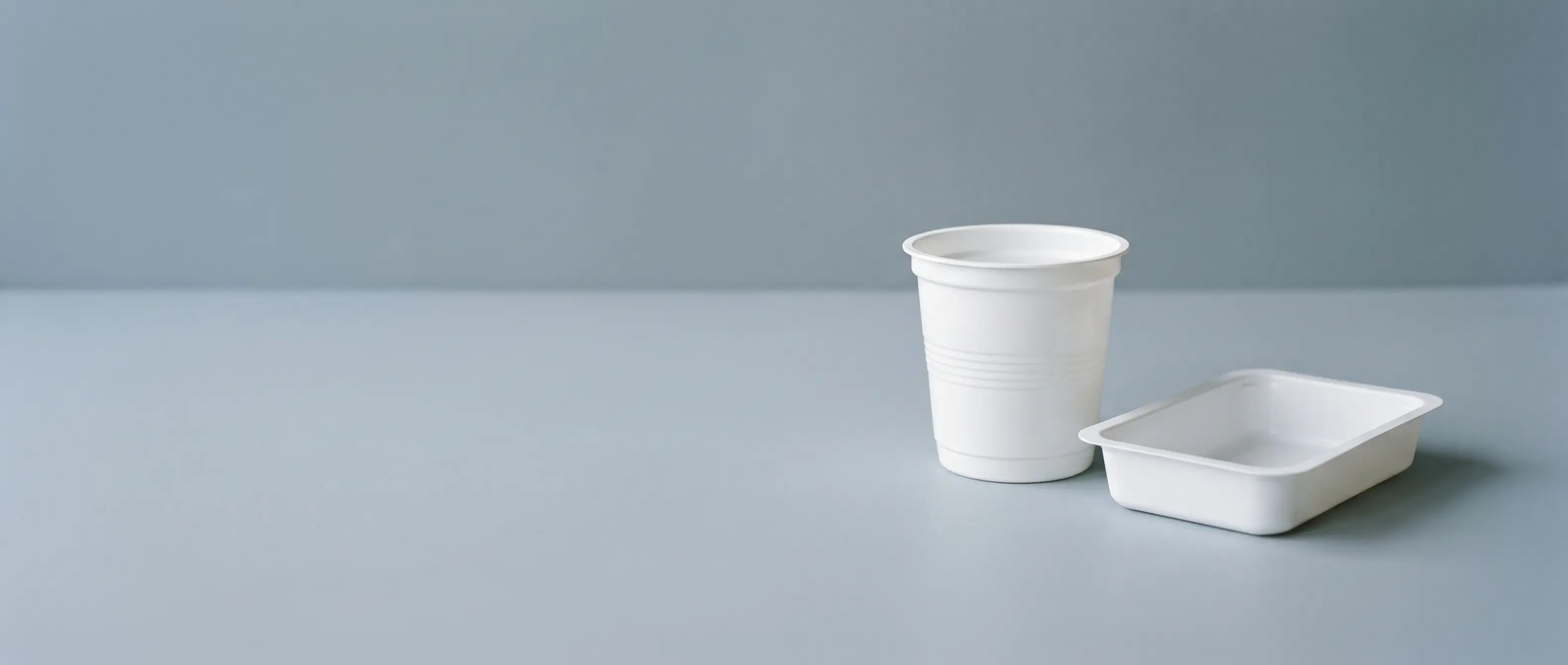
HIPS (high-impact PS) is polystyrene toughened with dispersed butadiene rubber (typically ~5–15%), giving much better impact resistance and deep-draw formability at the cost of transparency (it is opaque). HIPS is the standard thermoforming grade for trays, cups, liners and food packaging where toughness and a clean printable surface matter.
Foamed / expanded PS (EPS, XPS) is cellular polystyrene used for insulating and cushioning foodservice items — cups, clamshells, trays. It is light and thermally insulating, but foamed single-use PS is the specific target of many foodservice bans, and its use is contracting sharply for regulatory reasons.
Food-grade and filled grades round out the family: FDA-compliant PS grades meet food-contact requirements, while mineral-filled HIPS (with calcium carbonate) cuts cost and stiffens the material for single-use trays. Recycled HIPS blends are increasingly offered, though PS recycling infrastructure remains limited.
Styrene-butadiene copolymers (SBC / K-resin) are the clarity-plus-toughness compromise of the styrenics family: transparent like GPPS but markedly tougher, used where a clear pack must survive more handling than GPPS tolerates and PETG's price is not justified. SBC also blends with GPPS to tune the clarity–toughness balance point by point.
PS forming temperature and its wide, forgiving window
Polystyrene is, along with PVC, one of the two easiest materials to thermoform, and for the same reason: it is amorphous, so it softens progressively as it heats rather than collapsing over a narrow range. That gives it a wide forming window — on the order of 30 °C or more, against roughly 10–20 °C for semi-crystalline PP — and makes it forgiving of small temperature variations across the sheet. Typical HIPS forming-surface temperatures land around 140–180 °C depending on gauge, with short heating times.
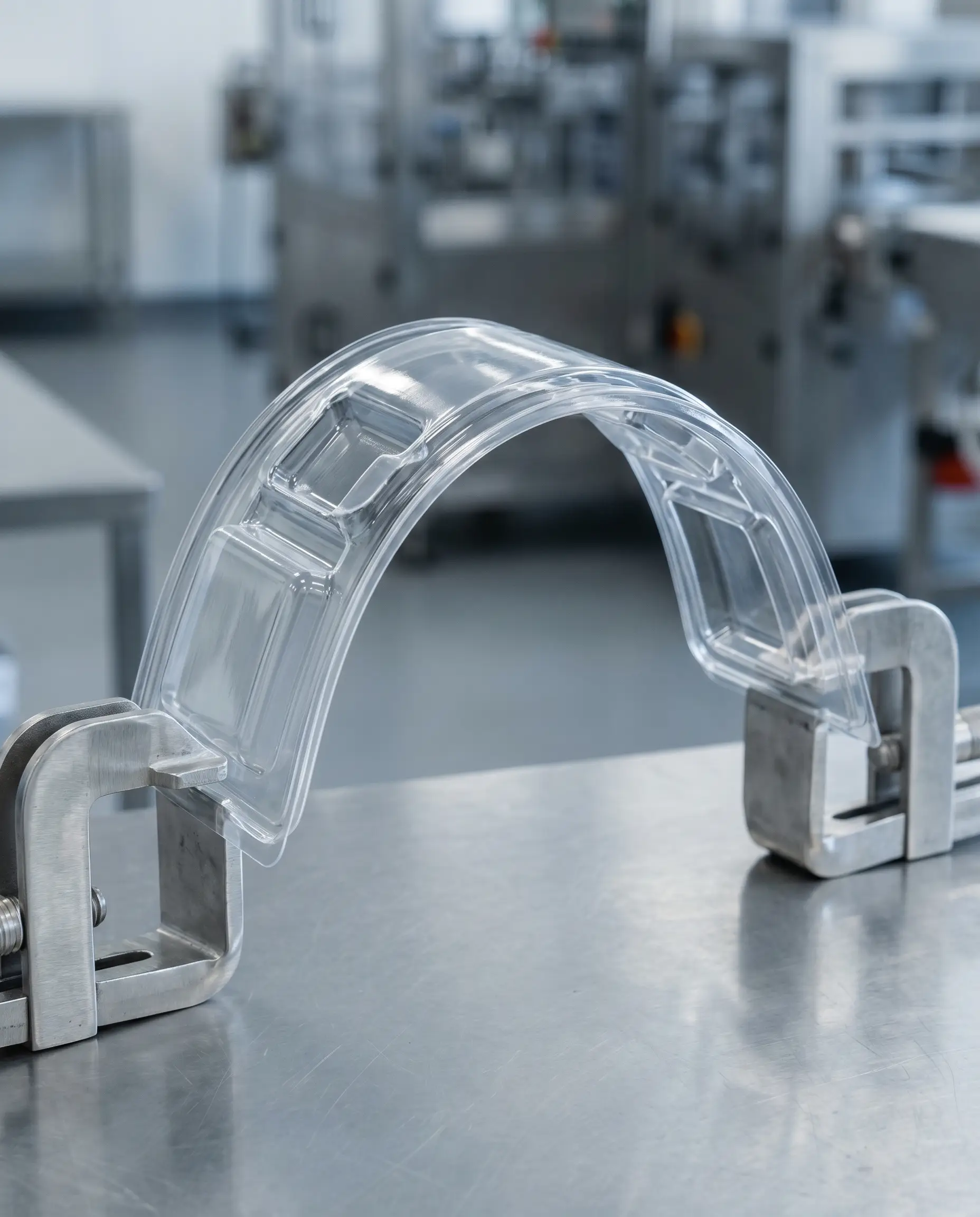
On InnovaPax equipment, precut PS sheet is loaded, heated from the top, and formed with pressure from above plus vacuum from below. That wide window is exactly why PS dominates high-speed form-fill-seal dairy and dessert lines: the process runs fast and stable, tolerates minor variation, and produces clean parts with low scrap. HIPS in particular flows into mould detail extremely well and holds sharp lines, which is why it is the global standard for refrigerator liners as well as food trays. Good hot strength and low internal stress after forming mean parts hold their shape and tolerance well.
Polystyrene generally does not require pre-drying under normal storage conditions, unlike hygroscopic PET — another processing convenience — though high-recycled-content or poorly-stored sheet may need it. Plug assist follows the usual pattern: optional for shallow cavities thanks to the forgiving window, recommended for medium draws, and required for deep-draw HIPS parts to keep walls even. Because PS forms so readily, it handles deep and complex geometries well when properly plug-assisted.
The one genuine processing limitation is heat: PS has low heat resistance, so parts cannot be used hot and the formed product must stay well below its softening point in service. Within its cool-to-ambient operating range, though, PS is one of the most production-friendly and cost-effective forming films available.
One line-level note: PS's trim behaviour rewards investment. Because the material chips rather than shears when dies dull, high-volume PS lines schedule die maintenance as a quality control, not a repair; the payback is clean edges, no dust contamination and stable weights. It is the cheapest quality lever on a PS line and the most commonly neglected.
Where PS still runs: applications in depth
Polystyrene's applications sort cleanly by grade and by what the product asks of the pack. GPPS goes where clarity leads and toughness is not demanded; HIPS goes where toughness, rigidity and a printable surface matter and opacity is fine; and both go where cost and forming ease dominate over barrier and heat resistance.
Dairy & dessert cups — Yogurt, pudding and dessert cups on high-speed form-fill-seal lines — PS's wide window suits fast, continuous forming. Meat & poultry trays — HIPS trays for fresh meat and poultry — rigid, tough and dimensionally stable with a clean, printable surface. Clear retail blisters (GPPS) — General-purpose polystyrene gives crystal-clear blisters and clamshells for display of consumer goods. Gamma-sterilized medical trays — PS resists gamma and E-beam sterilization without embrittling, suiting single-use medical trays.
High-speed dairy FFS is polystyrene's remaining stronghold and a masterclass in fit: the wide forming window tolerates the thermal chaos of a machine forming, filling and sealing in one continuous motion; no-drying convenience keeps changeovers fast; low, isotropic shrinkage holds tight cup-lid-and-print registration; and the sheet price anchors the lowest cost-per-cup in packaging. Fresh-protein HIPS trays exploit toughness and a clean surface for short-shelf-life product where barrier hardly matters; clear GPPS display blisters persist where the pack is pure presentation; and gamma-sterilized medical disposables are PS's most defensible technical niche, because radiation resistance is a property argument, not a cost argument.
PS troubleshooting: cracking, dust and warp
Cracking and splitting at corners or radii is the classic GPPS failure — a brittle material given a stress concentration. If cracks appear in forming, the sheet is likely too cold in that zone or the radius too tight; if they appear later in handling or transit, the design is concentrating stress. The fixes, in order: form warmer and more evenly, open the radii, and — if the application genuinely needs toughness — move to HIPS or PETG rather than fighting GPPS's nature.
Dust and angel hair at trimming comes from PS chipping rather than shearing at the die. Blunt dies are the usual culprit; PS punishes them faster than tougher materials. Sharp, well-maintained dies, correct clearances and a supported trim line eliminate most of it. Persistent dust contaminating food lines is a die-maintenance schedule problem, not a material defect.
Warp from uneven cooling shows in PS as bowed flat panels or ovaled cup rims — amorphous materials warp less than PP, but fast asymmetric cooling still locks in stress. Even cooling and adequate in-tool time straighten it out; a rim that measures round warm and oval cold is asymmetric cooling, not tooling error.
Pinholes or splits in deep-draw thin areas mean the draw exceeded the material distribution — even forgiving HIPS thins eventually. Add plug assist, redistribute depth, or increase gauge. In FFS cup production this shows as sporadic leakers; treat any leaker rate change as a heating-profile or plug question first.
Gloss variation or dull patches trace to uneven sheet temperature or tool surface condition: hot zones gloss, cold zones matte, and plate-out on the tool prints as dullness. An even heat profile and clean tooling restore uniform finish — cosmetics matter in retail-facing GPPS blisters, where a dull patch reads as damage.
PS barrier: weak, suited to dry and short-shelf-life use
Polystyrene is an honest performer here in the sense that no one specifies it for barrier: plain PS is a poor barrier to both oxygen and moisture. For its core applications that is acceptable, because those products either have short shelf lives, are consumed quickly, or do not depend on the pack for shelf-life extension — a dessert cup, a display blister or a same-day meat tray does not need a high barrier.
Where a longer shelf life or moisture protection is genuinely needed, PS is either laminated with a barrier layer (for example a co-extruded EVOH or a barrier film) or simply replaced by a material with an inherently better barrier — most often PP, which offers a far superior moisture barrier along with heat resistance. This substitution is a large part of why PP has eroded PS's share of thin-walled food packaging over the last two decades.
The practical guidance is straightforward: use PS where its low cost and easy forming lead and barrier is not a requirement; do not try to force PS into long-shelf-life or moisture-sensitive roles where a laminate would be needed and the sustainability penalty compounds — in those cases another material is usually the better and cleaner answer.
PS recyclability and foodservice bans
Sustainability is polystyrene's greatest weakness and the main force shrinking its role. PS carries resin identification code #6, but in practice it is recycled at very low rates — well under a few percent globally — because collection is limited, foamed PS is bulky and low-value to transport, and contamination is common. Under the PPWR's grading of packaging by recyclability, PS sits firmly on the disadvantaged side.
On top of poor recycling, foamed and single-use foodservice polystyrene faces outright bans in a growing number of jurisdictions, targeting exactly the cups, clamshells and trays that were long PS's core market. This regulatory pressure, more than any technical shortcoming, is what makes PS a declining choice for new foodservice and food-packaging development.
There is a modest counter-current: recycled-HIPS blends are increasingly offered for non-cosmetic and industrial packaging, and closed-loop schemes exist in some regions. But these do not change the overall trajectory. For new packaging — particularly food and foodservice, and particularly in the EU — the prudent path is to treat PS as a legacy material and design toward PP, PET or fibre alternatives unless a specific niche genuinely calls for it.
One development worth tracking: advanced (chemical) recycling of polystyrene — depolymerisation back to styrene monomer — is technically elegant because PS unzips to its monomer more readily than most plastics, and pilot capacity is growing. If it scales, PS's recyclability story could improve meaningfully; until it does at commercial volume, specifications should be written against today's low mechanical-recycling reality rather than tomorrow's promise.
Specifying PS: the decisions that matter
A polystyrene specification stands or falls on four calls. GPPS or HIPS is the first and largest: clarity versus toughness, decided by whether the pack displays or protects — and any application that needs both should trigger the PETG question instead. Gauge and rim design together come second: PS parts get their strength from geometry, so the rolled rim, the sidewall profile and the gauge are one decision, not three.
The regulatory horizon is the third: confirm the target markets' foodservice-PS status and the customer's own packaging commitments before tooling, because a PS format designed today must survive its own commercial lifetime. And the line economics close it: PS's case is strongest on high-speed FFS with its no-drying, wide-window, tight-tolerance advantages — a specification that cannot point to those line economics is usually a specification that should be PP.
Design follows the grade's fracture behaviour. GPPS is brittle, so sharp corners, thin webs and stress concentrations become crack initiation sites — generous radii everywhere, no sharp internal corners and conservative draw depths keep clear parts alive; HIPS, with its rubber phase, forgives far more but still rewards radii. PS's low, isotropic shrinkage is a genuine design asset that lets mating features — cup-and-lid fits, tamper rings, stacking registers — be dimensioned with confidence, and it is a quiet reason PS survives on precision high-speed lines.
Written against those four questions, PS remains a defensible, sharp-pencilled choice in its niches: the fastest dairy lines, the clearest low-stress blisters, the gamma-sterilized tray. Written on habit, it is the material most likely to need redesigning mid-life — which is the expensive way to learn what the specification should have said.
PS vs PP vs PET for thermoformed packaging
PS vs PP vs PET for thermoformed packaging. PS vs PP is the substitution that has reshaped thin-walled food packaging: PS is cheaper and easier to form with a wider window, while PP offers a far better moisture barrier, real heat resistance (microwave and hot-fill), and a much stronger recyclability and regulatory profile. For dairy tubs, deli containers and anything that might be warmed, PP has steadily replaced PS; PS holds on mainly where cost and forming ease dominate and neither barrier nor heat resistance matters. PS vs PET frames the clear-packaging decision: GPPS and PET both offer transparency, but PET wins decisively on toughness (GPPS is brittle), barrier, and — critically — recyclability, since PET has an established mono-material recycling stream and PS effectively does not; HIPS competes with PET on toughness for opaque trays but again loses on barrier and sustainability. Where clarity plus recyclability is required, PET is the stronger choice. Where PS still wins is a short, honest list: high-speed, low-cost dairy and dessert FFS lines where its wide window and price lead; clear, low-stress display blisters in GPPS; and gamma-sterilized single-use medical trays, where PS's radiation resistance is a real property argument rather than a cost argument. Outside those niches, the combination of poor barrier, low heat resistance and weak recyclability increasingly pushes new development toward PP and PET — and, for protein trays and foodservice under plastic-ban pressure, toward moulded fibre regardless of the technical scorecard.
What is the difference between GPPS and HIPS?
GPPS (general-purpose or crystal polystyrene) is transparent, rigid and glossy but brittle — used for clear blisters and display packaging. HIPS (high-impact polystyrene) is GPPS toughened with dispersed butadiene rubber, giving much better impact resistance and deep-draw formability, but it is opaque — used for trays, cups and liners. The choice comes down to clarity versus toughness.
Why is polystyrene so easy to thermoform?
PS is an amorphous polymer, so it softens gradually as it heats rather than collapsing over a narrow range. This gives it a wide, forgiving forming window (around 30 °C or more) and makes it ideal for fast, continuous form-fill-seal lines — the opposite of semi-crystalline PP, which has a much narrower window.
What is the forming temperature of HIPS?
Typically a sheet-surface temperature around 140–180 °C, depending on gauge and forming method, with short heating times. The wide window makes exact temperature less critical than with PP. Treat any figure as a starting range and fine-tune on your line.
Can polystyrene be sterilized?
Yes — PS is resistant to gamma and E-beam (radiation) sterilization without embrittling, which is a real advantage for single-use medical trays. It cannot be steam sterilized, however, because its low heat resistance means it softens well below steam temperatures.
Does polystyrene have a good barrier?
No — plain PS is a poor barrier to both oxygen and moisture. It suits products with short shelf lives or that do not depend on the pack for protection. For longer shelf life or moisture-sensitive foods, PS must be laminated with a barrier layer or, more often, replaced by a material like PP with a better inherent barrier.
Is polystyrene recyclable?
In principle PS carries resin code #6, but in practice it is recycled at very low rates globally due to limited collection, low value and contamination. This poor recyclability, together with bans on foamed and single-use foodservice PS in many regions, is the main reason PS is declining for new food packaging.
Why is PP replacing polystyrene?
PP offers a far better moisture barrier, real heat resistance (microwave and hot-fill), and a much stronger recyclability and regulatory profile, while remaining cost-competitive. For dairy tubs, deli containers and anything that might be warmed or needs shelf life, PP has steadily displaced PS in thin-walled food packaging.
Is polystyrene safe for food contact?
Yes — FDA-compliant PS grades are widely used and accepted for food contact, appearing in yogurt cups, meat trays, dessert pots and cutlery. Its limitations are barrier, heat resistance and sustainability, not contact safety in food-grade form.
What tolerances can thermoformed PS hold?
Tight ones, by thermoforming standards. PS's low, isotropic shrinkage means tooling translates predictably to parts, so mating features like cup-and-lid fits, tamper rings and stacking registers hold their dimensions reliably — a key reason PS persists on precision high-speed FFS lines. Validate on fully cooled parts as always.
How do I stop GPPS blisters cracking?
Attack it in order: form warmer with an even heat profile (cold zones take stress), open corner radii (sharp corners are crack initiators in a brittle material), and keep draw depths conservative. If the application genuinely needs impact toughness, switch to HIPS (opaque) or PETG (clear) rather than fighting GPPS's brittle nature.
What gauge does a typical PS dairy cup use?
High-speed FFS dairy cups run remarkably light — commonly in the region of 0.6–1.0 mm sheet formed into cups whose rolled rim and sidewall geometry, more than raw gauge, provide the stacking strength. The economics of PS FFS live in that light gauge; geometry does the structural work so material does not have to.
Is HIPS suitable for freezer applications?
Moderately — HIPS keeps useful toughness at refrigeration temperatures and shallow-freeze conditions, which suits ice-cream formats and chilled distribution, but it becomes progressively more brittle in deep-freeze rough handling, where HDPE or impact-copolymer PP hold toughness better. For hard freezer duty with real drop risk, test HIPS at temperature before committing.