PP packaging: the lightweight, heat-resistant workhorse
Polypropylene has quietly become one of the most important forming films in packaging. Its appeal is a specific, valuable combination: it is the lightest of the common films (~0.90 g/cm³), it resists heat well enough to go into a microwave or take a hot fill, it shrugs off grease and chemicals, and it offers an excellent moisture barrier — all at a competitive material cost.
The honest trade-offs: PP forms inside a narrow ~10–20 °C window and sags readily, so it demands temperature precision and plug assist; it is naturally hazier than PET; and its oxygen barrier is only moderate, often needing an EVOH layer for long shelf life. But it is a genuine mono-material — resin code #5 with an established recycling stream — and its low density yields more packs per kilo than any other common forming film.
PP grades: homopolymer, random and impact copolymer
Homopolymer PP is the stiffest and most heat-resistant grade, and the natural choice for hot-fill and microwaveable packaging where rigidity and temperature resistance matter most — the workhorse for rigid tubs and trays that must hold shape when warm.
Random copolymer PP is modified for better clarity and a softer, more forgiving character, chosen when transparency matters — see-through tubs and lids where a homopolymer’s haze would hurt shelf appeal. Modern clarified random-copolymer grades approach the transparency once reserved for PS and PET.
Impact copolymer PP is toughened for durability across a wide temperature range, suiting freezer-to-microwave applications where the pack must survive both deep cold and reheating without cracking — it trades some clarity for resilience.
rPP (recycled PP) carries post-consumer recycled content. Food-grade rPP is less mature than food-grade rPET because PP decontamination is more challenging, so recycled content is often blended with virgin PP to hit both the recycled-content target and the mechanical demands of thermoforming. The supply is developing rapidly under regulatory pressure.
PP forming temperature and the narrow window
The defining fact about forming PP is its narrow forming window. As a semi-crystalline polymer, PP stays relatively stiff as it heats until it approaches its crystalline melting point (around 160–165 °C), then softens rapidly over a small temperature range. The usable forming zone — hot enough to draw, not so hot that it sags — is only about 10–20 °C wide, roughly half the window of PS or PET. Typical forming-surface temperatures land around 150–165 °C, adjusted for gauge, and should be treated as a starting range to dial in on the line.
The practical consequence of that narrow window is that heating control is everything. An uneven temperature profile across the sheet, or a slightly-too-hot zone, tips PP straight into sag — the material’s low melt strength lets it droop under its own weight, producing uneven walls, thinning and, at worst, tearing. Zoned, well-controlled heating and consistent dwell times are not optional refinements with PP; they are the difference between a good part and a scrapped one.
Plug assist is close to mandatory for anything but the shallowest PP cavities. Because PP sags and thins so readily, a plug mechanically pre-stretches and guides the softened sheet into the cavity, distributing the material evenly before final forming. Without it, deep or complex PP parts develop dangerously thin floors and corners.
Grade selection also eases processing: standard PP’s low melt strength can be improved with dedicated high-melt-strength thermoforming grades (some using long-chain branching), which sag less and widen the effective window. PP’s tight windows and controlled cooling for crystallisation mean its cycle times run somewhat longer than PS’s — the compensations are material yield (density) and part performance, and high-volume PP lines win on total cost per delivered pack rather than raw cycle count.
Where PP earns its place: applications in depth
PP is the default forming film wherever heat, weight or grease resistance lead the requirements, and its applications all share a common thread: they need at least one PP-specific virtue that the amorphous alternatives cannot offer.
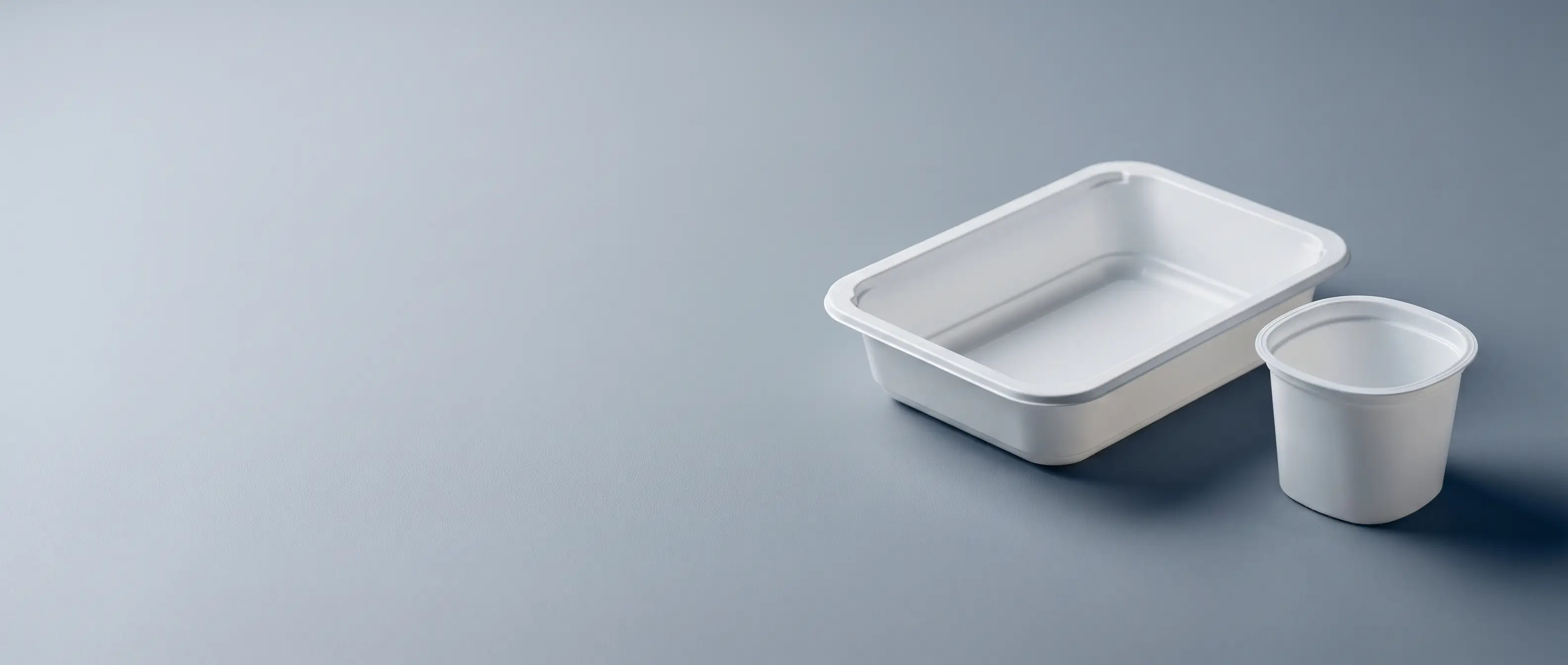
Dairy & deli tubs — Yogurt, spreads, dips and deli tubs — PP’s grease resistance and moisture barrier suit fatty, wet foods. Microwaveable meal trays — Ready-meal and hot-fill trays — PP’s heat resistance lets it go into the microwave where PET cannot. Freezer-to-microwave packs — Impact-copolymer PP survives freezer temperatures and reheating in the same pack. Medical & industrial trays — Autoclavable and chemically resistant trays for medical and industrial parts.
Dairy and deli is PP's home turf because every property advantage is active at once — grease resistance, moisture barrier, heat resistance and low shipping weight. Microwaveable meal trays are the application PP owns almost outright, combining freezer survival, microwave reheating and greasy contents. Medical and industrial trays exploit autoclavability — one of the few forming films that tolerates steam sterilization. The honest boundary is clarity and oxygen: where the pack must showcase the product with glass-like transparency, or where oxygen-sensitive shelf life governs, PET (or PP/EVOH) reopens the comparison.
Specifying PP: the decisions that matter
Specifying PP well comes down to five decisions taken in order. First, grade by duty: homopolymer for heat and stiffness, random copolymer where clarity sells, impact copolymer for freezer and rough handling — the single most consequential line on the specification, because no process setting converts one grade's behaviour into another's.
Second, gauge by mechanics, not habit: PP's density advantage only cashes if gauge is engineered to the stacking and handling loads rather than copied from the PET part it replaces. Third, barrier honestly: state the product's real oxygen sensitivity and shelf-life target, and only specify the EVOH co-extrusion if the data demands it — mono-PP keeps the recyclability grade and the cost down.
Fourth, the lidding system as part of the material: PP seals to PP-compatible sealant layers, so the lid film specification belongs in the same decision as the tray. Fifth, recycled content with eyes open: name the rPP percentage and the mechanical properties it must still meet, because recycled blends vary more than virgin and thermoforming exposes the variation. A specification written this way — grade, gauge, barrier, lid, recyclate, each justified by the product rather than by precedent — is what lets PP deliver its total-cost promise.
Designing PP parts: shrinkage, hinges and stiffness
The first number to respect in PP part design is shrinkage. As a semi-crystalline polymer, PP shrinks substantially and somewhat directionally as it crystallises on cooling — typically 1.5–2%, several times more than amorphous PET or PS. Tooling must be cut with that allowance built in, and tight-tolerance features should not span large distances; put critical dimensions on short, well-controlled features rather than across the full footprint.
Radii and draw distribution matter more in PP than in forgiving amorphous materials. Because the softened sheet sags and thins readily, sharp corners concentrate thinning into exactly the places that need strength; generous corner and edge radii (several times the gauge) spread the material and preserve wall thickness. Distribute cavity depth across the footprint where the design allows.
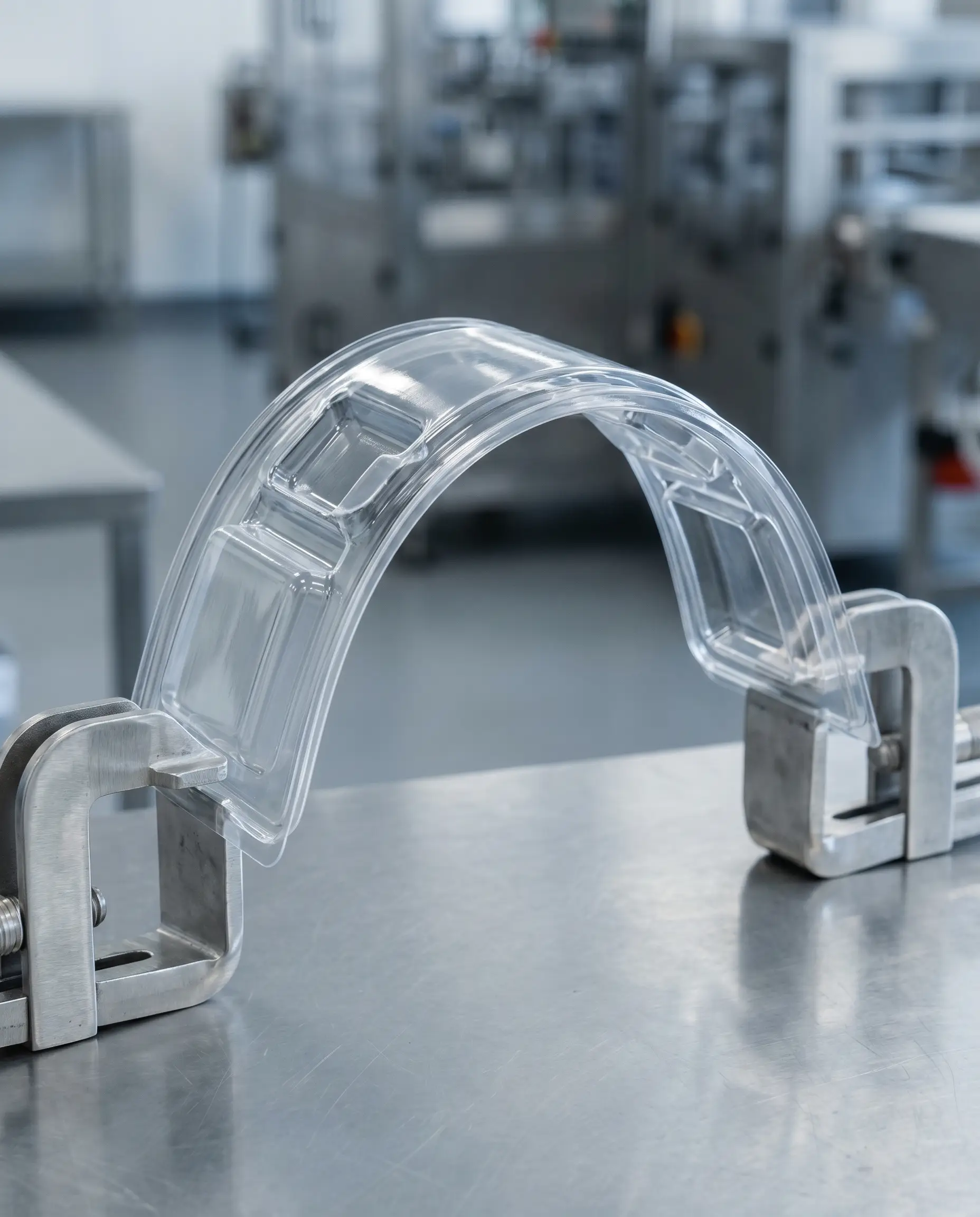
PP offers one design feature no other common forming film does: the living hinge. Its fatigue resistance lets a thinned hinge line survive thousands of flex cycles, enabling one-piece clamshells with integral lids. Hinge lines should run with controlled, even thickness. For stiffness at light gauge, use geometry rather than material — ribs, steps, corrugations and domed panels stiffen a PP part far more economically than adding gauge, and PP's low-friction surface actually helps denesting with a small deliberate denest step.
PP troubleshooting: sag, warp and uneven walls
Sheet sag during heating is PP’s signature problem — the material’s low melt strength lets the softened sheet droop under its own weight, and the narrow window means the line between properly softened and sagging is thin. Fixes, in order: verify zoned heating is even and not overshooting; shorten dwell at temperature; and if sag persists at correct temperature, move to a high-melt-strength (HMS) thermoforming grade designed precisely to resist it. Chasing sag by simply lowering temperature usually just trades it for poor detail.
Uneven wall thickness almost always traces to one of two causes: an uneven temperature profile across the sheet (hot zones thin first), or a draw performed without adequate plug assist. Map sheet temperature with an IR reading across zones before blaming the tool — a 10 °C difference across a PP sheet is enough to shift material distribution visibly — then confirm the plug geometry actually pre-stretches the area that is thinning.
Warp and dimensional drift come from PP’s crystallisation: uneven or too-fast cooling locks in differential shrinkage that releases as warp. Slow, even cooling and patience before trimming stabilises geometry; dimensions that measure correctly warm and wrong cold mean the shrink allowance in the tool is off. Thin or split floors in deep cavities mean the plug is not doing its job — wrong shape, wrong timing, or absent.
Cold brittleness in service — parts cracking in freezer distribution — is a grade problem, not a process problem: homopolymer PP embrittles at low temperature, so switch to an impact copolymer for cold-chain use. Poor detail reproduction (soft radii, unfilled features) means the sheet was formed too cold or pressure was insufficient; PP rewards forming at the upper safe end of its window with full pressure-plus-vacuum, and the HMS-grade route breaks the timid-temperature-versus-lost-detail trade-off.
PP barrier: strong on moisture, weaker on oxygen
PP’s barrier profile is almost the mirror image of what most people expect. On moisture, PP is excellent — one of the best moisture barriers among common forming films, a major reason it suits wet and humid foods so well. On oxygen, however, PP is only a moderate-to-low barrier, weaker than PET, which limits plain PP for oxygen-sensitive products that need a long shelf life.
The standard solution is a co-extruded EVOH layer, producing a PP/EVOH/PP structure that keeps PP’s moisture strength while adding a strong oxygen barrier for MAP and extended-shelf-life foods. The trade-off is a second material in the structure, which complicates recyclability — a tension the industry is actively working, since recyclability guidelines increasingly limit how much EVOH a nominally recyclable PP pack may contain.
The honest engineering summary is to match the structure to the shelf-life demand: use mono-PP where its excellent moisture barrier suffices, and add an EVOH layer only when oxygen sensitivity genuinely requires it — keeping the multi-material penalty for the cases that earn it.
PP recyclability, rPP and the PPWR
As a genuine mono-material with resin identification code #5 and an established recycling stream, PP is well-positioned under the PPWR’s drive toward recyclable single-polymer design. A mono-PP tub or tray is recyclable, and keeping PP packaging as a single polymer rather than adding barrier layers or dissimilar materials preserves that advantage and the favourable recyclability grade that comes with it.
PP’s relative challenge versus PET is recycled content. The PPWR sets rising recycled-content minimums, and food-grade recycled PP is less developed than food-grade rPET: PP’s varied waste stream and more difficult decontamination make food-contact rPP harder to produce and validate. In practice this is often handled by blending intermediate-performance recyclate with high-quality virgin PP to meet both the recycled-content target and the mechanical demands of thermoforming.
The design guidance is consistent: keep PP mono-material wherever the application allows, reserve EVOH and other barrier additions for products that genuinely need them, and track the maturing rPP supply so recycled-content obligations can be met as the 2030 minimums approach. Done this way, PP is a strong sustainability performer whose main gap — recycled content — is closing.
PP vs PET vs PVC for thermoformed packaging
PP vs PET is the most common, most application-driven choice in food packaging. PP wins decisively on heat resistance (microwave and hot-fill), weight (it is significantly lighter), moisture barrier and grease resistance; PET wins on clarity (PP is naturally hazier, though clarified grades close the gap), oxygen barrier, forming ease (PET’s wider window is more forgiving), and recycled-content maturity. The rule of thumb: choose PP when the product sees heat, grease or needs to be light; choose PET when clarity and oxygen barrier lead and the pack stays cool — neither is universally better. PP vs PVC is the clear modern choice over PVC for most new work: PVC forms more easily with a wider window and lower cost, but it carries chlorine, faces REACH and PPWR pressure, offers poor barriers and is not a preferred recyclable mono-material, whereas PP is recyclable, chlorine-free, food-safe, and offers a far better moisture barrier and heat resistance. The broader trend is unambiguous: PP has been steadily displacing the older amorphous materials (PS and PVC) in thin-walled packaging on the strength of its properties, heat resistance and lower cost, while PET holds the clarity-and-barrier applications. For a great many food packs — especially anything warm, wet or fatty — PP is now the material to beat.
Is PP microwave-safe?
Yes — heat resistance is PP’s signature advantage. Unlike standard APET, which softens around 70 °C, PP handles microwave reheating and hot-fill temperatures, which is why microwaveable meal trays and hot-served food packs are so often made from PP (particularly homopolymer grades).
Why is PP hard to thermoform?
PP is semi-crystalline with a sharp melting point and low melt strength, giving it a narrow forming window (about 10–20 °C, roughly half that of PET or PS) and a strong tendency to sag when heated. Forming it well requires precise temperature control, good zoned heating, and plug assist — it is more demanding than the older amorphous materials.
What is the forming temperature of PP?
Typically a film-surface temperature around 150–165 °C, just below its crystalline melting point, adjusted for gauge. The usable window is narrow, so temperature control matters more than with PET or PVC. Treat any figure as a starting range and fine-tune on your line.
Does PP have a good barrier?
PP has an excellent moisture barrier — among the best of the common forming films — which suits wet and humid foods. Its oxygen barrier is lower, so oxygen-sensitive products with long shelf lives usually need a co-extruded EVOH layer (PP/EVOH/PP) to add oxygen protection.
Is PP recyclable?
Yes. PP is a genuine mono-material with resin identification code #5 and an established recycling stream. Keeping a PP pack mono-material (avoiding barrier layers or dissimilar materials where possible) preserves its recyclability and its recyclability grade under the PPWR.
What is the difference between homopolymer and copolymer PP?
Homopolymer PP is stiffest and most heat-resistant, ideal for hot-fill and microwaveable rigid packs. Random copolymer PP offers better clarity for see-through tubs and lids. Impact copolymer PP is toughened for freezer-to-microwave durability. The grade is chosen by whether heat resistance, clarity or impact strength leads.
PP or PET — which is better?
It depends on the priority. PP wins on heat resistance (microwave, hot-fill), weight, moisture barrier and grease resistance; PET wins on clarity, oxygen barrier, forming ease and recycled-content maturity. Choose PP for warm, wet or fatty products; choose PET when clarity and oxygen barrier lead and the pack stays cool.
Can PP be recycled with food contact (rPP)?
Food-grade recycled PP exists but is less mature than food-grade rPET, because PP’s varied waste stream and harder decontamination make it more challenging to produce and validate. It is often blended with virgin PP to meet both recycled-content targets and thermoforming requirements, and the supply is developing quickly.
Can PP thermoformed parts have living hinges?
Yes — PP is the one common forming film with genuine living-hinge capability. Its fatigue resistance lets a thinned hinge line survive thousands of flex cycles, enabling one-piece clamshells with integral lids. The hinge line needs controlled, even thickness in forming; a starved hinge fails first.


 style="position:absolute;inset:0;width:100%;height:100%;object-fit:cover">
 style="position:absolute;inset:0;width:100%;height:100%;object-fit:cover;object-position:center 38%">
 style="width:100%;min-height:220px;object-fit:cover;border-radius:12px;border:1px solid #e6eaef;flex:1">