PETG packaging: PET's clarity with far more toughness
PETG — glycol-modified PET — takes the base PET polymer and replaces some of its building blocks with glycol, a small chemical change with a large practical payoff. The result keeps PET's excellent clarity and food-contact credentials while gaining much greater toughness, impact resistance and chemical resistance, plus a wider, more forgiving forming window. Where standard PET is strong but can be demanding to form and prone to cracking in deep or complex parts, PETG forms easily and takes abuse.
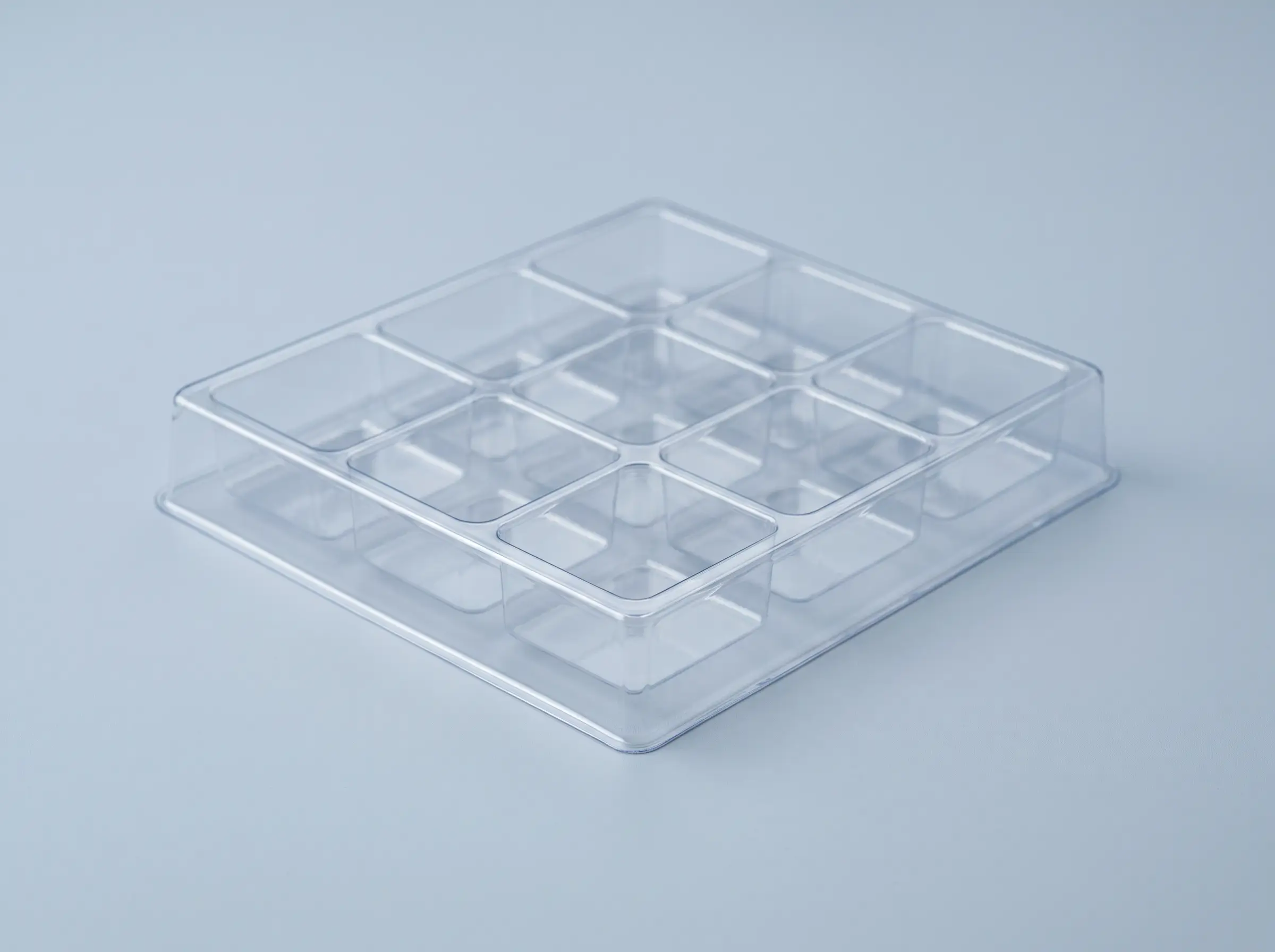
That combination has made PETG the go-to material for medical device trays, its signature market. A medical tray needs to show the device clearly, survive handling and shipping without cracking, and withstand sterilization — and PETG delivers all three: crystal clarity, high impact resistance, and compatibility with gamma and E-beam sterilization. It is, alongside HIPS, one of the most commonly specified FDA-compliant thermoforming materials.
PETG's forming behaviour is a genuine production advantage. As an amorphous material it has a wide, tolerant forming window at moderate temperatures (around 120–160 °C), making it one of the easiest clear materials to run — more forgiving than PET and without PET's strict drying discipline being quite as critical. It reproduces detail well and handles deep draws thanks to its toughness.
The trade-offs are modest but real. PETG costs somewhat more than standard PET or PVC, its barrier is moderate (similar to PET, so oxygen-sensitive products still need help), and its recyclability carries a caveat: although PETG is itself recyclable, it should be kept separate from the PET (#1) bottle stream, where it can act as a contaminant. Managed correctly, though, PETG is a high-performing, clean material that has been steadily displacing PVC in medical and demanding retail packaging.
PETG's rise tracks the medical-device industry's packaging maturation. As ISO 11607 validation, transit testing and aseptic-presentation requirements tightened, the true cost of a cracked tray or a punctured sterile barrier rose far above the sheet-price difference between materials — and PETG's toughness became cheap insurance. Today it is effectively the default clear rigid material in device packaging, with PVC's former share continuing to migrate as legacy validations retire, and its design vocabulary (retention fingers, peel-corner flanges, snap features) has become the industry's shared language.
Outside medical, PETG occupies the quality end of clear retail packaging: the heavy clamshell that survives a drop test, the premium food tray that arrives unmarked, the display part with a deep, sculpted form. The pattern in every case is the same — PETG is chosen where the cost of a failed or ugly pack exceeds its price premium, which is a growing rather than shrinking set of applications as brands treat packaging condition as part of product quality.
PETG grades and variants
Standard clear PETG — The general-purpose grade: excellent clarity, high toughness and easy forming for retail clamshells, premium food trays and display parts. The default when PET-like clarity with more impact resistance is needed.
Medical-grade PETG — Grades qualified for medical device packaging under ISO 10993 / 11607, valued for the combination of clarity (device visibility), impact resistance (protecting the device in transit) and gamma/E-beam sterilization compatibility. This is PETG's core professional market.
rPETG (recycled) — PETG with recycled content. Because PETG must be kept separate from the PET bottle stream, its recycled supply is a distinct channel from food-grade rPET, and availability is more limited — a point to plan for when recycled-content targets apply.
Copolyester variants — Related glycol-modified copolyesters tune toughness, chemical resistance and temperature performance for specific demanding applications. They extend the PETG family upward where standard PETG is not quite enough.
Embossed and textured PETG — Sheet supplied with fine surface texture, used in medical trays to reduce the glare that complicates visual inspection under theatre lighting and to soften scratch visibility in distribution. Texture costs a little sparkle but often nets better perceived quality where handling is real — a practical middle path for high-touch trays.
PETG forming temperature and its forgiving window
PETG is one of the most pleasant clear materials to thermoform, precisely because it combines an amorphous polymer's wide forming window with high toughness. It softens progressively over a broad range at moderate temperatures — forming-surface temperatures typically around 120–160 °C, lower and more forgiving than standard PET — so it tolerates minor temperature variation across the sheet without the tight control PET or PP demand. On InnovaPax equipment, precut PETG sheet is loaded, heated from the top, and formed with pressure from above plus vacuum from below.
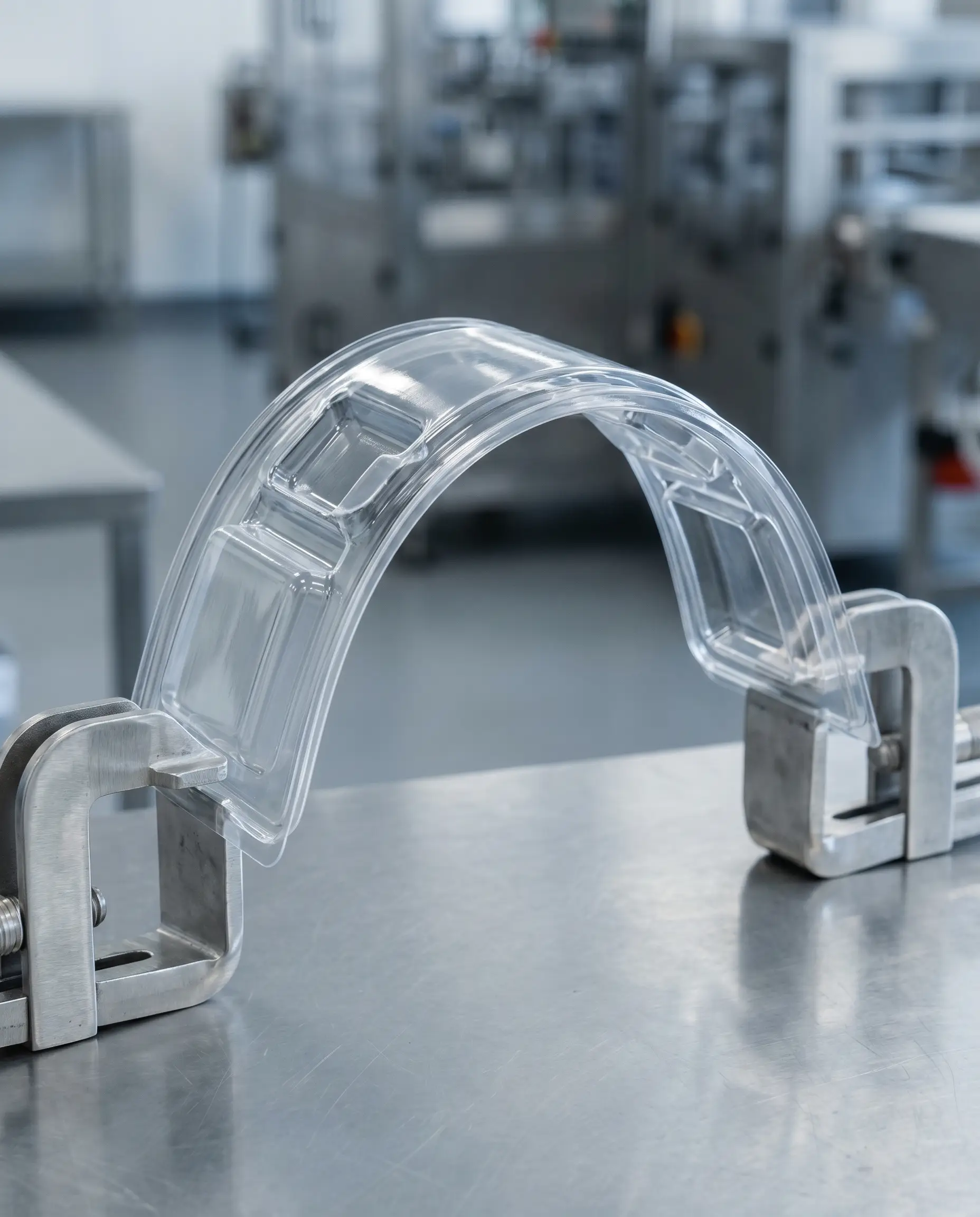
Its toughness pays off directly in deep and complex draws. Where brittle GPPS would crack and standard PET might thin or split, PETG stretches and forms cleanly into demanding geometries, holding detail and resisting the stress-whitening and cracking that limit some other clear materials. This is a large part of why it is chosen for medical trays with intricate device-retaining features and for heavy-duty clamshells.
PETG is less hygroscopic-sensitive in practice than PET — drying is still good practice but the material is generally more tolerant and forgiving on the line, contributing to its reputation as an easy, stable material to run. It also trims and die-cuts cleanly. Plug assist is optional for shallow cavities and recommended for medium and deep draws, as usual, though PETG's toughness makes it more resistant to the wall-thinning failures that plague less forgiving materials.
The main processing watch-point is simply cost discipline: because PETG is more expensive than PET or PVC, gauge optimisation and low scrap matter to the economics. But from a pure processability standpoint, PETG is close to ideal — clear, tough, forgiving, and stable — which is why it is a favourite for demanding formed parts.
A validation-stage note for medical work: lock the forming recipe early and document it. ISO 11607 ties packaging performance to a validated process; recipe drift that would be routine tuning on a retail line becomes a change-control event on a medical one. PETG's wide, stable window is an asset here precisely because a well-centred recipe stays valid — centre it during development, then leave it alone.
Where PETG leads: applications in depth
Sterile-barrier medical device trays are PETG's defining application, and the fit is total: crystal clarity for device inspection without opening; toughness that survives the drop, vibration and compression batteries of transit validation; sculpted retention geometry holding devices immobile yet presenting them aseptically to a gloved hand; and gamma/E-beam compatibility for terminal sterilization. Under ISO 11607's validation regime, where a single packaging failure can cost a recall, PETG's premium over PVC or PET reads as inexpensive insurance — which is why new device programs default to it.
Pharmaceutical and diagnostic secondary packaging extends the same logic: kit trays organising vials, syringes and devices into procedure order, where clarity communicates completeness at a glance and toughness protects through hospital logistics. PETG's clean formulation — no chlorine, no plasticizers — also simplifies the extractables-and-leachables conversations that pharmaceutical packaging reviews force.
Premium retail and heavy-duty clamshells use PETG where packaging survival is part of brand quality: electronics, cosmetics and tools whose clamshell must arrive glossy and uncracked after real-world distribution. The drop-test failure that embarrasses a GPPS or PVC pack is precisely what PETG was chosen to prevent.
Formed display and point-of-sale rounds out the space: deep-drawn, sculpted clear forms — risers, shrouds, product cradles — that exploit PETG's deep-draw tolerance and surface gloss. Here PETG competes with acrylic fabrication and wins on formed complexity and unit cost at volume.
Specifying PETG: the decisions that matter
A strong PETG specification makes five commitments. Grade and compliance first: name the medical grade and its ISO 10993 documentation where the application is clinical — the paperwork is part of the material. Gauge against the validation battery, not intuition: transit testing (drop, vibration, compression) decides PETG gauge, and its toughness routinely permits lighter gauge than intuition specifies — recover the price premium there.
Retention geometry with the real device: specify that retention features are validated against actual devices, gloved-hand release included, because paper dimensions miss how devices actually sit. The sterile-barrier system as a whole: tray, Tyvek lid, seal recipe and peel behaviour are one validated system under ISO 11607 — specify them together, change them together. And the recycling route: state that PETG parts be marked and routed outside the PET bottle stream, so the sustainability story is executed rather than assumed.
PETG rewards this thoroughness because its applications are exactly the ones where packaging failure is expensive. The specification that treats tray, lid, process and paperwork as one system is the specification that passes validation first time — and first-time validation is where PETG's premium quietly pays for itself.
Designing PETG parts: deep draws, undercuts and device retention
PETG is the material where ambitious geometry becomes realistic, and the design guidance is largely about using that freedom well. Its toughness supports deep draws and complex contours that would crack GPPS or thin PET, so device-retention features, snap details and sculpted cavities are on the table. The usual disciplines still apply — radii over sharp corners, plug assist on depth — but the envelope is genuinely wider, and medical tray design exploits it.
Device-retention design is PETG's signature craft: cavities that hold a medical device securely through transit yet release it cleanly to a gloved hand. Retention comes from designed interference — ribs, fingers and undercut lips sized to the device — and PETG's elasticity lets those features flex for release without whitening or cracking. Prototype retention features early with the real device; paper dimensions rarely capture how a device sits, and PETG's forgiving forming makes iteration cheap.
Undercuts are feasible in PETG within reason: the material's toughness lets parts snap off tool features that would lock or crack brittler films. Keep undercuts shallow and radiused, and place them where ejection geometry can flex the part naturally. This capability enables one-piece lids, snap-fit closures and retaining lips that other clear materials must avoid.
For sterile-barrier trays under ISO 11607, design the seal flange as carefully as the cavity: a flat, uninterrupted sealing land sized for the Tyvek lid and sealing tool, with a designed peel corner for aseptic presentation. Corner radii on the flange outline reduce the puncture risk sharp corners pose to the porous lid in transit — a classic packaging-validation failure mode that design prevents cheaply.
On cost discipline: PETG's price premium makes gauge optimisation worthwhile. Its toughness often permits a lighter gauge than a brittle material would need for the same protection — recover the premium there, and reserve heavier gauges for genuinely demanding trays rather than as a comfort margin.
PETG troubleshooting: sticking, gels and handling marks
Sticking in the tool is PETG's most common complaint: the material runs slightly tacky, and parts that overstay or overheat grip the tool at ejection. Fixes in order: bring the forming temperature down within the window (PETG rarely needs its hot edge), extend cooling marginally before ejection, and check tool surface condition — polished aluminium releases PETG well, while scarred or contaminated surfaces grip. Persistent sticking justifies a tool-surface treatment before it justifies release sprays on a medical line.
Gels and specks — small transparent lumps or dark points in the formed part — are sheet-quality defects, not process defects: unmelted or degraded polymer from extrusion. They matter acutely in medical trays where inspection standards are tight. Log and photograph them, and take the conversation to the sheet supplier; no forming parameter removes a gel that arrived in the sheet.
Scratches and handling marks show readily on PETG's relatively soft, glossy surface, and a scratched clear medical tray fails cosmetic inspection just as a cracked one fails functional. The remedy is handling discipline through the whole chain: protective film on premium sheet, clean conveyors and nests, and packing formed trays so faces do not slide against each other.
Blush or whitening at deep-draw walls indicates over-stretching in a zone that was too cold to flow: the material yielded rather than drew. Raise local sheet temperature or improve plug delivery to that zone. PETG whitens far later than most clear materials, so visible blush means the process is genuinely at its edge — respect it.
Gloss loss or surface orange-peel after forming points to overheating: PETG's surface degrades cosmetically before it fails structurally. Confirm heater profile and dwell; the fix is almost always a few degrees, not a redesign. Because PETG's window is wide, drifting hot is easy and the first symptom is cosmetic — treat gloss change as an early-warning instrument.
PETG barrier: moderate, like PET
PETG's barrier is broadly similar to standard PET: a moderate barrier to both oxygen and moisture. That is adequate for many medical, retail and premium-food applications — where the pack's job is protection, presentation and sterility rather than long-term shelf-life extension — but it is not a high barrier, so oxygen-sensitive products needing extended shelf life will require enhancement.
As with PET, the routes to a higher barrier are transparent coatings (AlOx or SiOx) that lift oxygen and moisture protection while preserving clarity, or, where more is needed, multi-layer structures — each adding cost and, in the multi-layer case, recyclability complexity. For most of PETG's core uses, though, the moderate inherent barrier is sufficient, and the material is chosen for its clarity-plus-toughness rather than for barrier at all.
The honest framing is that barrier is not why anyone selects PETG. If a job's defining requirement is a high oxygen or moisture barrier, PETG is not the natural starting point; if the defining requirements are clarity, toughness and sterilizability — as in medical trays — then PETG's moderate barrier is a non-issue and the material excels.
PETG vs PET vs PVC for thermoformed packaging
PETG vs PET. They share clarity and food-contact safety, but diverge on toughness, forming and recyclability. PETG is markedly tougher, more impact- and chemical-resistant, and easier to form with a wider window — ideal for deep, demanding or drop-tested parts. Standard PET is cheaper, has a mature food-grade recycled (rPET) supply, and recycles cleanly in the #1 bottle stream, which PETG does not. Choose PETG when toughness and forming ease lead; choose PET when cost and recyclability lead.
PETG vs PVC. This is the substitution driving much of PETG's growth. In medical and demanding retail packaging, PETG has been steadily replacing PVC: it offers comparable or better clarity and forming, far superior toughness, and — decisively — no chlorine and none of PVC's REACH/PPWR regulatory baggage. PVC remains cheaper and forms a touch more easily, but for new medical and premium work, PETG's cleaner profile and toughness usually win.
Where PETG leads outright. Whenever an application needs clarity and toughness and sterilizability together — medical device trays being the archetype — PETG is often the single best fit, outperforming brittle GPPS, chlorinated PVC, and harder-to-form standard PET. Its main constraints are cost and the recycling-stream separation, both manageable with planning.
One further comparison arises in premium clear packaging: PETG vs polycarbonate. PC is tougher still and far more heat-resistant, but costs more, forms at higher temperatures with drying demands, and carries bisphenol-A questions in food-adjacent uses that PETG simply avoids. PETG occupies the sweet spot — nearly all of the toughness most applications need, at lower cost and cleaner regulatory profile — leaving PC for the genuinely extreme duty PETG cannot meet.
PETG recyclability and the PET-stream caveat
PETG is a recyclable mono-material, which aligns it with the PPWR's push toward single-polymer, recyclable design. Chlorine-free and free of the regulatory pressures that dog PVC, it is a much cleaner choice than the material it most often replaces in medical and retail packaging.
The important caveat is stream separation: although PETG is recyclable, it must be kept out of the standard PET (#1) bottle-recycling stream, where its different melt behaviour makes it a contaminant that can degrade recycled PET quality. In well-managed systems PETG is collected and recycled on its own channel; where sorting is poor, its presence is a problem. This is a design-and-labelling consideration rather than a fundamental flaw, but it does mean PETG's recycled supply (rPETG) is a distinct, more limited channel than food-grade rPET.
The practical guidance: specify PETG confidently where its clarity-and-toughness advantages matter, label and route it correctly to keep it out of the PET bottle stream, and plan recycled-content sourcing through the PETG channel rather than assuming rPET availability. Handled this way, PETG is a strong sustainability performer whose one asterisk — stream separation — is a matter of correct handling, not an inherent weakness.
A sourcing note: as PETG volumes grow in medical packaging, take-back and closed-loop programs for uncontaminated PETG offcuts and time-expired sterile packs are emerging in the industry — a practical route to circularity that sidesteps the consumer-stream separation problem entirely, since industrial PETG waste is clean, identified and consolidated. Converters generating meaningful PETG trim should treat that stream as an asset.
What is the difference between PETG and PET?
PETG is glycol-modified PET: the same base polymer with some building blocks replaced by glycol. This keeps PET's clarity and food safety but adds much greater toughness, impact resistance and chemical resistance, plus a wider, more forgiving forming window. PET is cheaper and recycles in the #1 bottle stream; PETG does not and must be recycled separately.
Why is PETG used for medical device trays?
A medical tray must show the device clearly, survive handling without cracking, and withstand sterilization. PETG delivers all three: excellent clarity, high impact resistance, and compatibility with gamma and E-beam sterilization. That combination, plus easy forming of intricate device-retaining features, makes PETG a leading medical tray material.
What is the forming temperature of PETG?
Typically a sheet-surface temperature around 120–160 °C — lower and more forgiving than standard PET. As an amorphous material PETG has a wide forming window, making it one of the easiest clear materials to run. Treat any figure as a starting range and fine-tune on your line.
Is PETG tougher than PET?
Yes — markedly so. The glycol modification gives PETG much higher impact resistance and better chemical resistance than standard PET, letting it survive deep draws, handling and drop tests where PET might crack or stress-whiten. This toughness is one of the main reasons to choose PETG over PET.
Can PETG be sterilized?
Yes — PETG is compatible with gamma and E-beam (radiation) sterilization, which is why it is widely used for single-use medical device trays. Like other PET-family materials it is not suited to steam sterilization because of its heat limits.
Is PETG recyclable?
Yes, PETG is a recyclable mono-material — but it must be kept separate from the standard PET (#1) bottle stream, where it acts as a contaminant. In well-managed systems it is collected and recycled on its own channel. This means recycled PETG (rPETG) is a distinct, more limited supply than food-grade rPET.
PETG or PVC — which is better?
For medical and demanding retail packaging, usually PETG. It offers comparable or better clarity and forming, far superior toughness, and no chlorine or PVC-style regulatory baggage under REACH and the PPWR. PVC is cheaper and forms slightly more easily, but PETG's cleaner profile and durability increasingly win new work.
Does PETG have a good barrier?
PETG has a moderate barrier to oxygen and moisture, similar to standard PET — adequate for most medical, retail and premium-food uses, but not a high barrier. Oxygen-sensitive products needing long shelf life require a transparent coating (AlOx/SiOx) or multi-layer structure. Barrier is not the reason to choose PETG; clarity and toughness are.
Why does PETG stick to the mould, and how do I stop it?
PETG runs slightly tacky, so overheated or over-dwelled parts grip the tool at ejection. Reduce forming temperature within the window, extend cooling marginally, and check the tool surface — polished aluminium releases PETG well, while scarred or dirty surfaces grip. Fix temperature and surface before resorting to release agents, especially on medical lines.
Is PETG scratch-resistant?
No — its surface is relatively soft and glossy, so it shows scratches and handling marks readily, and cosmetic inspection standards (especially medical) will catch them. Manage it with handling discipline: protective film on premium sheet, clean nests and conveyors, and packing that stops formed faces sliding against each other.
What gauge is typical for PETG medical trays?
Medical device trays commonly run in the region of 0.5–1.0 mm depending on device weight and transit validation demands, with heavy instruments pushing higher. PETG's toughness often lets gauge come down relative to intuition — let the ISO 11607 transit battery (drop, vibration, compression) set the number, and recover the material premium in the saved gauge.
Does PETG need drying before forming?
PETG is a polyester and benefits from dry handling, but in practice it is notably more forgiving than standard PET: properly stored sheet typically runs well without aggressive drying regimes. Follow the supplier's guidance, keep sheet sealed and rotated, and escalate to drying if haze or brittleness appear — the symptoms and cures mirror PET's, just with wider margins.
Can PETG be autoclaved (steam sterilized)?
No — like the rest of the PET family, PETG's heat limits rule out steam sterilization at 121–134 °C; it is specified for gamma and E-beam (and compatible with EtO) instead. If the device program requires autoclaving of the packaged unit, the tray material conversation moves to PP or beyond — but for terminally radiation-sterilized devices, PETG is the standard answer.
How does PETG handle deep draws compared to PET?
Substantially better. PETG's glycol modification suppresses the crystallisation and brittleness behaviours that make deep PET draws risky, so it stretches further and more evenly before thinning or whitening — enabling the deep, sculpted device cavities medical trays rely on. Plug assist and radii discipline still apply, but the safe envelope is genuinely wider.
Is PETG the same as glycol-modified PET-G sheet sold for hobby use?
Chemically it is the same polymer family, but packaging and medical PETG sheet is manufactured, documented and quality-controlled to entirely different standards — food-contact or ISO 10993 compliance, gel and inclusion limits, controlled thickness tolerance, and lot traceability. For regulated packaging, specify packaging-grade sheet from a documented supply chain; the hobby-channel material is not a substitute however similar the name.