PET packaging: the default forming film
PET (polyethylene terephthalate) is the most widely used forming film in rigid packaging, and its dominance is not an accident of habit — it is the material that best balances the four things a packaging engineer usually needs at once: clarity, strength, a workable barrier, and recyclability. Few other polymers score well on all four, and none combine them with an equally mature recycling stream. That is why, across food trays, retail blisters, medical inserts and electronics packaging, PET is the default choice and the benchmark every alternative is measured against.
Optically, PET is exceptional. It forms with high, glass-like clarity that survives the forming process, giving the crisp product visibility that retail and fresh-food packaging depend on to sell. Mechanically, it is strong and dimensionally stable: a PET tray holds its shape under stacking, handling and temperature swings without brittleness or softness. It also resists most fats, oils and solvents, so it performs well against greasy or acidic foods.
The reason PET has pulled ahead of older materials in the last decade is recyclability under regulatory pressure. PET carries resin identification code #1, sits in an established, well-funded recycling stream, and can be produced as a genuine mono-material. As the EU's Packaging and Packaging Waste Regulation (PPWR) rewards recyclable, single-polymer designs and penalizes hard-to-recycle laminates, PET's mono-material story has turned from a nice-to-have into a commercial requirement. Several major retail groups now demand recyclable mono-material packaging outright — a bar PET clears and materials like PVC do not.
PET is honest about its two limitations. First, its oxygen barrier is only moderate — fine for many food and retail applications, but not enough on its own for oxygen-sensitive products needing long shelf life; those need a barrier enhancement. Second, standard amorphous PET (APET) has limited heat resistance, softening around 70 °C, which rules it out of ovenable and hot-fill uses — the reason the crystallized CPET variant exists. Inside those boundaries PET is hard to beat; outside them, the PET family has a variant or coating that extends the range.
PET grades: APET, PETG, rPET and CPET
"PET" is really a family of related grades that share the same base polymer but differ in ways that matter on the line and in the field. Choosing the right member of the family is often more consequential than choosing PET in the first place.
APET (amorphous PET) is the workhorse — the standard clear thermoforming grade for the vast majority of trays, blisters and clamshells. It offers the clarity, strength and formability that define PET, is fully recyclable as a mono-material, and is available with recycled content. When there is no special heat or toughness requirement, APET is the right, cost-effective default.
PETG (glycol-modified PET) replaces some building blocks with glycol, making it tougher, more impact- and chemically resistant, and giving a wider, more forgiving forming window. That toughness suits demanding industrial and medical parts, deep or complex draws, and anywhere a standard grade might crack. The trade-off is cost and a recyclability nuance — PETG is not always accepted in the same stream as bottle-grade PET.
rPET (recycled PET) is not a different polymer but PET with post-consumer recycled content designed in. It is central to meeting PPWR recycled-content minimums, and food-grade rPET from approved super-clean recycling processes is mature and widely available — PET is the one polymer with a genuinely reliable food-grade recycled supply chain. Very high recycled content can introduce slight colour/clarity variation that specifications should accommodate.
CPET (crystallized PET) is the heat-resistant family member. Crystallizing the polymer gives dimensional stability at high temperature, making it suitable for ovenable and dual-ovenable ready-meal trays that go from freezer to oven — an application APET cannot survive. CPET shares PET's recyclability but is a distinct material with its own forming behaviour and its own material card.
PET forming temperature and processing in practice
PET rewards good process control and punishes neglect. Compared with PVC and PP it demands higher forming temperatures and tighter control — the forgiving wide window of PVC is not on offer. On InnovaPax equipment, precut PET sheet is loaded, heated from the top, and formed with pressure from above combined with vacuum from below; that pressure-plus-vacuum combination (not vacuum alone) is what reproduces sharp detail and deeper cavities cleanly.
The single most important discipline is drying. PET is hygroscopic: if formed while damp, absorbed moisture flashes to steam and degrades the polymer chains — showing up as haze, brittleness, odour and inconsistent forming. Store sheet sealed and dry it where required. Most "bad PET" is really just wet PET, and it is entirely avoidable.
Heating must be even and controlled. PET's relatively narrow window means an uneven temperature profile produces uneven wall thickness — hot spots over-thin, cold spots under-form. Zoned heating and consistent handling pay off directly, and thicker gauges need proportionally more heating time to reach forming temperature without scorching.
Plug assist matters as cavities get deeper: for shallow cavities pressure and vacuum suffice, but as draw ratio rises a plug pre-stretches and guides the sheet into the cavity, keeping walls from over-thinning at the base and corners. PET also tolerates regrind — edge trim and skeletal waste can be reclaimed — but regrind must be managed for cleanliness and moisture and blended at controlled ratios. Across many SKUs, sheet moisture and heat profile are the two variables that deserve instrumentation.
Where PET leads: applications in depth
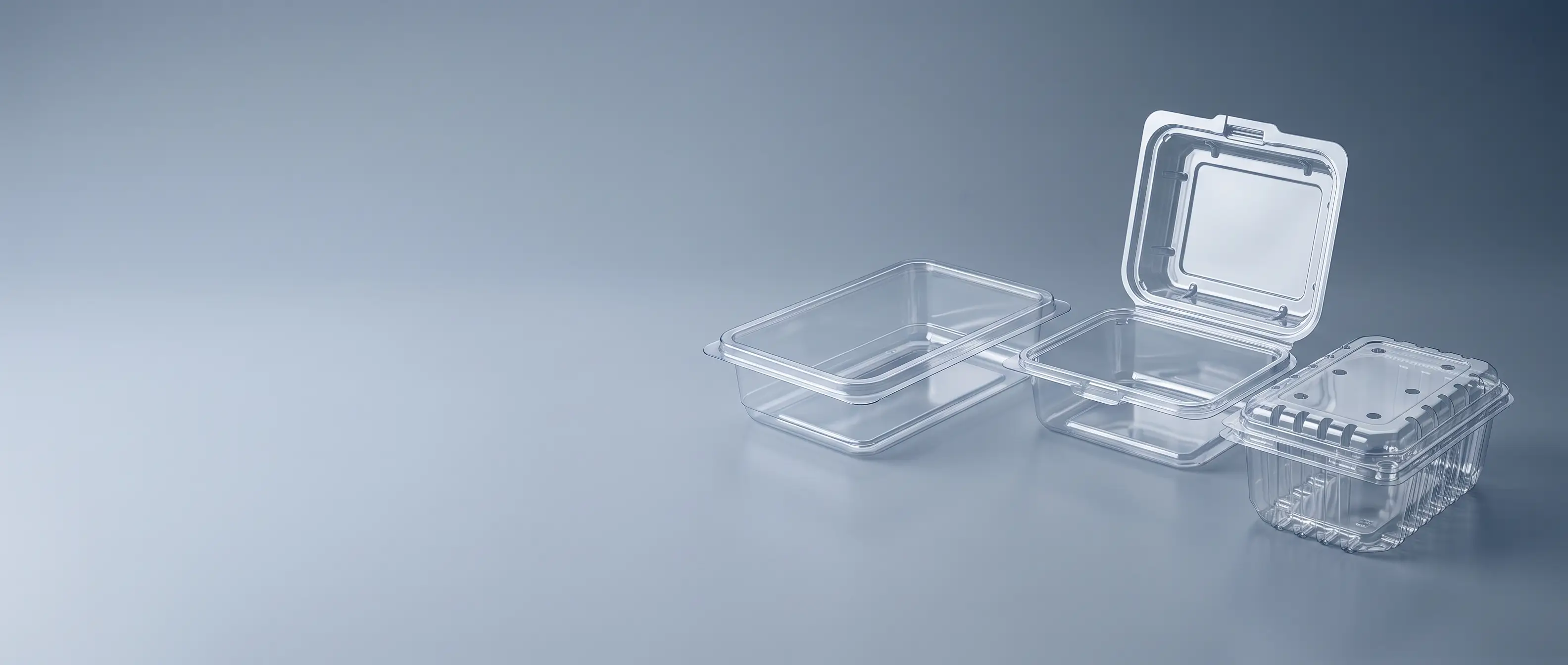
PET / APET is the default forming film across food, retail, medical and electronics packaging, and its applications share a common thread: they need clarity, strength and recyclable presentation at once.
Food trays — Clear trays for produce, meat, salads and ready meals — good moisture barrier and full product visibility. Blisters & clamshells — Retail blisters and clamshells for non-food goods — strong, clear, dimensionally stable and tamper-resistant. Medical tray inserts — Formed inserts for sterile barrier systems — compatible with gamma and E-beam sterilization. Electronics / ESD — Protective trays and inserts for electronics, also available in antistatic grades.
In every case the choice comes back to the same balance: glass-like clarity that survives forming, dimensional stability under stacking and transit, food-contact compliance, and a mono-material recyclability story that clears retailer and PPWR requirements PVC cannot.
PET troubleshooting: haze, webbing and thin corners
Haze, brittleness or odour is, in the great majority of cases, moisture damage: hygroscopic PET formed wet, the absorbed water flashed to steam, and the polymer degraded. The fix is upstream, not in the machine — store sealed, dry where required, rotate stock. No forming parameter recovers degraded PET.
Webbing and bridging (folds of excess material between cavities or across corners) indicate the sheet was too hot or the draw too deep for unassisted forming. Bring the temperature toward the middle of the window and give deep or closely spaced cavities plug assist.
Thin corners and floors follow the deep-draw rule: the first material to touch the cool tool freezes and stops stretching. The remedy hierarchy is add/correct plug assist, then open corner radii, and only then add gauge (which costs money every cycle).
Stress whitening or cracking at radii means the sheet was too cold in that zone or the radius too tight — even out the heating profile (zone-map with an IR reading) and open the radius. Trim dust and "angel hair" come from dull dies chipping rather than shearing — use sharp, maintained dies. Seal failures against lidding are usually a materials-matching question: the lid's sealant must be PET-matched and the flange clean and flat.
PET barrier properties and AlOx / SiOx coatings
PET's barrier profile is the part most often misunderstood. On moisture it offers a reasonable barrier suiting many chilled and ambient products. On oxygen it is only a moderate barrier — adequate for short-to-medium shelf lives but insufficient on its own for oxygen-sensitive products (many meats, cheeses, long-life items) that need weeks of oxidation protection.
The elegant part is that PET's oxygen limitation can be solved without abandoning the mono-material advantage. Transparent barrier coatings — principally aluminium oxide (AlOx) and silicon oxide (SiOx) — can be vacuum-deposited onto PET to lift oxygen and moisture barrier toward foil-class levels while keeping the pack clear and microwave-safe (unlike metallized layers). Because these are thin oxide coatings on a PET base rather than a laminated second polymer, a coated PET structure can still be assessed as essentially mono-PET for recyclability.
Where an even higher barrier is genuinely required, other routes exist — EVOH layers, or for extreme moisture protection the fluoropolymer PCTFE — but these reintroduce multi-material complexity and its recyclability penalty, so they are chosen only when the product truly demands it. For most applications the honest answer is: use plain PET where a moderate barrier suffices, and reach for AlOx or SiOx the moment oxygen-sensitivity and shelf life demand more.
PET recyclability, rPET and the PPWR
PET's sustainability story is the strongest of any mainstream forming film, and increasingly the reason it is specified. As a genuine mono-material, a pure PET tray reaches the top recyclability grades under the PPWR's grading system — the same system that, from 2030, bars the least recyclable packaging (grades D and E) from the market. Designing in PET today is therefore both an environmental and a market-access choice.
On recycled content, PET is uniquely well-placed. The PPWR sets rising minimum recycled-content requirements, and food-contact recycled content is the hardest to meet — except in PET, where approved super-clean recycling and mature bottle-to-bottle infrastructure make food-grade rPET genuinely available. This is why PET carries higher recycled-content targets than other polymers: the supply chain can actually deliver them.
PET also fares well on Extended Producer Responsibility (EPR) fees, which are increasingly modulated by recyclability: recyclable mono-PET typically sits in a favourable fee band, where hard-to-recycle laminates attract penalties. The one honest caveat is that adding barrier or combining PET with dissimilar materials can erode these advantages — which is why the coated-mono-PET approach keeps the sustainability case intact while solving the barrier limitation.
Specifying PET: the decisions that matter
A strong PET specification starts by naming the right family member. APET is the workhorse clear thermoforming grade; reach for CPET where ovenable heat resistance is required, PETG where extra toughness and a wider forming window justify the cost and recycling nuance, and design in rPET content to meet PPWR recycled-content minimums.
Then commit to process discipline: PET is hygroscopic, so specify dry storage and drying where required, and a controlled, even heat profile — most “bad PET” is simply wet or unevenly heated PET. Where oxygen sensitivity and shelf life demand more than PET’s moderate barrier, specify an AlOx or SiOx coating that lifts the barrier toward foil-class levels while keeping the pack essentially mono-PET for recyclability.
Finally, treat tray, lid and seal as one system, mark parts for the #1 recycling stream, and set recycled-content targets against PET’s genuinely available food-grade rPET supply. Specified this way, PET clears both the performance and the market-access bar in a single, recyclable material.
PET vs PVC vs PP for thermoformed packaging
PET vs PVC vs PP. PVC is cheaper per kilo and exceptionally easy to form with a wide, forgiving window, and de-nests and die-cuts beautifully — historically why it dominated blisters — but it raises plasticizer-migration and chlorine concerns, faces REACH/PPWR regulatory pressure, and fails the mono-material recyclability many retailers now require; PET is recyclable, plasticizer-free, UV-stable and food-safe, so for most new food/retail work (especially EU/export) PET is the strategic choice and PVC the legacy one. PP is lightweight, cost-effective and notably heat-resistant (microwave-safe, hot-fill capable) where APET would deform, and resists grease/chemicals well, but PET pulls ahead on clarity (PP is hazier), gas barrier (PP's O2 barrier is lower) and forming precision (PP has higher shrinkage and can be harder to process). Rule of thumb: choose PP when heat resistance, low weight or cost lead and clarity is secondary; choose PET when clarity, barrier and recyclable presentation matter most; choose CPET when you need PET's qualities and heat resistance together.
Is PET recyclable?
Yes — PET is one of the most recycled plastics in the world. It carries resin identification code #1, sits in an established recycling stream, and as a mono-material a PET tray reaches the top recyclability grades. It also readily accepts recycled (rPET) content, closing the loop.
Is PET food-safe?
Yes. PET is widely compliant for direct food contact under both EU and FDA rules. In rigid sheet form it contains no chlorine and no plasticizers, and it is chemically inert to most foods, which is part of why it performs well even with fatty and acidic products.
PET or PVC — which is better?
For most new work, PET. PVC is cheaper and easier to form, but it faces plasticizer and chlorine concerns, regulatory pressure under REACH and the PPWR, and does not meet the mono-material recyclability that many retailers now require. PET is recyclable, plasticizer-free and food-safe, at the cost of a little more precision in forming.
Why can't PET be steam sterilized?
Standard APET softens around 70 °C, far below steam sterilization temperatures of 121–134 °C, so it would distort. PET is instead compatible with gamma, E-beam and EtO sterilization. If heat resistance is required, the crystallized CPET variant is the answer.
What's the difference between APET, PETG and CPET?
APET is the standard clear amorphous grade for most trays and blisters; PETG is glycol-modified for extra toughness and chemical resistance and a wider forming window; CPET is crystallized for heat resistance, making it ovenable. All three share PET's fundamental recyclability.
Does PET have a good oxygen barrier?
PET provides a moderate oxygen barrier — enough for many food and retail uses, but not for oxygen-sensitive products needing long shelf life. Those need a transparent barrier coating such as AlOx or SiOx, which lifts the barrier toward foil-class levels and can be added without breaking the mono-material structure.
Can recycled PET (rPET) be used for food packaging?
Yes. Food-grade rPET from approved super-clean recycling processes is mature and widely used, backed by an established bottle-to-bottle supply chain. PET is in fact the one polymer with a genuinely reliable food-grade recycled supply, which is why it carries higher recycled-content targets than most others under the PPWR.
What forming temperature does PET need?
Typically a film-surface temperature in the region of 140–165 °C, adjusted for gauge — higher and more tightly controlled than PVC or PP. Treat any figure as a starting range: the correct value depends on your line, tooling and grade, and should be fine-tuned in production.
Why does my PET come out hazy or brittle?
The most common cause is moisture: PET is hygroscopic, and forming it while damp degrades the polymer, producing haze, brittleness and odour. Store sheet sealed and dry it where required before running — "bad PET" is very often just wet PET.