PCTFE (Aclar®): the ceiling of the clear barrier ladder
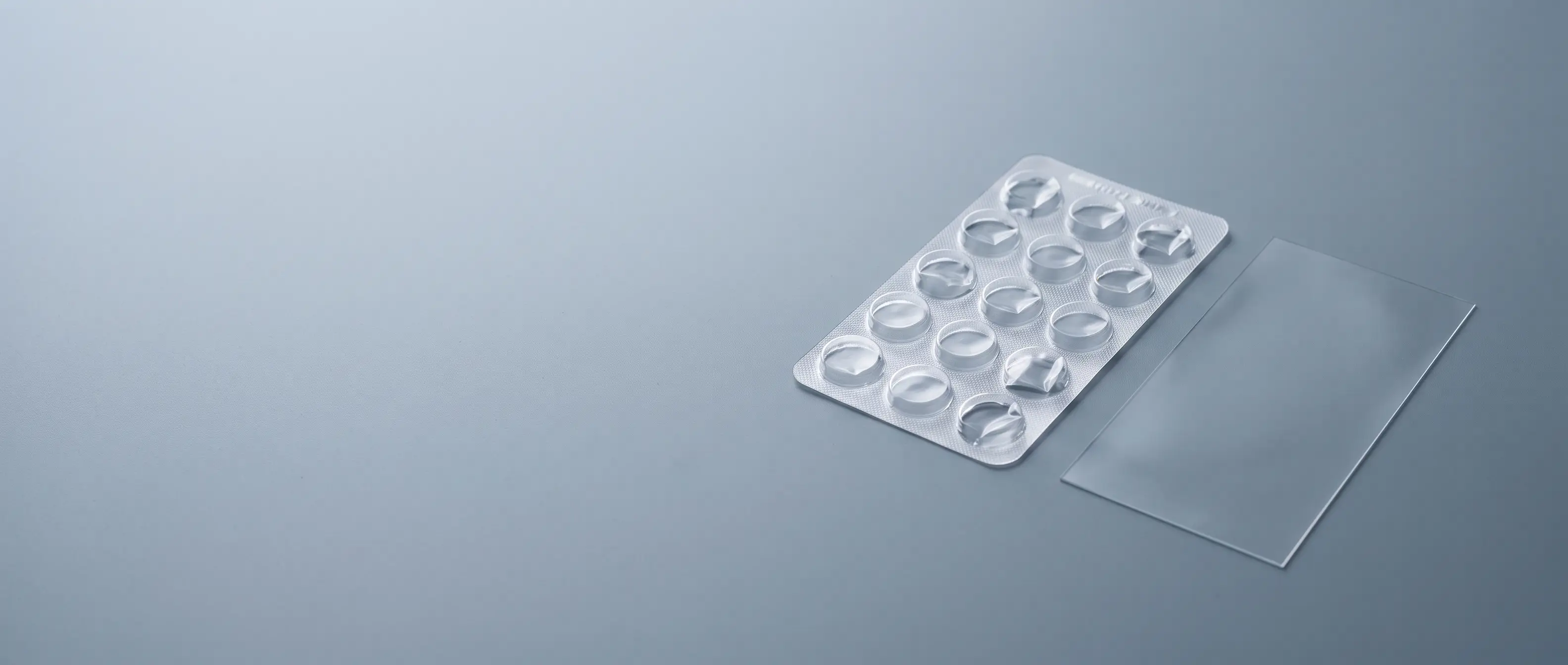
PCTFE — known to the pharmaceutical world almost entirely through Honeywell's trade name Aclar® — is a fluoropolymer with one defining credential: the highest moisture barrier of any clear, thermoformable film. Where every other forming film describes its water-vapour performance in qualified terms, PCTFE simply tops the chart, and has since laminating Aclar to PVC for drug blisters became established practice in the early 1970s. Its fully halogen-substituted backbone — fluorine and chlorine, no hydrogen — makes it dense, chemically inert, essentially non-hygroscopic and crystal clear.
The honest trade-offs are cost and circularity. PCTFE carries a genuine fluoropolymer price — the most expensive material in the blister world — so it travels as a thin barrier layer laminated to a forming body, classically rigid PVC (duplex PVC/Aclar and triplex PVC/Aclar/PVC), with the barrier level dialled by PCTFE gauge. The PVC does the forming, stiffening and sealing; the micrometres of PCTFE do the protecting. And a chlorinated body bonded to a fluorinated barrier has no realistic recycling route — PCTFE is specified for protection, not sustainability, which is exactly why it is used only where the stability data demand it.
PCTFE structures and grades
Duplex laminates (PVC/Aclar) — The classic structure: a rigid PVC forming body with a PCTFE layer laminated to the product side. The PCTFE faces inward — into the cavity, against the drug — and the PVC face seals to the lidding foil. This is the default Aclar blister and the one most stability files are built on.
Triplex laminates (PVC/Aclar/PVC) — PCTFE sandwiched between PVC layers, protecting the barrier film mechanically and presenting PVC on both faces. Specified where handling, sealing symmetry or barrier-layer protection argue for it.
Barrier-gauge families (e.g. UltRx series) — Supplier ranges stepping PCTFE thickness — roughly 51, 76, 102 and 152 µm in the best-known family — so barrier is purchased by the micron against the stability target rather than over-specified. Published WVTR figures for these builds land in the tenths of a gram per square metre per day, an order of magnitude below plain PVC.
Alternative-substrate laminates (PET, PP, COC, EVOH) — Aclar laminated to non-PVC bodies. COC/PCTFE combinations push clear-barrier performance furthest, PET and PP substrates serve halogen-reduction and format needs, and EVOH pairings add an oxygen barrier where both gases matter.
Forming PCTFE laminates: PVC manners, barrier discipline
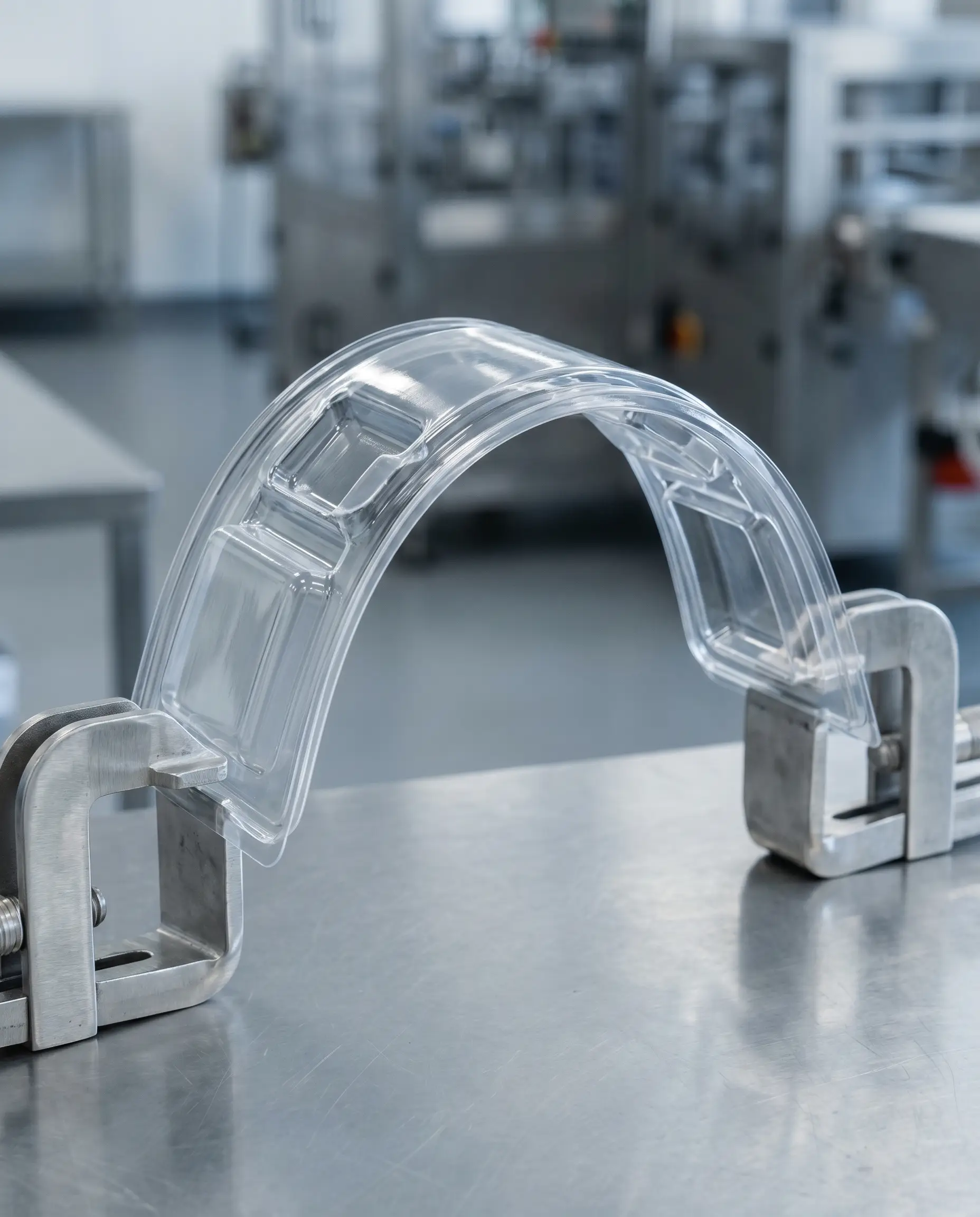
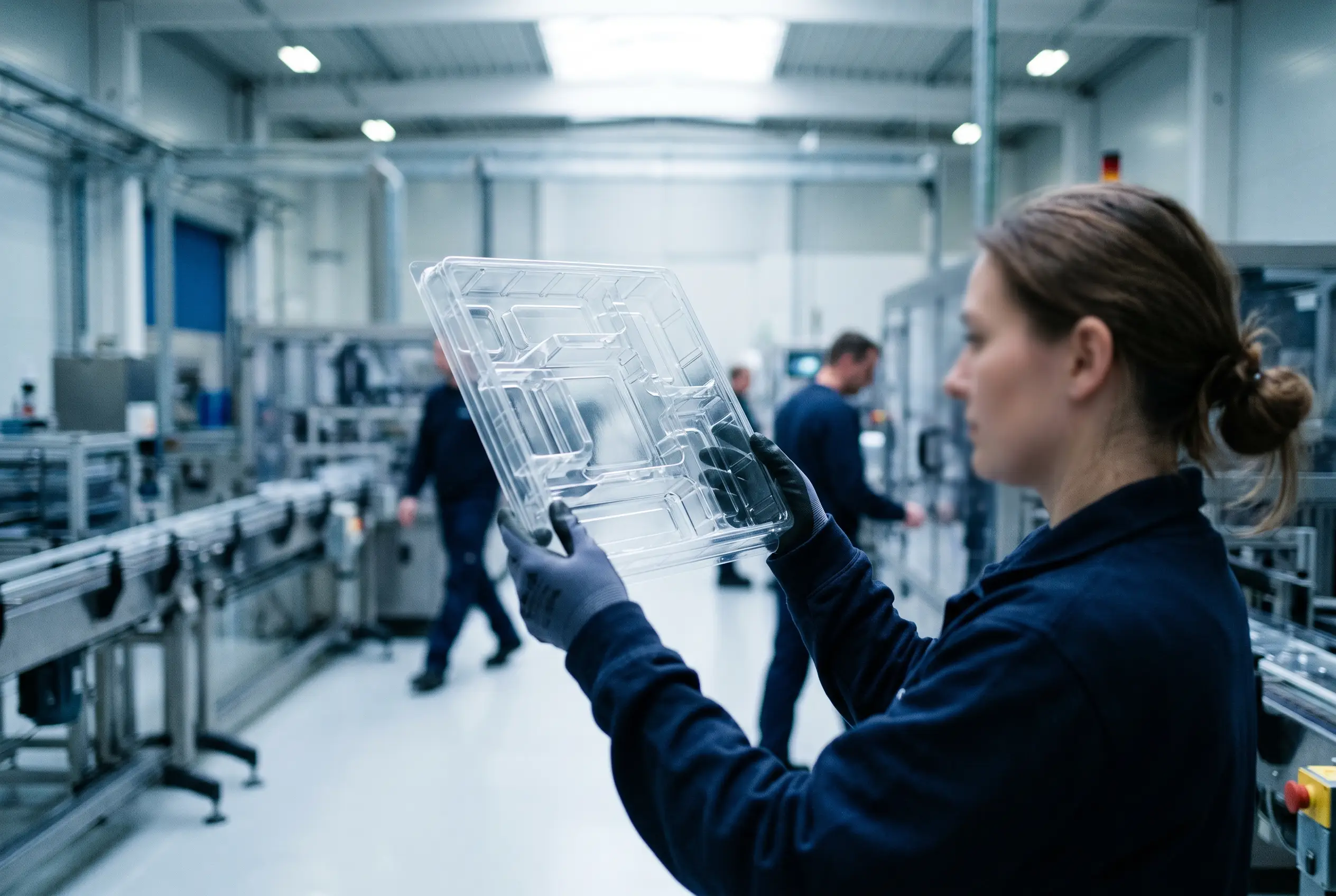
The processing headline is reassuring: Aclar laminates run on conventional blister lines. Suppliers state plainly that the films machine well on existing thermoforming equipment built for PVC, PVC/PVDC, COC and PP — typically without new tooling — and industry references place pharmaceutical thermoforming of these structures in the familiar ~100–165 °C envelope. A precut laminate sheet heats from above, forms with pressure from above and vacuum from below, and behaves on the line like the premium PVC film it mostly is by volume.
The discipline that distinguishes PCTFE work is orientation: the barrier layer has a correct side. In duplex structures the PCTFE must face the product — inside the cavity — both for barrier geometry and for sealing, since it is the PVC face that carries the heat-seal against the lidding foil's PVC lacquer. Web orientation is a controlled, verified parameter on an Aclar line, not an assumption; a reversed web forms beautifully and fails at the sealing station or, worse, in stability.
Barrier thinning is the central process risk. Forming stretches the laminate, and the PCTFE layer thins exactly where the cavity draws deepest — taking the barrier with it, since protection scales with gauge and the pack performs at its thinnest point. Plug assist on meaningful draws, conservative draw ratios, and cavity geometry that distributes stretch are not optional refinements here; they are how the purchased barrier survives forming. Serious programs verify formed-cavity barrier rather than certifying from flat-web data.
Temperature moderation protects the laminate. The structure is a bonded composite of dissimilar polymers: overheating risks the PVC body (degradation, with PVC's usual HCl signature) before the fluoropolymer notices, while excessive or uneven heat can stress the lamination bond. Even, moderate, well-profiled heating in the PVC-comfortable range keeps both partners happy — and the laminate needs no drying, stores without drama, and trims cleanly with sharp dies. Scrap discipline matters more than usual only because of what scrap costs: at fluoropolymer prices, trim ratios and setup waste deserve engineering attention commodity films never justify.
Where PCTFE is specified: applications in depth
PCTFE is the top of the clear-barrier ladder, and its applications share a common thread: moisture failure is unacceptable and opacity is unwelcome. Highly moisture-sensitive pharmaceuticals are the reason the format exists — hygroscopic and hydrolysis-prone formulations whose degradation kinetics defeat every lower rung of the barrier ladder. For these products the Aclar laminate is not a premium option but the qualifying condition for a clear blister at all; the alternative is surrendering the push-through pack to aluminium.
Highly moisture-sensitive drugs — Hygroscopic and hydrolysis-prone formulations — effervescents, certain antibiotics and modern amorphous APIs — whose stability data defeat PVC/PVDC. Tropical & Zone IVb markets — Blisters registered for hot-humid climates, where the stability study runs at 30 °C/75% RH and the barrier budget doubles. Clinical trial & high-value packs — Small-batch, high-stakes packaging where product value dwarfs film cost and requalification risk argues for the proven maximum. Moisture-critical devices & diagnostics — Formed packs and lidding for sensors, reagents and devices that fail wet — PCTFE keeps them dry behind a clear window.
Hot-humid-market registrations multiply the demand: ICH Zone IVb stability programs test at 30 °C/75% RH, roughly doubling the moisture challenge a temperate-market pack faces, so products that pass in PVC/PVDC for northern Europe routinely need PCTFE-class protection to register the same shelf life in the tropics. Clinical-trial and high-value packaging chooses PCTFE on a different logic — when the product in the cavity is worth thousands of times the film around it, the marginal price of the maximum proven barrier is noise. And the film extends beyond pharma into reagent, sensor and moisture-critical device packs. The pattern is constant: PCTFE appears wherever the product fails wet and the pack must stay clear.
Specifying PCTFE: the decisions that matter
A disciplined PCTFE specification makes five calls. Justify the rung first: PCTFE sits above PVC/PVDC and COC on the ladder, and the stability data — not habit or fear — should place the product there. The most common Aclar mistake is expensive over-specification; the ladder exists to be climbed exactly as far as the data require.
Gauge by the numbers: barrier scales with PCTFE thickness, supplier families step it precisely, and the WVTR target (at the registration climate, on formed blisters) selects the gauge. Structure deliberately: duplex for the standard case, triplex where the barrier layer needs mechanical protection or sealing symmetry, and alternative substrates (COC/PCTFE, PET- or PP-bodied) where halogen policy or format demands — each with the orientation rule written down: PCTFE faces the product.
Then the foil system named: standard PVC-lacquered aluminium for the classic structures, with push-through behaviour validated on the actual cavity geometry. And formed-blister verification specified: because forming thins the barrier where it stretches most, the specification should require barrier (or layer-distribution) data on formed cavities, not flat web. A PCTFE pack specified this way delivers the most protective clear format that exists; specified casually, it delivers the most expensive way to repeat a stability failure.
Designing PCTFE blisters: protect the microns you paid for
PCTFE blister design has one governing idea: the barrier is a thin, purchased layer, and every design choice either preserves or spends it. Shallow, well-radiused cavities matched closely to the product keep the PCTFE gauge intact where it matters; deep, sharp, ambitious draws thin the barrier at exactly the cavity floor where the tablet sits. Design as if each micron of fluoropolymer were invoiced separately — because it effectively is.
Cavity-to-product fit earns double returns in Aclar work: a snug cavity reduces the drawn area (less thinning, less expensive film per pack) and reduces the headspace whose humidity the barrier must manage. The generous, rattling cavities tolerable in commodity PVC are, in PCTFE, both a barrier compromise and a standing cost. Push-through geometry transfers from PVC practice — stiff shallow domes, thumb-force rupture against the foil — and the laminate's PVC body delivers it familiarly. Keep the classic disciplines: flat, adequate sealing flanges for the foil, radii that avoid stress concentration in the laminate, and trim lines on supported material.
Design the web layout for yield: at fluoropolymer prices, the skeleton between cavities is money. Tight nesting, minimal margins consistent with sealing and trimming, and format proportions chosen against the web width all move real cost — optimisation that commodity blisters skip becomes engineering work worth doing here.
Finally, design the upgrade path honestly: many Aclar programs are climbs from PVC/PVDC packs whose geometry already exists. Retaining footprint and cavity form while upgrading the film is usually possible and preserves tooling — but the barrier verification must be redone on the new laminate's formed cavities, and any draw that was marginal for PVDC coating thickness is doubly marginal for a laminated barrier layer. Inherit the geometry; re-earn the barrier data.
PCTFE troubleshooting: thin spots, orientation and seal faults
Stability or barrier-test failures on packs that measured fine as flat film are the signature PCTFE defect, and the cause is almost always barrier thinning in the draw: the PCTFE layer stretched thin at cavity floors and corners, and the pack performs at its thinnest point. Fixes in order: add or correct plug assist, moderate the draw ratio or open the geometry, and institute formed-cavity verification so the failure is caught at development rather than in stability chambers.
Seal failures against the lidding foil invite two checks before any temperature adjustment. First, web orientation: a reversed duplex presents PCTFE to the foil's PVC lacquer, which will not bond convincingly — verify which face is up before anything else. Second, lacquer matching: the foil must carry a PVC-compatible seal system for classic structures. Only after both are confirmed does the sealing recipe deserve suspicion.
PVC-side degradation — yellowing, streaks, the acrid HCl note — means the laminate's forming body overheated, exactly as on a plain PVC line: heater overshoot or a stalled sheet under heat. The PCTFE is likely undamaged, but the pack is scrap and the tooling is being corroded; treat it with PVC-line seriousness (setpoints, dwell discipline, shuttering on stoppage).
Delamination — layers separating at trim edges, flex points or in abusive forming — is rare in healthy processing and points either to genuinely excessive forming conditions or to a lamination-quality problem in the incoming web; document the pattern and involve the film supplier. Micro-cracks or crazing in cold-formed areas mean the laminate was drawn under-temperature — centre the recipe in the PVC-comfortable window and even out the heating profile. PCTFE structures reward the same unhurried, moderate forming that premium PVC does, and punish cold ambition the same way.
Barrier behaviour: the reference point
PCTFE's moisture barrier is the standard others are measured against: the lowest WVTR of any clear thermoformable film, an order of magnitude beyond plain PVC and decisively ahead of PVDC coatings and COC structures at comparable laminate builds. Because protection scales with PCTFE gauge, the barrier is specifiable by the micron — stepping up a supplier gauge family buys measured, predictable reductions in transmission, which is why the material anchors the top of every blister-barrier comparison chart.
The honest footnote is oxygen: PCTFE's O₂ barrier is good but not its superlative, and oxygen-critical products need that requirement engineered separately — EVOH-bearing laminate variants, barrier lidding, or a different format. PCTFE solves the water problem definitively; it should be specified for exactly that.
Two barrier virtues beyond the headline deserve naming: flex-crack resistance — the barrier survives forming, handling and push-through service, where brittle coatings can microcrack and quietly leak — and inertness: near-zero extractables, no plasticizers, negligible sorption of actives, which keeps the pharmaceutical review as clean as the window. The barrier is not only high; it stays high and stays silent through the pack's life.
Sustainability: performance with a fluorinated asterisk
PCTFE's sustainability file is honestly mixed. On the credit side, the laminates enable thin, light, unit-dose packs for products that would otherwise need bulkier formats or suffer stability losses — and in pharmaceuticals, the degraded or wasted drug is almost always the larger environmental (and human) cost than the milligrams of packaging protecting it. Barrier that prevents product loss is not decoration; lifecycle accounting should say so.
On the debit side, PVC/PCTFE laminates are multi-material composites with no realistic recycling route — a chlorinated body bonded to a fluorinated barrier defeats every mechanical stream — and pharmaceutical blister waste overwhelmingly incinerates or landfills regardless of material. The honest framing is that PCTFE packs are specified for protection, not circularity, and their volumes are small precisely because the material is used only where required.
The forward pressure is the fluoropolymer question: broadening PFAS definitions and disclosure regimes increasingly touch fluorinated polymers as a class, whatever their inertness, and pharmaceutical sustainability programs now routinely flag PCTFE in materiality reviews. Nothing currently restricts Aclar blisters, and the material's DMF history and inertness are strong cards — but new-program specifiers watching a decade ahead weigh that trajectory, which is precisely the tailwind behind halogen-free COC in the band below. The practical guidance: use PCTFE where its performance is genuinely required, at the gauge the data demand, and document the justification.
PCTFE vs PVC/PVDC vs cold-form aluminium
PCTFE vs PVC/PVDC frames the classic upgrade: PVDC-coated PVC owns the affordable middle of the barrier ladder, and Aclar laminates take over where the stability data outrun it — at several times the film cost, with decisively more moisture protection per pack. The pediatric-antibiotic pattern is typical: products migrate from PVC/PVDC to PVC/Aclar when climate zones, reformulations or observed degradation close the gap PVDC could not. PCTFE vs cold-form aluminium (Alu-Alu) is the final trade. Foil is the absolute barrier — effectively zero moisture and oxygen transmission, plus total light protection — but opaque, slower to form, and larger per dose, since cold-formed cavities need generous geometry. PCTFE is the last stop before that surrender: maximum moisture protection that still shows the product, still runs thermoform speeds, and still push-through dispenses from a compact card. Products choose between them on light sensitivity, dose economics and the value of visibility. On the raw moisture number, Alu-Alu wins outright — its WVTR is essentially zero — while PCTFE delivers the lowest WVTR of any clear film (an order of magnitude below plain PVC and decisively ahead of PVDC coatings, specifiable by the micron via supplier gauge families). Where the product must be seen and the format must thermoform, PCTFE is the moisture-barrier ceiling; where absolute barrier and light protection outrank visibility, Alu-Alu takes over. They bracket the top of the ladder — clear-maximum and opaque-absolute — and the stability data plus the marketing brief decide which rung the product lands on.
What is Aclar and how does it relate to PCTFE?
Aclar® is Honeywell's trade name for PCTFE (polychlorotrifluoroethylene) film — so dominant in pharmaceutical use that the names travel together. In blisters the film appears as thin barrier layers laminated to forming bodies, classically PVC/Aclar duplex and PVC/Aclar/PVC triplex structures.
How good is PCTFE's moisture barrier?
The best of any clear thermoformable film — the reference point of the blister-barrier ladder, an order of magnitude beyond plain PVC and ahead of PVDC and COC structures at comparable builds. Published WVTR for common Aclar builds lands in the tenths of a gram per square metre per day and lower. Protection scales with PCTFE gauge, so barrier is purchased by the micron against the stability target.
Does PCTFE form on standard blister machines?
Yes — suppliers state Aclar laminates machine well on conventional thermoforming lines built for PVC, PVC/PVDC, COC and PP, typically with existing tooling, in the familiar ~100–165 °C pharmaceutical forming envelope. The structure behaves on the line like a premium PVC film.
Which way does the PCTFE layer face?
Toward the product — inside the cavity. In duplex structures the PVC face seals to the lidding foil while the PCTFE faces the drug; web orientation is therefore a controlled, verified parameter on an Aclar line. A reversed web forms normally and then fails at sealing or in stability.
What lidding foil seals to Aclar laminates?
Standard aluminium push-through foils with PVC heat-seal lacquers — the same system as PVC and PVC/PVDC blisters, since the laminate's PVC face carries the seal. That compatibility is a key reason upgrades from PVDC packs proceed smoothly; direct sealing to a PCTFE face is a specialty requiring dedicated lacquer systems.
Why did my formed Aclar blisters fail barrier testing when the flat film passed?
Forming thinned the PCTFE where the cavity drew deepest, and the pack performs at its thinnest point. Add or correct plug assist, moderate the draw, and — structurally — verify barrier on formed cavities during development rather than certifying from flat-web data.
What gauge of PCTFE do blister laminates use?
Thin, deliberate layers: supplier families step PCTFE thickness so protection matches the stability target — the best-known range spans roughly 51 to 152 µm (2 to 6 mil), with lighter builds below. More microns, more barrier, more cost; the stability study chooses.
Is PCTFE the same as PTFE (Teflon)?
No — related fluoropolymer family, different polymer. PCTFE carries a chlorine on each repeat unit, which packs the chains densely and produces the moisture barrier PTFE lacks; it is also melt-processable into clear film, which PTFE is not. For packaging purposes they share only the fluoropolymer surname.
Is PCTFE affected by PFAS regulations?
Currently, pharmaceutical PCTFE use is not restricted, and the material's inertness and long DMF history stand in its favour. But broadening PFAS definitions increasingly touch fluoropolymers as a class, and new-program specifiers routinely weigh that trajectory — one driver of halogen-free COC's growth in the barrier band below Aclar.
When should I choose PCTFE over PVC/PVDC or COC?
When the stability data say so: PCTFE is the top rung of the clear ladder, above PVDC coatings and COC structures, and below only opaque cold-form aluminium. Climb exactly as far as the product's WVTR requirement (at the registration climate, on formed blisters) demands — over-specifying Aclar is the format's most common expensive mistake.
Does PCTFE need drying before forming?
No — nothing in the laminate is meaningfully hygroscopic: PCTFE itself absorbs essentially no water, and the PVC body handles like PVC. Store the web protected, control orientation, and form; the moisture disciplines that govern PET-family films do not apply here.
Can Aclar laminates be recycled?
Realistically, no — a chlorinated forming body bonded to a fluorinated barrier layer defeats mechanical recycling streams, and pharmaceutical blister waste largely incinerates regardless of material. The honest sustainability case is protection: PCTFE is specified only where required, at the gauge required, to keep high-value product from becoming waste itself.
Can PCTFE laminates run push-through blisters?
Yes — the PVC forming body delivers the familiar stiff, thumb-rupture push-through action against standard aluminium foils, which is a core reason Aclar packs feel and dispense exactly like the PVC formats they upgrade. Validate rupture force on the actual cavity geometry and gauge, as always.
How long has PCTFE been used in pharmaceutical packaging?
Since the early 1970s, when laminating Aclar film to PVC for drug blisters became established practice — after earlier careers in aerospace, military and electronics protection. Five decades of marketed-product precedent, DMF history and regulator familiarity are a real part of the material's value in high-stakes programs, where a proven maximum beats a promising alternative.