What nanometres of aluminium buy you
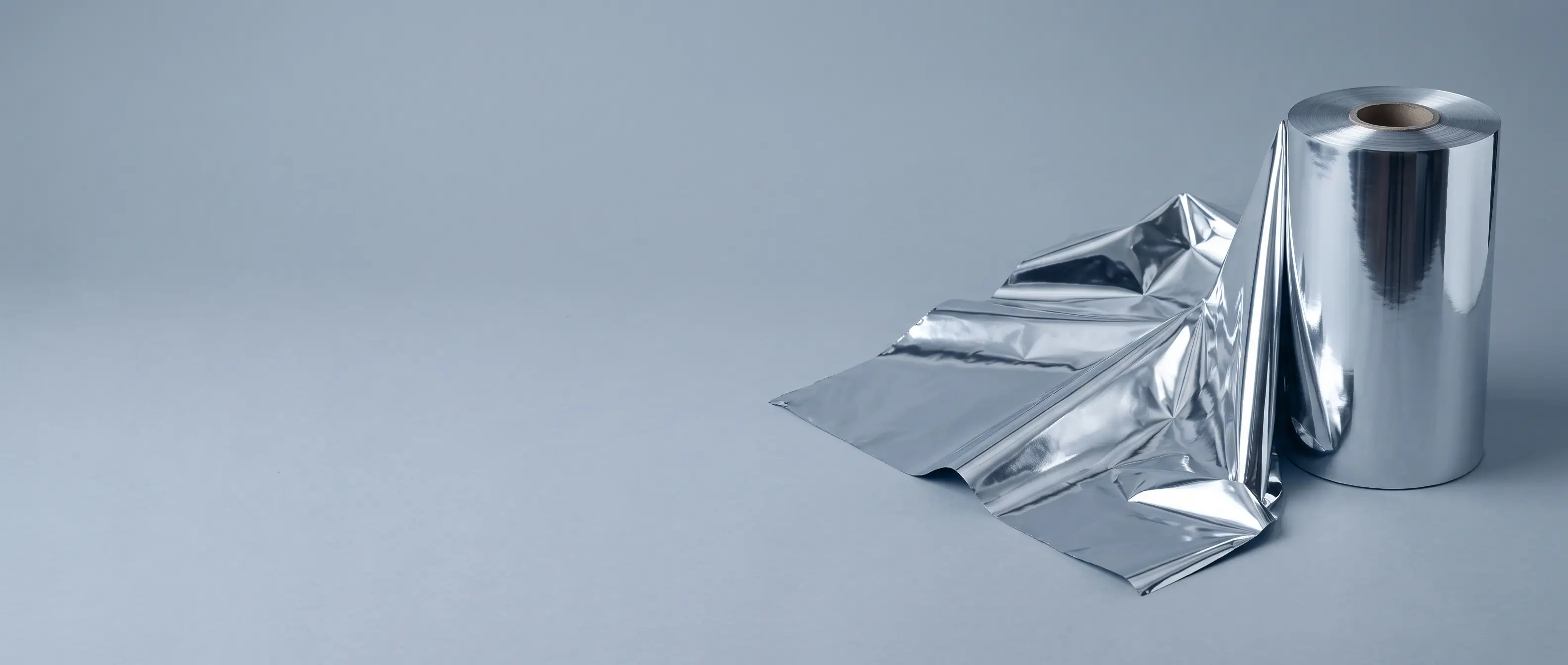
Vacuum metallising takes the oldest idea in barrier packaging — put aluminium between the product and the world — and asks how little aluminium the job actually needs. The answer is startling: a layer only nanometres thick, evaporated onto a PET or BOPP web in a vacuum chamber, delivers high oxygen and moisture barrier plus genuine light protection using roughly a hundredfold less metal than the thinnest self-supporting foil. The web contributes the mechanics; the metal contributes the physics.
The layer is specified not in nanometres but in optical density — a light-transmission measure read inline as the web leaves the metalliser, with packaging grades commonly in the OD 2–3 band. The honest boundaries: this is not foil — no dead-fold, no absolute claim; the opacity that delivers total light protection also forfeits display; the pack cannot be microwaved and blinds metal detectors; and barrier is defect-limited, qualified on the finished, converted construction — never the coated roll's certificate.
Metallised grades and constructions
metPET (metallised polyester) is the barrier reference: dimensionally stable, heat-tolerant, with strong metal adhesion — the ply of choice where barrier leads, in coffee, dried foods, lidding and pharma laminates. PET12 is the classic gauge. metBOPP (metallised polypropylene) is the volume workhorse: lighter, cheaper, moisture-strong, and the natural barrier ply of all-PP snack and confectionery laminates — where keeping the whole construction in the polypropylene family is itself a design goal.
Optical-density grades (~OD 2–3) are the metal dial: standard OD for general barrier and light duty, enhanced and maximum grades where oxygen, aroma or photo-protection targets tighten. OD is measured inline during metallising and belongs in the specification by number. High-bond and topcoated grades carry enhanced metal-to-substrate adhesion or protective topcoats for demanding converting chains and aggressive product chemistries. Metallised paper puts the same nanolayer on a fibre substrate for labels and wraps.
Construction formats matter as much as the grade. Metallised webs supply either as rolls for lamination, or as finished laminates — print web plus metallised ply plus sealant — engineered to duty. The finished route outsources handling risk to the party controlling it, and is the default for specifiers without vacuum-web experience.
Converting metallised webs: the nanolayer rules, metal edition
Aluminium bends where ceramics break, so the handling window is wider than an oxide's — but it is a window, not an exemption. Tensions stay controlled, rollers generous, nips set; crease and gusset abuse still cracks the metal; and the classic failure signature is identical — certificates pass, finished laminates fail, and the damage happened in between.
The metallised face laminates inward. The metal rides inside the sandwich, away from abrasion, print processes and the product alike. Reverse-printing the outer web against the metal gives the family's signature mirror-brilliant graphics — a commercial feature the oxides cannot match — while keeping ink chemistry off the aluminium. Adhesion is a specification item: the metal-to-web bond is the construction's quiet weak point, and high-bond grades exist for exactly the aggressive adhesives, retort duty or migrating chemistries that delaminate it.
Sealing belongs to the sealant — PE, PP or PET-seal per the pack, at that sealant's ordinary windows, with seal-jaw strain kept off the barrier-critical area. Qualification comes at the end: OTR/WVTR on finished constructions, Gelbo-type flex data where distribution is rough, adhesion after lamination, and optical consistency where the metallic look is the brand. Flat-web certificates open the conversation; finished-pack data close it.
Where metallised film earns its place: applications in depth
Metallised film's applications share one signature: a flat, flexible pack that needs serious oxygen, moisture and light protection at commodity cost, where transparency and microwave reheating are not requirements. What changes across applications is which of the metal layer's virtues - barrier, total light block, or foil-adjacent economics - is doing the deciding.
Snack & confectionery flow-wrap - metBOPP's home category: crisps, bars and confectionery in all-PP laminates — moisture barrier, light block and shelf presence at commodity cost. Coffee & dried-food laminates - metPET plies holding aroma, oxygen and light where the product punishes all three — the classic foil-replacement band. Lidding webs & sachets - Dairy and ambient lidding, stick packs and single-dose sachets — barrier plus print brilliance on the metal's mirror surface. Light-critical food & pharma - Fats, vitamins, photosensitive actives: total photo-protection from nanometres of metal — the duty no clear barrier can serve.
In each case the metal serves flat: laminate plies and lidding webs, laminated metal-inward and sealed via their sealant, never drawn into a cavity. The honest boundary travels with it - opaque, not microwaveable, and invisible to metal detectors - so products that must be seen, reheated in-pack or metal-inspected route to the transparent oxide coatings instead, and products needing an absolute, dead-fold barrier climb to genuine foil.
Specifying metallised film: substrate, OD, adhesion, proof
A metallised specification stands on a few decisions. Substrate first, by laminate family and duty: barrier-led, heat-adjacent or dimensionally demanding work takes metPET; snack-class, moisture-led, all-PP construction takes metBOPP. The host family of the finished laminate - and its recycling stream - usually decides before barrier tables do.
Optical density is the family's one dial and belongs in the specification by number: derive the barrier and light-transmission requirement from the product, pick the OD grade that meets it on the finished construction, and state it - OD is the supplier's inline-measured quantity. Name the adhesion class too: standard or high-bond grade, adhesive system per the metalliser's compatibility guidance, and bond strength after lamination as an acceptance test; metal loss to the adhesive is the family's characteristic latent defect.
Finish with the construction drawing and the verification clauses. State metal-inward lamination, print on the outer web (reverse-printed where the metallic look is wanted), a sealant web matched to the pack's seal duty and stream, and flag the operational exclusions - no microwave, no metal detection. Then verify: OTR/WVTR on finished constructions, light transmission where photo-protection is claimed, flex-crack (Gelbo-type) where transit is rough, adhesion after lamination, and recyclability of the complete construction against the destination protocol.
Designing with metallised film: flat, buried, honestly excluded
Design flat or design out. As with the oxide coatings, formed components cannot carry the nanolayer - cavities take EVOH or move to genuine foil cold-form, and the metallised ply serves the flat webs around them. Packs that respect the split get metal's virtues without fighting its physics.
Bury the metal, exploit the mirror. The layer rides inside the laminate, and its inner position is a design asset: reverse-printed graphics against the metal give the shelf brilliance that built the snack aisle's look. Matte topcoats and register-metallised effects extend the palette where brands want metal's function without its shine. Budget the folds - flow-wrap fins, gussets and crease lines are the layer's stress points; keep barrier-critical area away from the hardest folds where the format allows, and carry flex-test data where it does not.
Respect the exclusions at design time. Microwave reheating and post-pack metal detection are structural noes: products whose life includes either belong on the oxide card. And claim only what the construction earns - mono-PET or mono-PP recyclability, light-protection levels and barrier class are finished-construction claims, sealant, adhesives and inks included, verified against protocol.
Metallised-film troubleshooting: cracks, bonds and grey areas
Finished laminate fails barrier while the roll passed — the family signature. Converting stress cracked the layer (tensions, radii, nips, creases) or lamination attacked it. Audit the chain against the handling window, confirm metal-inward orientation, and qualify on finished constructions. Metal's ductility means the culprit is often a harder abuse than would injure an oxide — look for the crease, the slitter, the tight idler.
Delamination — metal separating from web or adhesive — means the metal-to-substrate bond was lost: aggressive adhesive chemistry, insufficient web treatment at metallising, product migration through the sealant, or retort-class duty on a non-rated construction. Move to high-bond grades and metalliser-approved adhesive systems; test bond strength after lamination and after any thermal process. Barrier that fades through distribution is flex-cracking in the field — reproduce it with Gelbo-type testing, then armour the construction or carry a measured barrier-after-abuse figure in the shelf-life math.
Optical defects — grey streaks, pinholing, cloudiness — are deposition-side quality or downstream abrasion on an exposed metal face: run-length streaks point to the metalliser, localised scuffing to a station handling the metal face bare. Seal-zone failures are the crush zone cracking the layer at the seal's shoulder — integrity tests pass, shelf life fails; keep the barrier ply's worst strain outside the critical area.
Barrier behaviour: high, dual, dark — and defect-limited
The nanolayer mathematics govern here as with the oxides: performance is defect-limited, set by pinholes and mechanical history rather than by metal thickness once the layer is continuous. Fresh metPET12 at standard OD lands broadly in the high-barrier band — the 0.1–1 unit class for OTR and WVTR — overlapping oxide-coated PET and the heavy clear chemistries, comfortably beyond every plain film, and short of foil's absolute. metBOPP trades some barrier for its substrate's economics and moisture strength, exactly as its snack duty prefers.
The layer is dual and humidity-calm: one deposition blocks both gases, with no EVOH-style RH derating. What metal adds is the third axis no clear barrier reaches — light. At packaging ODs the photo-protection runs high to effectively total, a structural property specified by OD that converts light-transmission clauses from laminate problems into single-ply answers.
The honest boundaries: this is not foil — no dead-fold, no absolute claim, and products whose stability files demand zero transmission still end at metal sheet, not metal vapour. The opacity that delivers photo-protection also forfeits display; and the operational exclusions — microwave, metal detection — are physics, not grades. Within those boundaries the metallised ply owns its band: the most protection per krone in flexible packaging, with the lights turned off.
Sustainability: almost foil's protection, a fraction of foil's footprint
The family's environmental case is the arithmetic of its founding idea: a hundredfold less aluminium than foil for the broad band of duties that never needed foil's absolute. Primary aluminium is energy-intensive; using nanometres where the last generation used micrometres is among flexible packaging's largest quiet dematerialisations, and every foil laminate converted to a metallised construction repeats it.
The recycling position is workable and improving: nanometre metallisation is negligible mass, current design-for-recycling guidance broadly accepts it in mono-PET and mono-PP constructions, and NIR sorting reads metallised films far better than foil laminates whose metal content confounds the optics. The disciplines are the family's usual — the claim belongs to the finished construction (sealant, adhesives, inks) verified against the destination protocol, and mixed-substrate metallised laminates remain as unrecyclable as any other mixed laminate.
Honest debits: opacity removes the "see the product" lever clear packs use against over-packaging, and the microwave exclusion pushes some reheat formats to heavier solutions. Against these stands the light-protection dividend: photo-degradation is a real food-waste channel, and for light-sensitive products the metal's total block is itself a waste-prevention technology. For the opaque, cost-led, light-critical band — a very large band — the metallised ply remains the specification the arithmetic keeps choosing.
Metallised film vs AlOx/SiOx, aluminium foil, EVOH and PVdC
Metallised film sits between two neighbours it is best understood against. Against the AlOx / SiOx oxide coatings it is the deliberate mirror image — same nanolayer grammar, opposite virtues: metal is cheaper at scale, blocks light totally and is more converting-tolerant, and gives mirror-brilliant reverse-printed graphics; the oxides are transparent, microwaveable and metal-detectable. Three product questions — must it be seen, reheated in-pack, or metal-detected? — route most specifications before a barrier table is ever opened. Against aluminium foil, metallised film is the foil-adjacent, foil-light option: foil's self-supporting sheet delivers zero transmission and dead-fold at a hundredfold the aluminium, real cost and a recycling story mono-material design cannot rescue, while the metallised ply covers the broad band of duties below foil's absolute — high barrier, total light protection, workable mono-PET/PP recyclability — at commodity cost. It is opaque and not microwavable (both consequences of the metal), and its barrier, though far above any plain film, stops short of solid foil.
What is metallised film?
A polymer web — classically 12 µm PET or BOPP — carrying a vacuum-deposited aluminium layer only nanometres thick. The metal gives the film high oxygen and moisture barrier plus light protection at a tiny fraction of foil's aluminium content, while the web keeps the mechanics of a plastic film. It serves as laminate plies and lidding webs, converted and sealed — never thermoformed.
How does metallised film compare with aluminium foil?
Foil is a self-supporting metal sheet (typically 6–9 µm and up) with absolute barrier and dead-fold; metallisation is a nanometre coating — roughly a hundred times less aluminium — with high-but-not-absolute barrier, no dead-fold, and film mechanics. Foil ends the barrier ladder; metallised film covers the broad band below it at far lower cost, weight and material intensity.
What does optical density mean for metallised film?
The standard specification of the metal layer: a logarithmic measure of light transmission through the coating. Common packaging grades run around OD 2–3 — the higher the OD, the thicker the aluminium, the better the barrier and light block. OD is measured inline during metallising and is the number to put in the specification rather than nanometres.
What barrier does metallised PET actually deliver?
Fresh metPET12 lands broadly in the high-barrier band — the 0.1–1 unit class for OTR and WVTR at standard optical densities, structure- and handling-dependent — comparable territory to the oxide coatings and well beyond plain films. As with all nanolayer barriers, the finished-construction value after converting is the number that counts.
What is the difference between metPET and metBOPP?
The substrate's career: metallised PET is the barrier reference — dimensionally stable, heat-tolerant, the ply of choice where barrier leads. Metallised BOPP is the snack-laminate workhorse — lighter, cheaper, moisture-strong and at home in crisp and confectionery flow-wrap where its whole laminate is polypropylene. Choose by the laminate's host family and the duty's barrier priority.
Can metallised film be thermoformed?
No — like the oxide coatings, the metal layer serves flat. A draw stretches the web far beyond the coating's tolerance, cracking the layer and spending the barrier. Metallised webs are laminate plies and lidding components; formed cavities take their barrier from EVOH cores or move to genuine foil-based cold-form structures.
Is metallised film microwave-safe?
No — metal in a microwave arcs and shields, and metallised packs are excluded from microwave use just as foil is. This is the family's clearest boundary against the AlOx/SiOx coatings, whose ceramic layers microwave without issue. Packs designed for in-pack reheating should not carry metallisation.
Does metallised film block light completely?
At standard packaging optical densities the light block is high to effectively total — the family's signature advantage over every clear barrier. Light-sensitive products (fats, vitamins, coffee, dairy powders) get genuine photo-protection from the metal layer; where a specification needs a stated transmission limit, OD is the dial that sets it.
How flex-sensitive is the metal layer?
Meaningfully more tolerant than the oxide ceramics — aluminium is ductile where glass is not — but still a nanolayer that cracks and abrades under converting abuse, tight radii and distribution flexing. The disciplines are the same family rules: controlled tensions, lamination metal-inward, flex-crack (Gelbo-type) data where transit is rough, and barrier qualified on the finished construction.
Does metallised film work with metal detectors?
No — even a nanometre aluminium layer triggers and blinds metal detection, so packs metal-detected after filling cannot carry metallisation. Lines that inspect through the pack use X-ray instead, or specify the transparent oxide coatings whose ceramics pass detection cleanly. This operational constraint quietly decides more specifications than barrier tables do.
Is metallised film recyclable?
The aluminium is nanometres thick — negligible mass — and current design-for-recycling guidance broadly accepts metallisation levels in mono-PET and mono-PP constructions, with NIR sorting handling metallised films far better than foil laminates. As always the claim belongs to the finished construction (sealant, adhesives, inks) verified against the destination protocol — and genuine foil laminates remain a different, harder story.
Is the aluminium layer food-safe?
Yes — in standard constructions the metal rides inside the laminate and is not the food-contact surface; the sealant web faces the product. Metallised films have decades of food-packaging history and the aluminium layer itself is inert; food-contact status, as always, belongs to the specific construction and its declaration of compliance.