Medical paper: the porous sterile-barrier lid that takes the steam autoclave
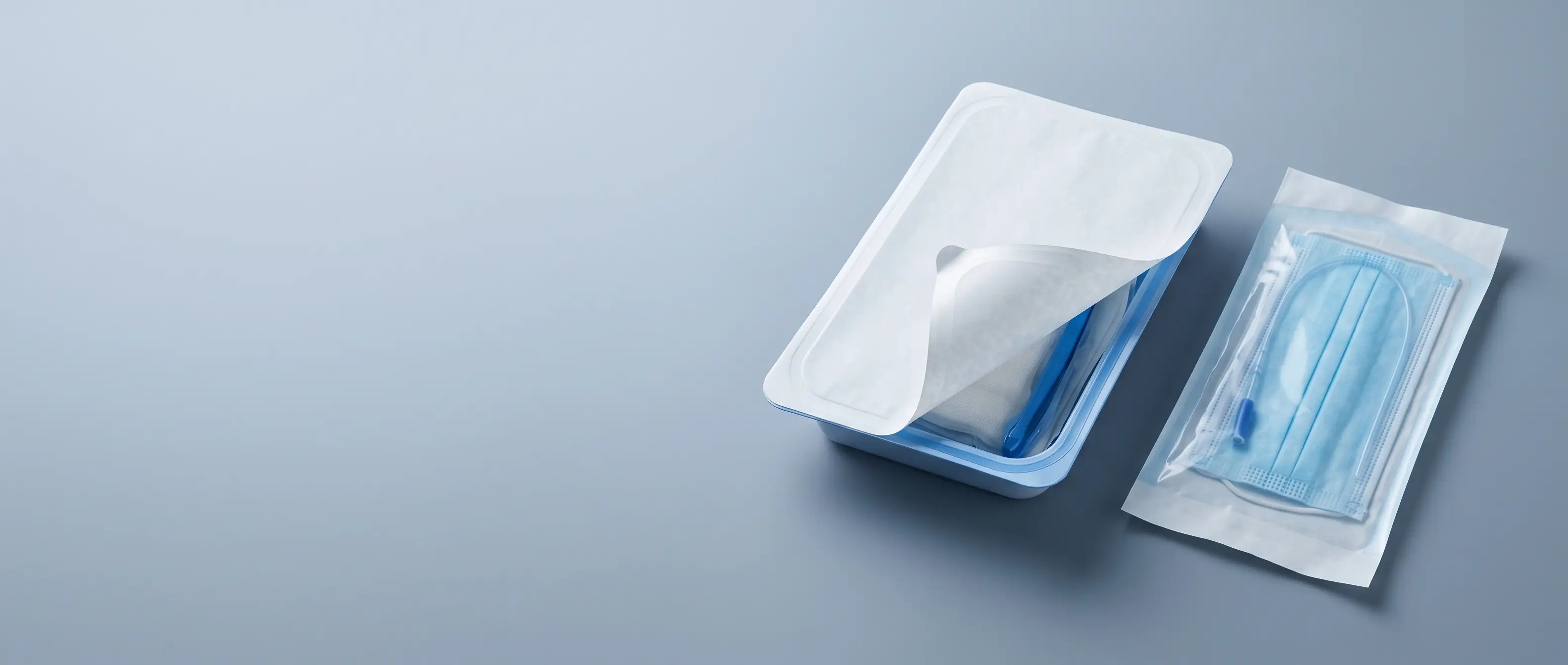
Medical paper is the original porous sterile-barrier material and, in one crucial respect, still the unbeatable one: it survives steam sterilization. Made from medical-grade cellulose — controlled, purified, bleached kraft paper engineered to demanding and consistent specifications — it does the same fundamental job as Tyvek: its porous fibre structure lets sterilant (EO gas, and critically steam vapour) pass through to sterilize the contents, while the tortuous fibre pathways form a microbial barrier that keeps bacteria out afterward. Where Tyvek's polyethylene melts in an autoclave, paper's cellulose does not — and that single difference defines the material's enduring role.
That steam capability puts medical paper at the heart of hospital and reusable-instrument sterilization, a world that runs overwhelmingly on the autoclave. Sterilization pouches (the ubiquitous paper-film peel pouch), sterilization wraps enveloping instrument sets for central-sterile departments, and steam-terminally-sterilized device lids are all paper's territory precisely because steam is the dominant hospital method and paper is the porous material that takes it. Tyvek owns EO and radiation; paper owns steam — and steam is enormous.
The material comes in two functional families. Uncoated papers serve wraps and self-seal pouches, where the barrier is achieved by folding technique or an adhesive strip rather than a heat seal. Heat-seal-coated papers carry a sealant layer that bonds peelably to tray films and pouch webs — the coating, as with Tyvek's base coating, is where the peelable, ideally fibre-tear-free bond is actually engineered. The EN 868 standard series (Part 3 covering paper specifically, alongside the broader ISO 11607 system requirements) codifies these grades and their performance.
Its limitations are the mirror image of Tyvek's: lower strength — especially wet strength, a genuine concern given steam sterilization's moisture — higher linting from loose fibres, and more variability than the fused-fibre nonwoven. Where a device is sharp, heavy or wet, where linting must be minimal, or where puncture resistance protects the barrier through hard transit, Tyvek's toughness earns its premium. Paper trades robustness for steam-capability, cost and print. For a specifier the two porous materials sort cleanly by one question: steam or not? Steam sterilization points to medical paper; EO or radiation with demanding strength points to Tyvek. Like Tyvek, paper is never a material in isolation — it is one component of an ISO 11607 sterile barrier system, validated as a whole.
Medical paper grades and formats
Uncoated medical papers (wraps/CSR) — Purified kraft papers for sterilization wraps and self-seal pouches, achieving barrier by fold technique or adhesive strip rather than heat seal — the central-sterile department's workhorse for instrument-set wrapping.
Heat-seal-coated papers — Papers carrying a sealant coating that bonds peelably to tray films and pouch webs — the coating engineers the peelable, fibre-tear-managed bond, matched to the base material (PETG/APET/PP) as with Tyvek.
Pouch papers (paper-film peel pouches) — Grades optimised for the paper face of the classic peel pouch, printed with sterilization process indicators, sealed to a transparent film face for content viewing — hospital and OEM sterilization's most familiar format.
EN 868 grades — Papers meeting the EN 868 series specifications (Part 3 for paper) — the standardised, characterised grades whose validated performance underpins compliant sterile barrier systems across Europe and beyond.
Lidding with medical paper: seal it or fold it, never form it
Like Tyvek, medical paper is a lid or a wrap, never a forming web — no forming temperature, no draw, no cavity. But paper splits into two process worlds that Tyvek does not. Coated papers seal, heat-bonding to a tray or pouch film exactly as Tyvek does, with the peelable bond engineered by the sealant coating. Uncoated papers wrap or self-seal, achieving their barrier by folding technique (sterilization wraps) or by an adhesive strip (self-seal pouches). The application chooses which world.
In the sealing world the discipline mirrors Tyvek's with paper's own tendencies: coated papers seal to PETG/APET (broadly ~120–150 °C tool as a starting point) a touch warmer than Tyvek, to PP warmer still with a matched coating, and the peelable, fibre-tear-managed bond is validated the same way — but paper's looser fibre structure makes fibre tear a sharper risk, so the seal window's upper edge is watched carefully. The lid, coating and base remain one validated system.
Steam sterilization is the process paper exists to survive, and it drives paper-specific handling. Steam is hot, saturated moisture, and wet strength is therefore a live concern: the barrier must hold through the autoclave's condensing-steam phase without weakening to failure. Medical papers are engineered for this, but it constrains basis weight, handling and design — a wet, over-stressed paper barrier is a failure mode that Tyvek's polyethylene never faces.
Printing is where paper shines mechanically: it takes process indicators (the colour-change marks confirming a pack went through sterilization), device and lot information, and instructions with a clarity and economy Tyvek cannot match — and for sterilization pouches that printed indicator is a functional part of the pack, not decoration. Print is validated as a component (indicator accuracy, legibility through sterilization, no migration) like any other element of the system.
Where medical paper leads: applications in depth
Sterilization pouches are medical paper's most visible application — the paper-film peel pouch found in every hospital and countless OEM packs. The paper face breathes for sterilization (EO or steam) and carries the printed process indicator; the transparent film face lets staff see the contents; the seal peels open for aseptic presentation. Billions are used annually, and paper's cost, printability and steam capability make it the pouch face's natural material.
Sterilization wraps (CSR) are the central-sterile department's core: instrument sets wrapped in medical paper (or paper-based nonwovens) for steam autoclaving, then stored and unwrapped aseptically in theatre. This reusable-instrument sterilization workflow is overwhelmingly steam-based — exactly paper's territory — and the wrap's fold-and-tape barrier is a validated technique embedded in hospital practice worldwide.
Steam-terminally-sterilized device lids are the tray application Tyvek structurally cannot serve: where a device and its pack are terminally sterilized by steam, a coated medical paper lid provides the porous, peelable, autoclave-surviving barrier a PETG or APET tray needs. It is the direct steam-world counterpart to the Tyvek-lidded EO/radiation tray.
The honest boundary is paper's fragility: sharp, heavy or wet devices, hard transit, minimal-linting requirements and pristine aseptic-presentation demands all push toward Tyvek's superior strength, puncture resistance and clean peel. Paper leads where steam, cost, print and hospital-workflow familiarity dominate; it yields where mechanical robustness and linting control are the governing requirements.
Specifying medical paper: the decisions that matter
A medical paper specification settles five things, and the first is decisive. Sterilization method: steam autoclave points firmly to paper (Tyvek is out); EO and radiation are shared territory where paper competes on cost and print against Tyvek's toughness. Coated or uncoated by format: coated grades for heat-sealed tray lids and pouch faces; uncoated for wraps and self-seal pouches — the format determines which, and the EN 868 grade is named accordingly.
Basis weight against wet strength: steam's moisture makes wet strength a real constraint, so basis weight is chosen for barrier integrity through the autoclave, not just dry handling — a paper-specific calculation with no Tyvek equivalent. The seal (or wrap) system validated: for coated grades, the paper-coating-base peel bond with fibre-tear and strength criteria under ISO 11607-2; for wraps, the validated fold technique and indicator system — sterile barrier as procedure.
And the printed indicator and information specified as a component: process-indicator accuracy, legibility through sterilization, and no ink migration into the barrier — on paper the print is often functional, not decorative. Specified this way — method, coating/format, wet-strength-appropriate weight, validated seal-or-wrap, functional print — medical paper delivers the steam-world sterile barrier the hospital sector runs on.
Designing medical-paper packs: fold, seal and the wet phase
Medical-paper pack design branches immediately by format. For coated-paper tray lids the discipline mirrors Tyvek: a flat, planar, adequately wide seal flange on the base; a defined peel-initiation feature for aseptic opening; and cavity design that shields the device from the more fragile paper barrier. Paper's lower strength makes device shielding more important, not less — a sharp edge that Tyvek shrugs off can breach paper.
For pouches, design the paper face as the functional-print and breathing surface and the film face as the viewing window, with the peel seal defined for one-handed aseptic opening — and size the pouch so the device does not stress the seals or abrade the paper in transit. The printed process indicator's placement and the peel direction are part of the design, validated for real use.
For wraps (CSR), design is really technique and set design: the instrument set's mass and geometry, the validated fold sequence, and the indicator-tape closure — with sharp instruments protected so they do not puncture the paper barrier during handling and storage. Design for the wet phase throughout: steam sterilization saturates the barrier, so avoid geometries that pool condensate, over-stress wet paper or trap moisture against the barrier — drainage, orientation and wet-strength-appropriate basis weight are steam-specific design inputs.
Medical paper handling: fibre tear, linting and the wet phase
Fibre tear is paper's characteristic seal defect: because the fibre structure is looser than Tyvek's fused web, an over-hot or over-pressured seal can pull fibres from the paper on peel, leaving a fuzzy, contaminating tear. Watch the upper edge of the seal window and validate for clean, fibre-tear-managed peel.
Linting runs through every converting, die-cutting, printing and handling step: paper's loose cellulose fibres shed at cut edges and under abrasion, and lint in a sterile field is a contamination event, so clean cutting, edge management and low-abrasion handling are essential — and even then paper generally lints more than Tyvek.
The wet phase is paper's unique failure mode: steam sterilization saturates the barrier, and a paper that weakens and breaches during the autoclave's condensing-steam phase is a sterility failure. Basis weight, grade and design are all chosen with wet strength in mind — a concern Tyvek's polyethylene never faces.
Medical paper barrier: porous by design, not an environmental barrier
Medical paper is a porous, breathable barrier, not an environmental one: its fibre structure is engineered to let sterilant (EO gas and, critically, steam vapour) pass through to sterilize the contents while forming a microbial barrier that keeps bacteria out afterward. That porosity is the whole point — it is what a foil lid cannot do.
Because it is porous, medical paper does not protect against oxygen or moisture ingress in storage the way a foil lid does; where a moisture- or oxygen-sensitive product needs an absolute environmental barrier, a non-porous foil lid is used instead — chosen precisely when the pack need not breathe for its sterilization method.
The barrier is validated as a system: microbial-barrier performance (characterised under EN 868 and tests such as ASTM F1608), seal or wrap integrity, and the sterilization method together determine whether a given medical paper grade and construction deliver a compliant sterile barrier.
Medical paper vs Tyvek, nonwovens and foil for sterile lidding
Medical paper vs Tyvek is the porous-lid decision, and it turns on steam and toughness. Paper survives steam autoclaving (Tyvek does not), costs less, and prints better; Tyvek answers with far greater strength — especially wet — superior puncture and tear resistance, much lower linting, and cleaner peel. Steam-sterilized, cost-driven, print-heavy hospital packs lean paper; EO or radiation packs with sharp or heavy devices, hard transit and pristine-peel needs lean Tyvek — the sterilization method usually decides first. Against paper-based nonwovens (SMS polypropylene) for wraps, nonwovens offer better drape, strength and lower linting while sharing steam capability, so the wrap market genuinely splits; paper holds on cost, print and familiarity. Against foil lidding it is porous-versus-barrier: foil gives absolute environmental barrier but cannot breathe, so it suits a pack that need not breathe during its sterilization method, whereas paper is chosen precisely because EO or in-pack steam needs vapour ingress.
Medical paper recyclability and the coating caveat
Uncoated medical papers — sterilization wraps and self-seal pouch papers — retain most of paper's renewable, fibre-stream end-of-life promise: they recover with paper and, being cellulose, keep more of paper's compostability than a plastic lid.
Coated grades trade some of that for sealing function: the heat-seal coating that enables peelable tray lidding is a non-paper layer that compromises the recyclability and compostability uncoated grades retain, so coated lidding sits between paper and plastic on end-of-life.
For a specifier chasing lower-impact packaging, the format choice carries an end-of-life consequence: where a wrap or self-seal pouch will do, uncoated paper keeps the fibre-stream advantage; where a peelable coated tray lid is required, the coating caveat is accepted for the sealing performance it buys.
Why use medical paper instead of Tyvek?
Chiefly because it survives steam sterilization, which Tyvek's polyethylene cannot - making paper the porous material of the autoclave-dominated hospital world. It is also cheaper and prints better (including sterilization process indicators). Tyvek wins on strength, puncture resistance, low linting and clean peel; the sterilization method usually decides which you need.
Can medical paper be steam sterilized?
Yes - that is its defining advantage. Cellulose withstands autoclave temperatures and steam's moisture, and its porosity lets steam vapour penetrate to sterilize the contents while the fibre structure blocks microbes afterward. This steam capability is exactly what Tyvek lacks, and it is why paper dominates hospital sterilization pouches and wraps.
Is medical paper formed like a tray?
No - like all lidding, it is never formed. Coated grades heat-seal flat to a formed tray or pouch film; uncoated grades wrap instrument sets (fold-and-tape) or close self-seal pouches (adhesive strip). The tray is the formed component; the paper is the porous, breathable top or wrap.
What is EN 868?
The European standard series for packaging materials and systems for terminally sterilized medical devices - Part 3 specifically covers paper - defining the specifications and test methods that characterise medical papers and related materials. EN 868 grades sit within the broader ISO 11607 sterile-barrier-system requirements that govern the validated whole.
What is a sterilization pouch made of?
The classic peel pouch pairs a medical paper face (porous, for sterilant breathability, carrying the printed process indicator) with a transparent film face (for viewing the contents), sealed around the edges and peelable for aseptic opening. The paper face is what lets EO or steam sterilize the sealed pouch.
Does coated medical paper still count as recyclable?
Less so than uncoated: the heat-seal coating that enables peelable tray lidding is a non-paper layer that compromises the recyclability and compostability uncoated grades retain. Uncoated wraps and pouch papers keep more of paper's renewable end-of-life promise in the fibre/paper stream; coated lidding trades some of it for sealing function.
What is wet strength and why does it matter for medical paper?
Wet strength is the paper's ability to hold together when saturated - and it matters acutely because steam sterilization soaks the barrier in condensing moisture. A paper barrier that weakens and breaches during the autoclave's wet phase is a sterility failure, so basis weight, grade and design are all chosen with wet strength in mind. It is a paper-specific concern Tyvek never faces.
Why does medical paper lint more than Tyvek?
Paper is made of loose cellulose fibres that shed at cut edges and under abrasion, whereas Tyvek's flash-spun HDPE fibres are fused into a continuous structure. Lint in a sterile field is a contamination risk, so paper demands careful clean cutting, edge control and handling - and even then generally lints more than Tyvek, one of the trade-offs against paper's steam and cost advantages.
Can medical paper be used for EO and radiation sterilization too?
Yes - paper is porous to EO gas and withstands gamma and e-beam, so it competes with Tyvek across those methods on cost and printability. Tyvek's superior strength, puncture resistance and low linting often win the EO/radiation applications with demanding devices or transit, but paper is a legitimate choice where those are not the governing needs.