HDPE packaging: the tough, chemical-resistant moisture barrier
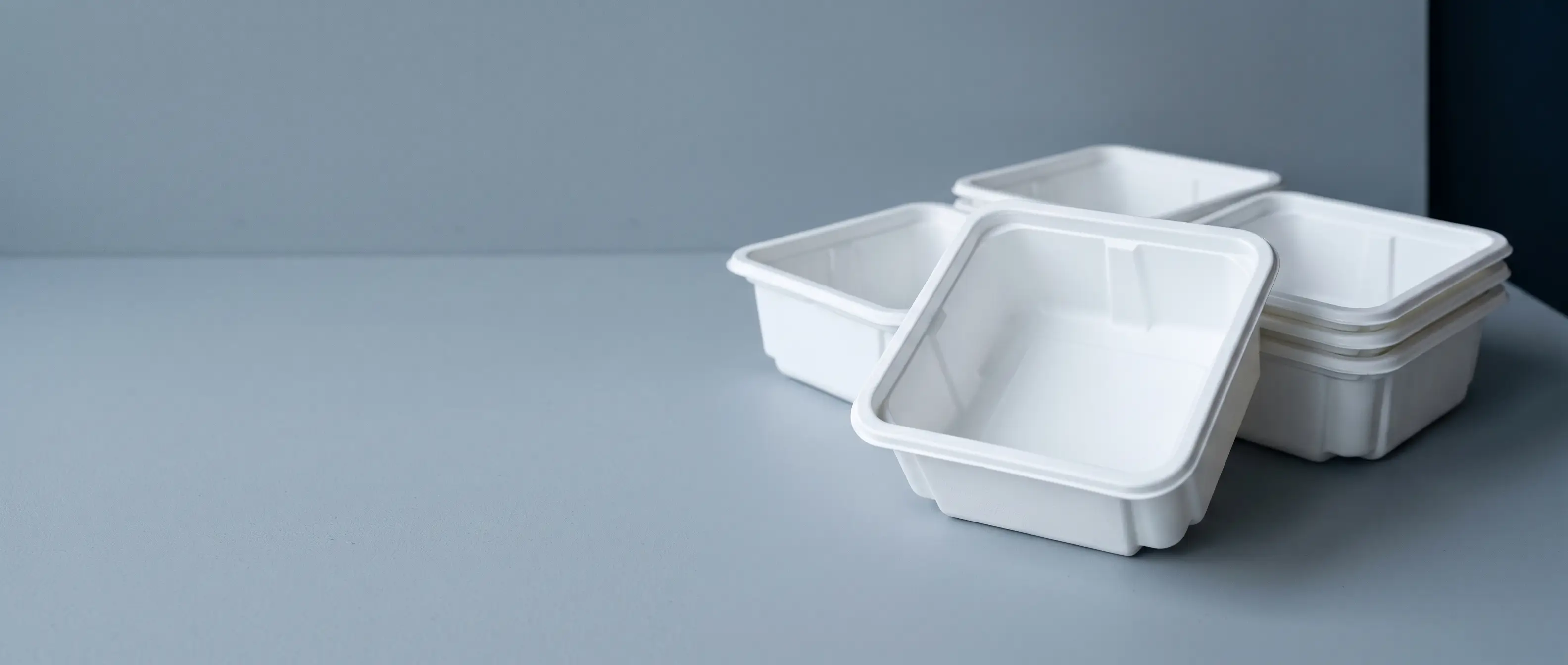
HDPE occupies a different corner of the packaging world from the clear forming films: it is opaque, semi-rigid and built for durability, barrier and chemical resistance rather than presentation. Where PET and PETG sell visibility, HDPE sells protection — an excellent moisture barrier, outstanding chemical resistance, and impact toughness that holds up even at low temperatures.
The honest trade-offs are opacity and a low-to-moderate oxygen barrier: HDPE is not for clear packaging or oxygen-sensitive shelf life. But as a semi-crystalline polymer it forms much like PP — a narrow window and higher, directional shrinkage that demand tight temperature control — while offering a recyclable mono-material (resin code #2) with a mature rHDPE supply that few other forming plastics can match.
HDPE grades and recycled content
Virgin HDPE — The standard grade: opaque, tough, chemically resistant, with an excellent moisture barrier. Used where durability, barrier and chemical resistance lead and clarity is not required.
Recycled HDPE (rHDPE) — HDPE with 30–100% post-consumer recycled content. HDPE has one of the more mature recycled supplies of any packaging plastic, and rHDPE retains strong moisture and chemical barrier performance, making it a leading choice for recycled-content durable packaging.
Food-grade HDPE — FDA/EU-compliant grades for direct food contact, used for tubs and containers where HDPE's moisture barrier and toughness suit the product. Food-grade recycled HDPE is also increasingly available through approved processes.
Medical / specialty HDPE — Grades qualified for medical and specialty use, valued for chemical resistance, toughness and (where relevant) sterilization compatibility in durable device and specimen packaging.
HMW-HDPE (high molecular weight) — The heavy-duty end of the family: higher molecular weight brings greater toughness, stress-crack resistance and long-term durability for demanding returnable and industrial forms, at the cost of more demanding processing. Where a tray's service life is measured in years and hundreds of cycles, HMW grades earn their premium.
Structured / textured HDPE sheet — Sheet supplied with moulded texture or embossed patterns, used for grip surfaces, slip resistance on dunnage, and scratch-hiding on working packaging whose cosmetics must survive years of service. Texture also disguises the slight colour variation of high-recycled-content sheet — a practical pairing with rHDPE programs.
HDPE forming temperature and semi-crystalline behaviour
HDPE forms much like PP, and for the same underlying reason: it is semi-crystalline, so it stays relatively stiff as it heats until it approaches melting, then softens over a narrow range. That gives it a narrow forming window — unlike the wide, forgiving windows of amorphous PS, PVC and PETG — and demands tight temperature control. Typical forming-surface temperatures sit around 140–165 °C, adjusted for gauge. On InnovaPax equipment, precut HDPE sheet is loaded, heated from the top, and formed with pressure from above plus vacuum from below.
HDPE also shows higher and more directional (anisotropic) shrinkage than amorphous materials as it cools and crystallises, which must be accounted for in tooling and part design to hit dimensional tolerances. Controlled cooling stabilises the part and limits warping, particularly for deeper draws. This is engineering to plan for, not a defect — but it means HDPE tooling and process setup carry more considerations than a forgiving material like PS.
Because HDPE softens over a narrow range and can sag, plug assist is important for anything beyond shallow cavities, pre-stretching and guiding the material for even wall thickness. HDPE is generally run at thicker gauges as a semi-rigid material rather than a thin film, which suits its role in durable tubs, trays and industrial packaging rather than delicate clear blisters.
One practical advantage: HDPE does not require the drying discipline of hygroscopic PET, and it tolerates regrind well. Its consistent, robust behaviour once the window and shrinkage are dialled in makes it a dependable production material for the durable, barrier-focused parts it is chosen for. A tooling-room note: HDPE's combination of shrink and toughness makes first-article patience the cheapest discipline on a new tool. Cut the tool to calculated shrink, form, stabilise parts a full day, measure, and correct once — rather than chasing warm-part measurements through multiple tool revisions.
Where HDPE leads: applications in depth
HDPE is the durable, protective end of the forming-film catalogue, and its applications share a common thread: they need an excellent moisture barrier, outstanding chemical resistance and impact toughness rather than product visibility.
Chemical & industrial trays — Trays and tubs for chemicals, lubricants and industrial parts — HDPE's chemical resistance and toughness suit aggressive contents. Moisture-critical packaging — Where an excellent moisture barrier is essential — HDPE is among the best moisture barriers of the common films. Durable / semi-rigid tubs — Tough, drop-resistant tubs and containers that must survive rough handling and cold, including freezer use. Recycled-content packaging — rHDPE (30–100% recycled) for sustainability-driven durable packaging with a strong recycling story.
In every case the choice comes back to the same balance: a moisture and chemical barrier among the best of the common films, cold-capable toughness that survives drops and freezer service, and a mono-material recyclability story (resin #2, rHDPE) that clears PPWR and retailer requirements — with opacity as no cost, because these packs protect rather than display.
Specifying HDPE: the decisions that matter
An HDPE specification earns its keep on five lines. Duty cycle first: single-trip or returnable, because everything downstream — gauge, geometry, marking — follows from whether the part must survive one journey or three hundred. Shrink and tolerance discipline: state the 2–3% allowance, the stabilisation period before measurement, and which few dimensions are actually critical — HDPE punishes specifications that pretend everything is tight.
Recycled content by number: rHDPE's maturity means the percentage can be specified confidently, with colour and cosmetic tolerance stated so recyclate variation is planned rather than disputed. Surface-energy consequences: any printing, labelling or sealing requirement must name the surface treatment (corona/flame), because untreated HDPE rejects most decoration. And washdown chemistry where relevant: returnable food-industry trays should list the cleaning agents and temperatures the part must survive — HDPE almost always passes, but the specification should say so testably.
Specified against duty cycle rather than habit, HDPE is among the most predictable and lowest-drama materials in the catalogue: it does what the datasheet says, batch after batch, wash after wash. The specifications that go wrong are the ones that treated it as a stiff, clear material it never claimed to be — matching the specification to HDPE's actual character is the whole game.
Designing HDPE parts: shrink allowance, draft and stiffening
HDPE part design starts with the largest shrink allowance of the common forming films: plan for roughly 2–3%, directional, as the material crystallises. Tooling must be cut oversize accordingly, tight tolerances belong on short features, and mating dimensions should be validated on fully cooled, stabilised parts. Designs that ignore HDPE's shrink read as tooling errors when they are really material physics.
Draft angles want to be generous. HDPE's shrink grips male tool features harder than amorphous materials do, so shallow draft that releases a PS part can lock an HDPE one; opening draft a few degrees costs little visually and saves ejection damage. For stiffness, use geometry aggressively: ribs, corrugations, stepped walls and domed bottoms. HDPE at packaging gauges is tough but flexible, and flat panels oil-can; the material rewards the corrugated-and-ribbed design language visible in every industrial HDPE tray.
Design for the duty, not the shelf: HDPE parts are usually working packaging — stacked, dropped, hosed down, frozen, returned and reused. That means stacking features rated for the filled weight, radiused corners that survive drops at freezer temperatures, drainage where washdown is real, and wall sections sized for repeated service rather than single use.
Returnable and recycled-content design close the loop: molded-in identification (resin code, ownership marks), stackable/nestable geometry for empty return logistics, and colour and cosmetic specs that tolerate rHDPE's slight variation. HDPE's mature recycled supply means a returnable tray can credibly be made from and return to the recycling stream — a design story worth building deliberately.
HDPE troubleshooting: warp, sag and dimensional drift
Warp is HDPE's headline defect, and it is crystallisation mechanics: uneven or too-fast cooling locks differential shrinkage into the part, which releases as bow and twist. Fixes: even, patient cooling with adequate in-tool time; symmetric cooling where possible (the tool-side face cools faster than the air side); and geometry that resists warp — ribs and corrugations fight it structurally. A design full of large flat panels will warp in HDPE no matter how good the process; give the material geometry to hold onto.
Dimensional drift — parts in tolerance at the machine and out of it a day later — is post-crystallisation shrinkage completing. HDPE keeps moving longer than amorphous materials after forming. Measure and qualify against stabilised parts (24 hours is a reasonable discipline), and if drift is chronic, revisit the tool's shrink allowance rather than chasing the process.
Sheet sag during heating: as with PP, semi-crystalline HDPE softens abruptly near its melting range and droops. Even zoned heating, tight dwell control and gauge-appropriate heat times manage it; persistent sag at correct settings suggests the sheet or grade, not the machine. Uneven walls and thin corners follow the semi-crystalline pattern: temperature-profile unevenness plus insufficient plug assist. Map sheet temperature across zones first, then verify plug geometry delivers material to the deep sections before final forming.
Poor weld or seal performance in lidded or sealed HDPE formats usually reflects HDPE's low surface energy: it seals well to itself and polyolefin-compatible layers but poorly to polar sealants, and printing or labelling similarly needs surface treatment (corona/flame) to key. Seal and decoration failures on HDPE are usually compatibility and surface-energy questions before they are process questions.
HDPE barrier: excellent moisture, lower oxygen
HDPE's barrier strengths are moisture and chemicals. Its moisture barrier is excellent — among the best of the common forming films — and its chemical resistance is outstanding, resisting acids, bases, solvents and oils. This pairing is precisely why HDPE dominates packaging for moisture-critical and chemically aggressive contents, from detergents and lubricants to moisture-sensitive dry goods.
Its weakness is oxygen: like other polyolefins, HDPE offers only a low-to-moderate oxygen barrier, so oxygen-sensitive products with long shelf lives are not HDPE's natural fit without an added barrier layer. Where both HDPE's moisture/chemical strength and an oxygen barrier are needed, multi-layer structures (for example with EVOH) are used — adding the usual multi-material recyclability considerations.
The clean guidance is to match HDPE to its strengths: choose it when moisture barrier, chemical resistance and toughness lead — a large and valuable set of industrial and durable-goods applications — and look elsewhere, or to a multi-layer structure, when a high oxygen barrier or product clarity is the governing requirement.
HDPE recyclability and recycled content
HDPE has one of the strongest sustainability positions of any packaging plastic. It is a recyclable mono-material carrying resin identification code #2, and — crucially — it is widely accepted in curbside recycling with a mature, well-established recycling stream. Under the PPWR's grading of packaging by recyclability, HDPE sits firmly on the favourable side, and keeping HDPE packaging mono-material preserves that advantage.
Its recycled supply is genuinely mature. Recycled HDPE (rHDPE) is available at 30–100% content and, importantly, retains its key performance — strong moisture and chemical barrier and toughness — so recycled content does not force a meaningful compromise for many durable applications. Food-grade rHDPE through approved processes is also increasingly available. This makes HDPE one of the easier materials on which to meet rising recycled-content obligations.
The design guidance is straightforward and favourable: keep HDPE packaging mono-material to preserve its clean recyclability, specify rHDPE where recycled-content targets or sustainability positioning call for it (the performance penalty is small), and reserve multi-layer structures for the specific cases that genuinely need an added oxygen barrier. For durable, barrier-focused packaging, HDPE offers a rare combination of real performance and a strong, real-world recycling credential.
HDPE vs PP vs PET for thermoformed packaging
HDPE vs PP. These two semi-crystalline polyolefins are close cousins, and are often the choice for durable, chemical- or moisture-focused packaging. Both offer excellent moisture barriers, good chemical resistance and recyclability, and both have narrow forming windows. HDPE edges ahead on cold-impact toughness and chemical resistance and is a touch stiffer; PP is lighter, offers higher heat resistance (microwave/hot-fill), and can be made clear in clarified grades. Choose HDPE for maximum toughness, cold impact and chemical resistance; choose PP when heat resistance, lower weight or clarity matters. HDPE vs PET. They rarely compete directly because they serve different needs: PET is clear, an all-round performer with a moderate barrier and mature recyclability; HDPE is opaque, with a superior moisture and chemical barrier and greater toughness. Where product visibility and balanced performance lead, PET wins; where an excellent moisture/chemical barrier and durability lead and opacity is acceptable, HDPE wins. They are complementary rather than substitutes. Where HDPE leads. HDPE is the material of choice whenever packaging must combine an excellent moisture barrier, outstanding chemical resistance and impact toughness — industrial and chemical packaging, durable tubs, freezer-capable containers — backed by a strong, curbside-friendly recycling story. Its constraints are opacity and a lower oxygen barrier, which simply steer it away from clear, oxygen-sensitive applications toward the durable, protective ones it excels at.
What is HDPE best used for in packaging?
HDPE excels where an excellent moisture barrier, outstanding chemical resistance and impact toughness are needed — industrial and chemical packaging, durable and freezer-capable tubs and trays, and moisture-critical products. It is opaque, so it is chosen for protection and durability rather than product visibility.
What is the forming temperature of HDPE?
Typically a sheet-surface temperature around 140–165 °C, adjusted for gauge. As a semi-crystalline polymer HDPE has a narrow forming window and needs tight temperature control, similar to PP. Treat any figure as a starting range and fine-tune on your line.
Is HDPE hard to thermoform?
It is more demanding than amorphous materials. Being semi-crystalline, HDPE has a narrow forming window and higher, more directional shrinkage, so it needs precise temperature control, plug assist and careful tooling and cooling — much like PP. It is dependable once the window and shrinkage are dialled in, and is usually run at thicker, semi-rigid gauges.
Does HDPE have a good barrier?
HDPE has an excellent moisture barrier — among the best of the common films — and outstanding chemical resistance, but only a low-to-moderate oxygen barrier. It suits moisture-critical and chemically aggressive contents; oxygen-sensitive products with long shelf lives need an added barrier layer (for example EVOH in a multi-layer structure).
Is HDPE recyclable?
Yes — strongly so. HDPE is a recyclable mono-material with resin code #2, widely accepted in curbside recycling, with a mature recycling stream. It is one of the best-positioned packaging plastics under the PPWR, and recycled HDPE (rHDPE) is widely available.
Can I use recycled HDPE (rHDPE)?
Yes — rHDPE is available at 30–100% recycled content and retains strong moisture and chemical barrier performance and toughness, so recycled content involves little compromise for many durable applications. Food-grade rHDPE through approved processes is increasingly available too, making recycled-content targets easier to meet.
HDPE or PP — which is better?
They are close cousins. HDPE edges ahead on cold-impact toughness, chemical resistance and stiffness; PP is lighter, more heat-resistant (microwave/hot-fill) and can be made clear. Choose HDPE for maximum toughness, cold impact and chemical resistance; choose PP when heat resistance, lower weight or clarity leads.
Why is HDPE opaque?
As a semi-crystalline polymer, HDPE's crystalline regions scatter light, making it naturally opaque or translucent rather than clear. This is why HDPE is selected for durability, barrier and chemical resistance rather than product visibility — for clear packaging, an amorphous material like PET or PETG is used instead.
What shrinkage allowance should HDPE tooling use?
Plan for roughly 2–3%, directional — the largest of the common forming films — and cut tooling oversize accordingly. Keep tight tolerances on short features, and qualify dimensions on parts stabilised for around 24 hours, because HDPE continues shrinking after forming as crystallisation completes.
Why did my HDPE part warp, and how do I fix it?
Warp is locked-in differential shrinkage from uneven or too-fast cooling — crystallisation mechanics, not tooling error. Cool evenly and patiently with adequate in-tool time, and give the design warp-resisting geometry: ribs, corrugations and stepped walls. Large flat panels will warp in HDPE regardless of process skill.
What gauge does thermoformed HDPE typically run?
Heavier than retail films: durable trays and dunnage commonly run 1–3 mm and beyond, because HDPE's role is structural. Gauge follows the duty cycle — single-trip protective forms sit at the light end, multi-hundred-cycle returnable trays at the heavy end — with ribs and corrugations doing as much structural work as raw thickness.
Can HDPE be printed or labelled?
Only with surface treatment — HDPE's low surface energy rejects most inks and adhesives untreated. Corona or flame treatment immediately before decoration is standard, and in-mould or moulded-in identification (embossed logos, resin codes, ownership marks) sidesteps the problem entirely for returnable assets, which is why embossing dominates industrial HDPE marking.
Is HDPE food-safe?
Yes — food-grade HDPE meets EU and FDA food-contact requirements and has decades of food-contact history from milk bottles onward. Its chemical inertness works in food's favour: no plasticizers, no chlorine, minimal interaction with contents. Food-grade recycled HDPE through approved processes extends the same clearance to recycled content.
Can HDPE parts be welded or joined?
Yes, and better than most forming films: HDPE welds excellently to itself by hot-plate, hot-gas and spin methods, which industrial fabrication exploits for tanks and assemblies. Adhesive bonding, by contrast, is poor without surface treatment — HDPE's low surface energy rejects most adhesives — so joining strategy should prefer welding or mechanical features over glue.
How does HDPE differ from LDPE in thermoforming?
HDPE's higher density and crystallinity make it markedly stiffer and stronger, with a better moisture barrier and higher temperature tolerance — the structural member of the polyethylene family, and the one that thermoforms into self-supporting trays. LDPE is soft, flexible and tough, at home in films and squeeze applications rather than rigid forming; where an LDPE-formed part would slump, HDPE holds its shape.
Does HDPE become brittle over time or in sunlight?
Not meaningfully with age indoors — HDPE's long-term stability is excellent — but unstabilized HDPE does degrade under prolonged UV exposure, chalking and embrittling over months to years outdoors. For outdoor or greenhouse service, specify UV-stabilized grades (carbon black being the classic, near-permanent solution); for normal indoor packaging and dunnage duty, standard grades hold their properties for the part's working life.