CPET packaging: the dual-ovenable, freezer-to-oven tray film
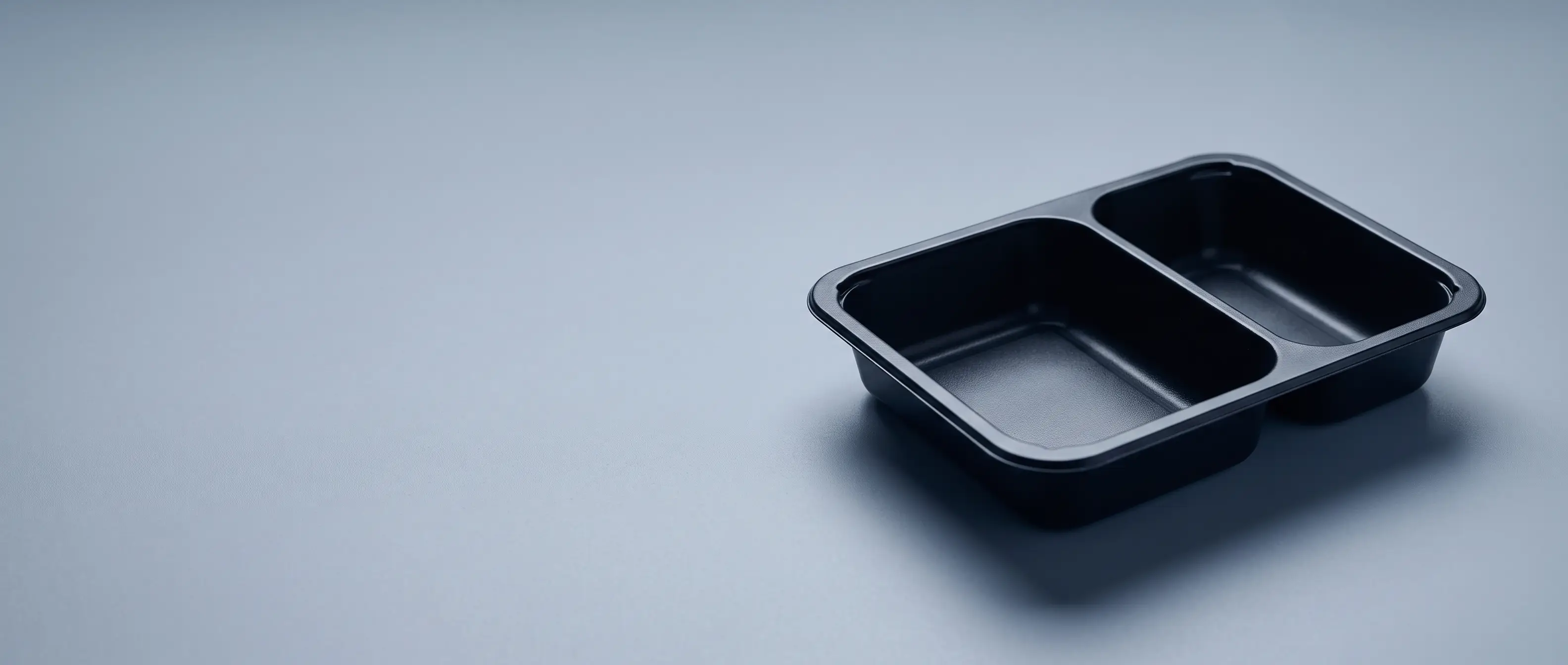
CPET (crystallised PET) is the heat-resistant member of the PET family, and it exists to solve the one problem plain PET cannot: standard amorphous PET (APET) softens around 70 °C, which rules it out of anything that must be heated in a tray. Crystallising the same polymer — heat-setting it so its molecular chains lock into an ordered, semi-crystalline structure — transforms that behaviour. The result is a rigid, opaque (usually black) forming film that stays dimensionally stable across an enormous temperature span and is the default material for dual-ovenable ready-meal trays.
The signature capability is temperature range. A CPET tray withstands freezer storage down to about −40 °C and then goes straight into a conventional oven or microwave at up to 200–220 °C without warping, melting or losing shape — a genuine freezer-to-oven, dual-ovenable material. That single property is why chilled and frozen ready meals, oven-baked convenience foods and hot-fill applications specify CPET where APET would collapse. It keeps PET's food-contact compliance and chemical inertness while adding the heat resistance APET lacks.
The trade-offs are honest. CPET is opaque, not clear, so it is a protective and functional tray rather than a display pack — the crystalline structure that gives heat resistance also scatters light. It must be formed in a hot crystallising mould rather than cold-formed, which makes it a more specialised, slower forming process than APET. And while CPET is chemically PET (resin #1) and recyclable in principle, in practice its black colour and crystalline, tray-shaped form mean it is frequently not sorted in kerbside PET streams — the recyclability is real on paper but weaker in the field than a clear APET bottle.
CPET grades and the PET family: APET, PETG, rPET and CPET
"PET" is a family of related grades that share one base polymer but behave very differently on the line and in the field, and CPET is the specialised heat-resistant member. Choosing correctly between the family members is usually more consequential than choosing PET in the first place.
APET (amorphous PET) is the clear workhorse — the standard thermoforming grade for the vast majority of cold trays, blisters and clamshells. It offers PET's clarity, strength and formability and is easily cold- or warm-formed, but it softens around 70 °C and is not ovenable. PETG (glycol-modified PET) trades some of that for extra toughness, impact resistance and a wider forming window, suiting demanding industrial and medical parts, again in cold service.
CPET (crystallised PET) is the heat-resistant grade. By heat-setting the polymer into a semi-crystalline structure — usually with nucleating agents that guide and speed crystallisation — it gains dimensional stability at high temperature. This makes it the material for ovenable and dual-ovenable ready-meal trays that travel from freezer to oven, an application no other mainstream PET grade survives. The crystalline structure is also what makes CPET opaque, and it is very commonly pigmented black.
rPET (recycled PET) is not a separate grade but recycled content designed into a PET structure, central to meeting recycled-content targets. Recycled content can be incorporated into CPET, but colour and clarity are already compromises in CPET (it is opaque anyway), so pigmented/black CPET is a natural home for some recyclate. Across the family the pattern is consistent: pick APET for clear cold packs, PETG for tough cold parts, CPET for heat — and treat each as a distinct material with its own forming behaviour and its own material card.
CPET forming: crystallising in a hot mould, not cold-forming
CPET's forming process is fundamentally different from APET's, and the difference is crystallisation. Where APET is thermoformed and quenched cold to stay amorphous and clear, CPET must be formed in a HOT crystallising mould so the polymer can develop its ordered, semi-crystalline structure while it is held in shape. It is not cold-formed; the heat of the mould is doing chemistry, not just shaping.
In practice a CPET sheet is heated to soften it, formed against a hot tool, and held so that crystallisation is heat-set into the final geometry. Typical crystallising mould temperatures sit in the region of 170–190 °C (with an operable window roughly 150–215 °C), and nucleating agents in the resin accelerate and control the crystallisation so cycle times stay workable. The tray only earns its heat resistance if that crystallisation is achieved properly and evenly — under-crystallised CPET behaves more like APET and can distort in the oven.
Because the process relies on hot tooling and heat-setting, CPET forming is more specialised and generally slower than APET forming. Tooling, heating profile and dwell must all be tuned to reach the target crystallinity across the whole part, including thick corners and deep draws. This is why CPET is a made-to-spec, sourced-to-order material rather than an off-the-shelf cold-form sheet.
The mechanism otherwise follows familiar thermoforming logic — a precut sheet is positioned, heated, and formed with pressure and vacuum, with plug assist for deeper cavities — but every parameter is shifted upward and the cooling step is replaced by a controlled hot heat-set. Get the crystallisation right and the tray is dual-ovenable; get it wrong and it warps the first time it sees an oven.
Where CPET leads: applications in depth
CPET is the ovenable end of the forming-film catalogue, and its applications share one demand: the tray must survive heat that would destroy standard PET. They are freezer-to-oven convenience formats first and foremost.
Dual-ovenable ready meals — Chilled and frozen ready-meal trays that go from freezer straight into a conventional or microwave oven up to 200–220 °C. Oven-baked convenience foods — Rigid trays for foods finished or reheated in-tray — pastries, gratins, roast components — where the pack must survive oven heat. Hot-fill & high-temperature packs — Formats filled hot or exposed to sustained heat where APET would deform; CPET holds shape and dimensional stability. Freezer-to-oven catering trays — Single- and multi-compartment trays for chilled/frozen catering, prepared cold and regenerated hot in the same tray.
In every case the choice comes back to the same balance: dual-ovenable heat resistance from about −40 °C to +200/220 °C, dimensional stability that holds shape through a full reheat or bake, and PET food-contact compliance — with opacity as no cost, because these packs are cooked in rather than displayed through.
CPET in the oven: dual-ovenable performance and its limits
CPET's whole reason for existing is what happens at temperature. A properly crystallised CPET tray is dual-ovenable — usable in both conventional and microwave ovens — and holds its shape across a span from about −40 °C in the freezer to 200–220 °C in the oven, typically withstanding oven temperatures for the duration of a normal reheat or bake without warping or melting.
That range is what makes true freezer-to-oven convenience possible: the meal is filled cold, frozen or chilled, distributed, and then regenerated hot in the exact same tray the consumer bought. No transfer to ovenware, no secondary dish. APET cannot do this at all; CPET is the mainstream material that can, which is why it dominates ovenable ready-meal packaging.
The limits are worth stating plainly. The upper figure (commonly quoted around 220 °C) is a practical ceiling for a normal reheat time, not an indefinite rating — very long, very hot bakes should be validated. Plain CPET is microwave-safe, but a CPET/foil laminate is conventional-oven-only because of the metal layer. And CPET's oxygen barrier, like all PET, is only moderate — where a hot-fill or long-shelf-life product needs more, a barrier layer or foil laminate is added, with the recyclability trade-off that implies.
Within its envelope CPET is extremely dependable: it is engineered specifically for repeated thermal cycling and dimensional stability under heat, and that reliability, more than any other property, is what buyers are paying for.
CPET barrier, sealing and lidding in practice
As a PET-based material, CPET carries PET's barrier profile: a reasonable moisture barrier and only a moderate oxygen barrier. For many chilled and frozen ready meals with a defined shelf life that is sufficient, but oxygen-sensitive or long-life products need help — either a barrier coating/layer or, at the high end, a CPET/foil laminate that adds an absolute oxygen and moisture barrier along with extra rigidity and temperature headroom.
CPET trays are almost always closed with a heat-sealed lidding film rather than by sealing the CPET to itself — this material page treats CPET as the formed tray, not as the lidding. The lidding film must be matched to the tray (a PET-compatible sealant, often a peelable ovenable lid) and rated for the same oven temperatures, so that the seal survives the same freezer-to-oven journey the tray does. Flange flatness and cleanliness matter for a reliable seal, exactly as with any formed tray.
Where the very highest barrier and temperature performance is required, the CPET/foil route wins on function but changes the recyclability and end-use story: the aluminium layer makes the pack conventional-oven-only (not microwave) and multi-material. For most dual-ovenable ready meals, plain CPET with a matched ovenable lidding film is the balanced answer; foil laminates are reserved for products that genuinely demand the extra barrier and rigidity.
Specifying CPET: the decisions that matter
A CPET specification is written around heat and process rather than clarity. State the oven duty first: conventional-only, microwave-only or genuinely dual-ovenable, and the peak temperature and dwell the tray must survive, because that sets the required degree of crystallisation and rules a CPET/foil laminate in or out (foil means conventional-oven-only). Under-specified oven duty is the commonest way a CPET tray fails — it looks like CPET but was never crystallised enough to behave like it.
Then commit to the forming and appearance realities. CPET is formed in a hot crystallising mould, so the spec should acknowledge a more specialised, sourced-to-order supply and validate crystallinity across thick corners and deep draws, not just flat panels. Colour is usually black or another opaque pigment; if kerbside recyclability matters, specify a detectable (non-carbon-black) pigment so near-infrared sorters can see the tray, and be explicit that tray-format PET collection is less mature than the bottle stream.
Finally, treat tray and lid as one ovenable system: the lidding film must be PET-matched and rated for the same freezer-to-oven journey. Specified this way — oven duty, crystallisation, pigment/sortability and a matched ovenable lid — CPET delivers the one thing no other mainstream forming film can, a tray that goes from freezer to oven and back to (in principle) the PET recycling family.
Designing CPET parts: heat-set geometry and the hot mould
CPET part design starts from heat, not cosmetics. Because the tray is crystallised (heat-set) and must hold its shape at 200 °C+, geometry has to support dimensional stability through repeated thermal cycling: generous radii, ribs and stepped walls that resist sag when hot, and stacking/nesting features that survive both freezer handling and oven heat.
The hot crystallising mould drives tooling decisions. Tooling and heating must be tuned so crystallinity is reached evenly across the whole part — thick corners and deep draws are where under-crystallisation hides, and an under-crystallised zone is the first place a tray warps in the oven. Draft and release are planned for a hot tool and a heat-set part, which behaves differently from a cold-quenched APET part.
Design for the actual journey: fill cold, freeze or chill, distribute, then regenerate hot in the same tray. That means flange design compatible with an ovenable lidding film, compartments sized for even heating, and wall sections that stay rigid at reheat temperature rather than merely at ambient. The tray is cookware for one use — it should be designed as such.
Colour and recyclability are a design decision, not an afterthought. If the programme wants a credible recycling story, design in a detectable pigment rather than carbon-black so materials-recovery sorters can identify the PET, mark the resin clearly, and be realistic in the brief about tray-PET collection maturity — building the honest recyclability position into the part rather than claiming a clear-APET-grade outcome CPET cannot match in the field.
CPET recyclability: PET in principle, harder in practice
CPET's sustainability story is more nuanced than clear APET's. Chemically, CPET is polyethylene terephthalate — the same resin #1 that underpins the world's most successful plastic recycling stream — so in principle it belongs to the recyclable PET family and a mono-material CPET tray is a mono-PET item.
In practice, two things weaken that on the ground. First, CPET is usually pigmented, very often black: black plastics are notoriously difficult for the near-infrared optical sorters used in materials recovery facilities to detect, so black trays frequently fall through to residual waste even when the polymer itself is perfectly recyclable. Second, tray-format PET (whether APET or CPET) is generally handled separately from, and less maturely than, the bottle stream that anchors PET recycling; crystalline, ovenable trays add further sorting complexity.
The honest position is therefore: CPET is recyclable in principle as PET, and detectable/kerbside-sortable trays (for example non-black CPET, or schemes with tray-PET collection) improve the real-world outcome — but a typical black CPET ready-meal tray is often not sorted in kerbside PET streams today. Under the PPWR's design-for-recycling grading, colour and sortability matter, so specifying detectable pigments where possible, and being clear-eyed about tray collection reality, is the responsible way to handle CPET's recyclability claim rather than overstating it.
CPET vs APET vs CPET/foil for thermoformed trays
CPET vs APET vs CPET/foil laminate. APET is clear, amorphous PET — the clarity and low-cost workhorse for cold trays and blisters, easily thermoformed in a cold or warm mould, but it softens around 70 °C and cannot be heated in-tray, so it is unusable for ovenable food. CPET is the same polymer crystallised (heat-set): opaque rather than clear, formed in a hot crystallising mould, and stable from −40 °C freezer to +200/220 °C oven — the material to choose the moment a tray must be dual-ovenable, at the cost of transparency and a more specialised forming process. A CPET/foil (CPET-laminated-to-aluminium) construction goes further still: bonding the CPET tray to an aluminium layer adds an absolute oxygen and moisture barrier, extra rigidity and even higher temperature headroom (suited to conventional-oven-only use, not microwave, because of the metal), at the price of higher cost and multi-material recyclability. Rule of thumb: choose APET when clarity and cost lead and no heating is involved; choose plain CPET when you need dual-ovenable freezer-to-oven performance in a mono-PET tray; choose CPET/foil when barrier, rigidity and the highest oven temperatures matter more than microwaveability and recyclability.
Is CPET ovenable?
Yes — dual-ovenable is CPET's defining property. A properly crystallised CPET tray can be used in both conventional and microwave ovens and holds its shape from about −40 °C in the freezer up to 200–220 °C in the oven, so a meal can go straight from freezer to oven in the same tray. Standard APET cannot do this because it softens around 70 °C.
What temperature can CPET withstand?
CPET is stable across roughly −40 °C to +200/220 °C. The upper figure is a practical ceiling for a normal reheat or bake, not an indefinite rating; very long or very hot cooking should be validated for the specific tray and grade.
Why is CPET usually opaque or black?
The crystalline (heat-set) structure that gives CPET its heat resistance also scatters light, so CPET is opaque rather than clear. It is very commonly pigmented black for appearance and cost. If you need a clear tray, use APET or PETG — but those are not ovenable.
How is CPET formed — can it be cold-formed?
No. CPET must be thermoformed in a hot crystallising mould (typically around 170–190 °C tooling), where the polymer is heat-set into its semi-crystalline structure while held in shape. It is not cold-formed; the hot mould is what develops the heat resistance, which makes CPET a more specialised, slower process than APET.
What's the difference between CPET and APET?
They are the same base polymer in different states. APET is amorphous — clear, cheap, easily cold-formed, but softens around 70 °C and is not ovenable. CPET is crystallised (heat-set) — opaque, formed in a hot mould, and dual-ovenable from freezer to 200–220 °C. Choose APET for clear cold packs, CPET when the tray must be heated.
Is CPET recyclable?
In principle yes — CPET is PET (resin #1). In practice, black/crystalline ready-meal trays are frequently not sorted in kerbside PET streams: black pigment defeats near-infrared sorters and tray-format PET is handled separately from the bottle stream. Non-black, detectable CPET and dedicated tray collection improve the real-world outcome.
Is CPET food-safe?
Yes. CPET is compliant for direct food contact under both EU and FDA rules, and as a PET-based material it is chemically inert to most foods. It is specifically engineered for hot-food and ovenable use, so it is safe at the elevated temperatures its applications require.
What is CPET/foil and when is it used?
A CPET/foil laminate bonds the CPET tray to an aluminium layer, adding an absolute oxygen and moisture barrier, extra rigidity and higher temperature headroom. The trade-off is that the metal makes it conventional-oven-only (not microwave) and multi-material, so recyclability suffers. It is used when barrier and rigidity matter more than microwaveability.
Does CPET have a good barrier?
CPET has PET's profile: a reasonable moisture barrier and only a moderate oxygen barrier — adequate for many chilled and frozen ready meals with a defined shelf life. Oxygen-sensitive or long-life products need a barrier layer or a CPET/foil laminate, accepting the recyclability trade-off that a multi-material structure brings.


 style="position:absolute;inset:0;width:100%;height:100%;object-fit:cover">