COC packaging: the halogen-free moisture-barrier forming film
Cyclic olefin copolymer (COC) is what happens when polyethylene's chemistry is given a rigid backbone. Copolymerising ethylene with a bulky cyclic monomer — norbornene — interrupts the chain's ability to crystallise and stiffens it dramatically, producing an amorphous, glass-clear polyolefin: transparent like PET or PVC, but built from nothing except carbon and hydrogen. Its close sibling COP (cyclic olefin polymer) reaches similar properties by a different polymerisation route; in packaging practice the two are specified almost interchangeably, and this page treats them together.
Two properties define the material's career. The first is its moisture barrier — among the very best of any melt-processable clear polymer, several times better than PVC and PET, and in formed blister structures reaching the neighbourhood of 0.20–0.35 g/m²/day at tropical test conditions: territory otherwise occupied by PVDC coatings and PCTFE (Aclar) laminates. The second is what it lacks: no chlorine, no fluorine, no halogens at all, which places COC on the right side of every PVC- and PVDC-phase-out policy in the pharmaceutical industry, and makes it polyolefin-compatible at end of life.
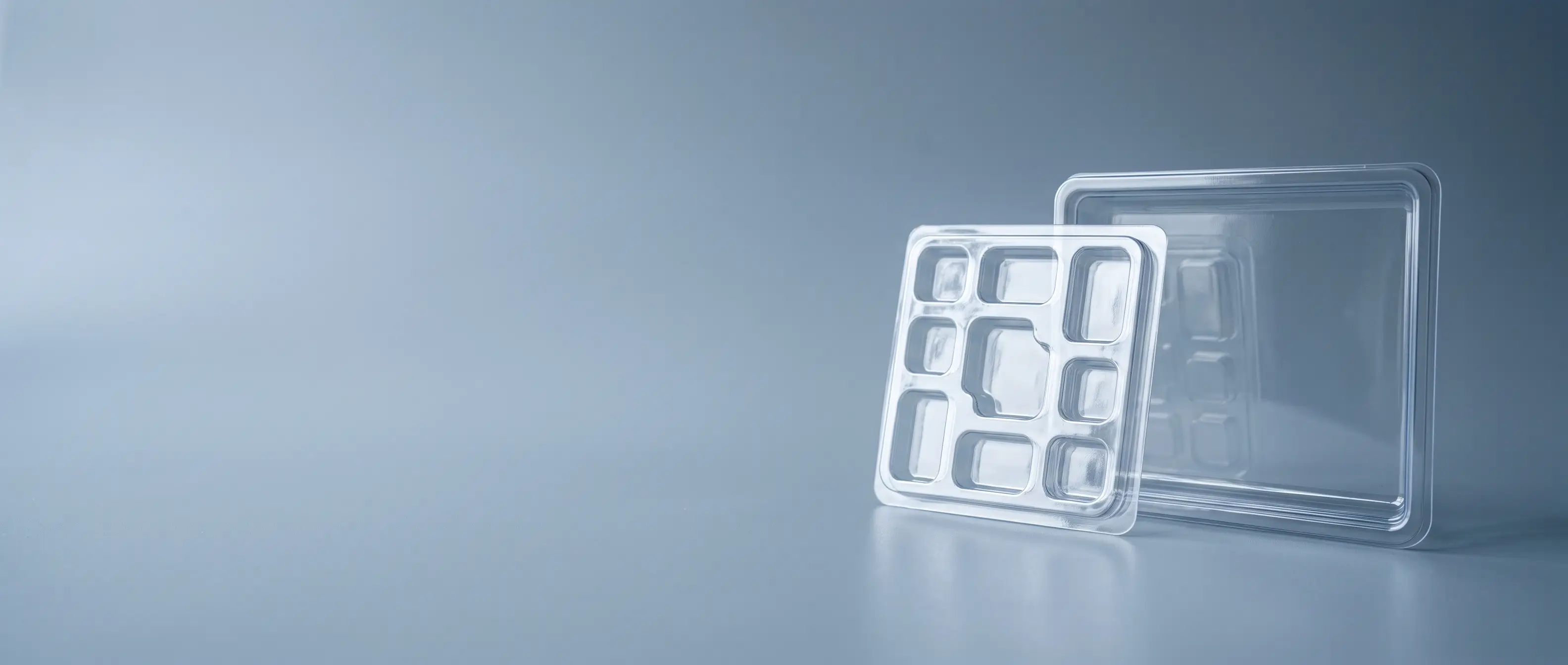
The material's weakness is equally clear-cut: neat COC is brittle. High norbornene content buys stiffness and barrier at the cost of toughness, so packaging COC almost never travels alone — the industry-standard format is a coextrusion, typically PP/COC/PP or PE/COC/PE, in which thin polyolefin skins contribute toughness, a forgiving forming surface and a heat-seal layer while the thick COC core does the barrier work. A well-known pharmaceutical example runs 30 µm PP skins over a 240 µm COC core; the structure forms and runs as one sheet.
For a packaging specifier the strategic point is this: COC is the material that lets a moisture-sensitive product exit the halogen ladder. Where the traditional escalation runs PVC → PVC/PVDC → PVC/Aclar — each rung adding barrier and halogenated chemistry together — COC structures deliver mid-to-high-rung protection with polyolefin chemistry, a clear window, and a recycling story the chlorinated stack can never tell. Its honest trade-offs are a specialist price, only a modest oxygen barrier, and neat brittleness that the coextruded skins are there to manage.
COC/COP grades and structures
Film/extrusion COC grades are the moderate-Tg grades engineered for coextrusion and thermoforming — the workhorses of blister structures, balancing formability with barrier and stiffness.
High-Tg COC grades use higher norbornene content for heat resistance (grades range up to Tg beyond 170 °C) and are used where sterilization or service temperature demands it, at the cost of a harder forming window.
COP (cyclic olefin polymer) is the ring-opening-polymerised sibling: similar clarity, purity and barrier, prominent in syringes, vials and diagnostics, and specified largely interchangeably with COC in rigid applications.
Coextruded blister structures (PP/COC/PP, PE/COC/PE) are the standard packaging format: polyolefin skins for toughness and sealing over a COC barrier core, with the structure ratios tuning barrier (core thickness) against cost and forming behaviour.
COC-enhanced polyolefin blends bring COC into PE or PP films at lower loadings — not a barrier core but a property booster, raising stiffness, heat resistance and moisture barrier of conventional polyolefin films while keeping haze low and processing conventional. The budget end of the COC family's usefulness.
Forming COC structures: PVC-like recipes, polyolefin manners
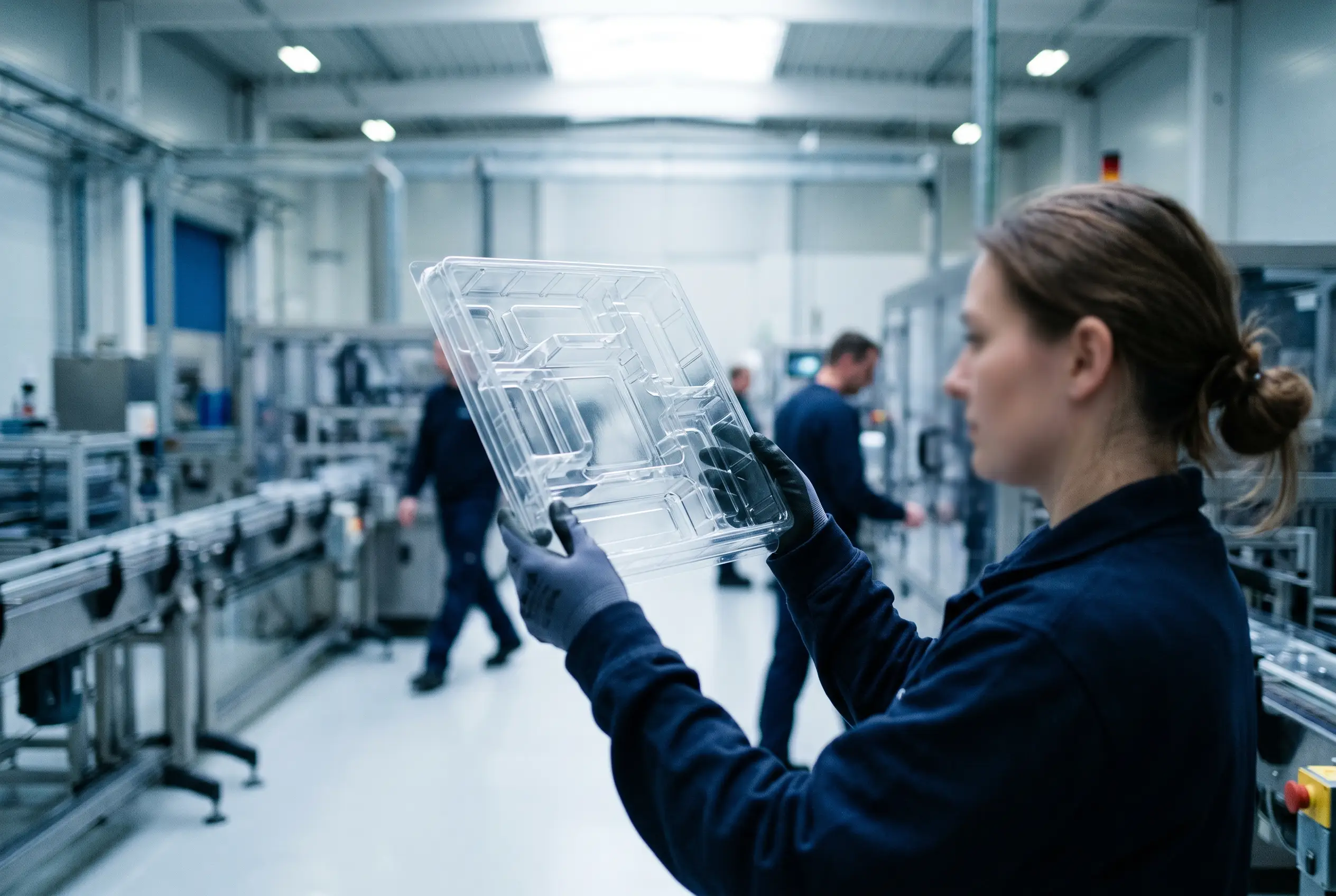
The good news first: COC blister films form much like PVC — at relatively low, comfortable temperatures with quick cycles — which is a large part of why pharmaceutical lines adopt them with modest requalification rather than re-engineering. A precut sheet is heated from above into its forming range (moderate temperatures in the region of 120–150 °C surface as a starting point, grade- and structure-dependent), then formed with pressure from above and vacuum from below in the usual way. Deep cavities form notably well — the amorphous core draws evenly — and cycle times run fast.
The material's amorphous character does the heavy lifting: no crystallisation kinetics to manage, no crystallinity-driven shrink surprises, and dimensional stability after forming that suppliers highlight as a signature property. Shrinkage is low and predictable, tolerances hold, and the recipe, once centred, stays centred — qualities that matter disproportionately on validated pharmaceutical lines where change control makes every adjustment expensive.
The coextruded structure imposes its own discipline: the sheet is a laminate and must be heated as one. The PP or PE skins and the COC core soften differently, so aggressive or uneven heating risks skin-core disagreement — surface orange peel, internal stress, or delamination in extreme abuse. Even, moderate, well-profiled heat is the rule; the structures are engineered to form together, and they do, provided the recipe respects the window rather than testing its edges.
Neat COC's brittleness surfaces in handling more than forming: mono-COC sheet and high-COC structures want gentle web tension, generous radii in tooling, and sharp trim dies — the material chips at dull tooling like PS does. In standard skinned structures the polyolefin surfaces absorb most of this, which is precisely their job; trim behaviour and edge quality follow the skins, not the core.
Sealing follows the skin: PP-skinned structures seal with PP-compatible lidding systems, PE-skinned with PE-compatible — at polyolefin seal temperatures, to foils or films lacquered accordingly. This is a genuine change from PVC lines (whose foil lacquers are PVC-specific) and belongs in the conversion plan: the lidding foil converts with the base film, as one system. Push-through function is preserved — COC structures are stiff enough for classic push-through blisters, one of the properties that made them credible PVC successors.
No drying drama completes the picture: COC is non-hygroscopic — a polyolefin through and through — so the moisture disciplines that govern PET and PLA simply do not apply. Sheet handles like PP: store it clean and reasonably protected, and form it. On lines juggling multiple materials, that simplicity is worth naming in the changeover documentation.
Where COC earns its premium: applications in depth
COC's applications share one signature: they need a clear, moisture-critical, purity-forward forming film that halogenated incumbents can only half-satisfy. What changes across applications is which of COC's virtues — barrier, halogen-freedom or optical purity — is doing the deciding.
Moisture-sensitive pharma blisters — Tablets and capsules whose stability data demand more than PVC/PVDC — COC structures deliver Aclar-class protection halogen-free. Halogen-free blister programs — Corporate and market mandates phasing out PVC and PVDC — COC is the drop-in barrier answer that keeps the blister clear. Diagnostics & labware — Microfluidics, cuvettes and diagnostic consumables exploiting COC's optical purity, low autofluorescence and biocompatibility. Moisture-critical device & sensor packs — Formed packs for electronics, sensors and desiccant-sensitive hardware where clear, chlorine-free moisture protection matters.
In every case the same properties do their jobs at once: a moisture barrier in PVC/PVDC-to-Aclar territory, a glass-clear window that keeps the product visible, halogen-free chemistry that stays on the right side of phase-out policy, and the purity that pharma and diagnostics demand. The honest boundary is the same too: COC's oxygen barrier is only modest, and its specialist price confines it to applications that genuinely need what it uniquely offers — products comfortable in PVC/PVDC economics and untouched by halogen policy will not pay for it.
Specifying COC: the decisions that matter
A COC specification stands on five decisions. Structure first: mono COC/COP for diagnostics and rigid components, or — for essentially all blister work — a coextrusion, with skins chosen (PP or PE) for the sealing system and the core gauged to the barrier target. The core thickness is the barrier dial: state the WVTR requirement from the drug's stability data and let the structure answer it, rather than copying a competitor's gauge.
Grade explicitly: norbornene content sets Tg, stiffness and the forming window, and suppliers' film grades differ meaningfully — a specification naming only 'COC' leaves the material half-chosen. The lidding system is part of the film: polyolefin skins seal to polyolefin-lacquered foils, not PVC-lacquered ones, so the foil converts with the base film and both belong in the same qualification.
Compliance documentation by market: pharma-guideline grades exist for US, EU and Japan — name the dossiers required. And the sustainability claim, verified: halogen-free is a chemistry fact, but 'recyclable in the polyolefin stream' is a market-by-market claim that should be validated for the destination before it reaches the artwork. Specified this way, COC delivers exactly what it promises; specified as 'clear barrier film', it delivers expensive surprises.
Designing COC blisters: stiffness to exploit, brittleness to respect
COC blister design begins from a pleasant surplus: stiffness. The formed cavity is rigid at modest gauge — push-through response is crisp, and thin structures protect well — so the design instinct from PVC transfers almost directly: matched cavity-to-product fit, shallow rigid domes, and gauge chosen for barrier (core thickness) as much as mechanics. Resist the urge to add gauge for comfort; in COC, gauge is barrier budget and money.
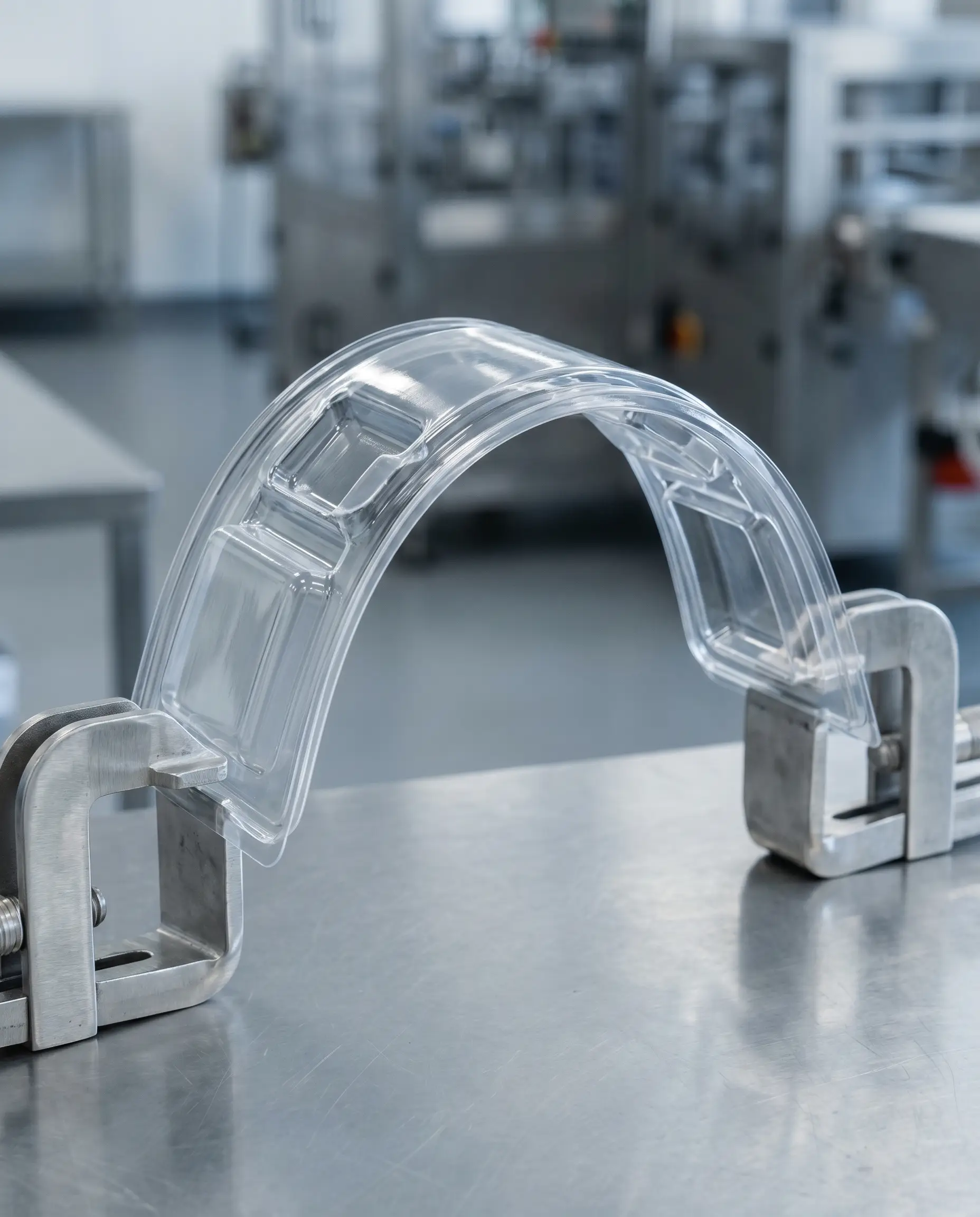
Radii discipline matters more than in PVC, because the core's brittleness — even inside skins — punishes stress concentrations in drop and flex. Generous cavity radii, no sharp internal corners, and smooth flange-to-cavity transitions keep the structure's toughness where the skins put it. Deep draws are genuinely available (the amorphous core draws evenly and deep cavities form well) — use them with radii, not against them.
Design the flange for the polyolefin seal: flat, adequately wide sealing lands sized for polyolefin-lacquer foil systems, with peel or push-through geometry chosen deliberately. Push-through works crisply against COC's stiffness; peelable systems follow the skin chemistry. Either way the foil is a designed component, selected with the film, not after it.
For diagnostics and mono-COC parts, design to the material's optical mission: flat, unstressed optical windows where measurements happen, generous radii everywhere else, and features that respect brittle-material trimming (supported trim lines, no narrow bridges). COC's dimensional stability rewards precision features — registration pins, capillary geometries — that softer films cannot hold.
Tooling transfers comfortably from the PVC world: moderate forming temperatures suit aluminium production tools and permit printed tooling for prototypes and short runs, and low, predictable shrink means the tool you cut is very nearly the part you get. Blister programs converting from PVC frequently retain footprint and cavity geometry wholesale, revalidating recipe and foil — one of COC's quietest commercial advantages.
COC troubleshooting: cracks, skin trouble and seal mismatches
Cracking or splitting — in forming, trimming or downstream handling — is the core's brittleness reaching the surface. In forming it means too-cold sheet or too-tight radii: raise and even out the (moderate) forming temperature and open the geometry. In trimming it means dull dies: COC chips like polystyrene at blunt tooling, and die maintenance is the fix. In the field it means design stress concentration or a structure too COC-rich for its handling life — thicken the skins or open the radii.
Surface orange peel, blistering or skin defects on coextruded sheet point to heating that stressed the skin-core partnership: too hot, too fast, or uneven. The skins soften before the core; aggressive radiant profiles cook them while the core catches up. Slow the heat, even the profile, and stay mid-window — coex structures reward moderation.
Delamination — skins separating from core at trim edges or flex points — is rare in intact processing and usually indicates either genuinely abusive forming (far over-temperature) or a sheet-quality problem at the coextrusion stage. Document it and involve the film supplier; no forming parameter repairs a poorly bonded structure.
Weak or inconsistent seals against lidding foil are, first and always, a lacquer-matching question: polyolefin skins demand polyolefin-compatible foil lacquers, and a PVC-lacquered foil on a COC line produces exactly the intermittent, unconvincing seals that get blamed on temperature. Verify the foil system matches the skin chemistry before touching the sealing station.
Barrier shortfalls in stability testing — a formed blister transmitting more moisture than the flat-film datasheet promised — are geometry, not material: forming thins the core exactly where the cavity draws deepest, and the barrier follows the thinnest point. Measure formed-cavity distribution, add plug assist or open the draw where thinning concentrates, and specify barrier from formed-blister data rather than flat-sheet numbers.
Barrier behaviour: a moisture specialist, honestly labelled
COC's moisture barrier is the property the material was hired for: several-fold better than PVC and PET, the best of the polyolefin family, and in practical formed blister structures typically in the region of 0.20–0.35 g/m²/day at 38 °C/90% RH — the band where PVC/PVDC operates and approaching what thin PCTFE laminations deliver. The structure's core thickness is the dial: more core, more barrier, and comparative studies on marketed drugs have found well-built COC blisters matching or beating PVDC- and PCTFE-based incumbents.
The oxygen story is deliberately modest: COC is a meaningfully better oxygen barrier than polyethylene but far from EVOH or PVDC territory, and oxygen-critical products must carry that requirement in the lidding foil, an added structure layer, or a different material choice entirely. Specifying COC for an oxygen problem is the category error to avoid; it is a moisture specialist and says so.
Beyond water vapour, COC contributes solvent and aroma barrier credentials — notably strong resistance to alcohols and polar solvents (a property exploited in sanitiser and medical-swab packaging) and useful fragrance retention — plus the purity dividends of its clean chemistry: minimal extractables, low sorption of actives, and no plasticizer or halogen migration questions to answer in a pharmaceutical review.
Sustainability: the clean-chemistry barrier
COC's sustainability identity is built on what it is not: no chlorine, no fluorine, no plasticizers — pure carbon-hydrogen chemistry in a category historically owned by PVC, PVDC and PCTFE. For pharmaceutical companies with halogen phase-out policies, that chemistry is the point: COC is how a moisture-sensitive product exits the chlorinated barrier ladder without surrendering protection or the clear window.
The end-of-life story is genuinely promising and honestly unfinished: COC is polyolefin-compatible, and all-polyolefin blister constructions (COC core, PP or PE skins, polyolefin-sealable lidding) designed for single-stream polyolefin recycling exist in patents and pilot programs — a structural recyclability no chlorinated laminate can offer. Real-world acceptance, however, remains market-by-market: pharmaceutical blisters of any material face collection challenges, and claims should be validated for the destination market rather than assumed from chemistry.
Incineration — the actual fate of most pharmaceutical packaging — also distinguishes the material: COC burns as a clean hydrocarbon, without the corrosive HCl of PVC/PVDC or the persistence questions of fluoropolymers. In lifecycle terms that is a modest advantage; in a hospital-waste and take-back-scheme context it is a practical one.
The forward trajectory tracks pharma's own commitments: PPWR pressure on packaging recyclability, corporate PVC/PVDC exit timelines, and growing scrutiny of PFAS-adjacent fluoropolymers all push blister specifications toward exactly the space COC occupies. Its constraint is price, not policy — and in regulated packaging, policy has a habit of winning.
COC vs PVC/PVDC, Aclar, alu-alu and PP
COC vs PVC/PVDC vs Aclar (PCTFE). COC's contest with the incumbent chlorinated standards is where its case is made. Against PVC/PVDC — the duplex-coated barrier standard — COC structures match the moisture protection with clear-window optics, halogen-free chemistry and a polyolefin recycling narrative; where procurement rules on price alone the coated PVDC survives, but where corporate sustainability policy or market regulation weighs in, COC's case compounds annually. Against PCTFE (Aclar), the top of the clear-barrier ladder, PCTFE remains the superior moisture barrier per micron and the choice for the most extreme products, but at fluoropolymer prices and with fluorinated chemistry that sustainability policies increasingly question; COC undercuts it substantially on cost and answers with core thickness what it concedes per micron, and the mid-market has been moving COC's way. Against cold-form alu-alu, aluminium is the absolute barrier — effectively zero transmission — but opaque, slower to form and larger per dose; COC extends how far 'clear' can climb before a product's stability data forces a surrender to foil. And against plain PP, COC is simply what the same polyolefin family becomes when the stability study demands several times more barrier: many programs sensibly ladder PP → PP/COC/PP as sensitivity rises, staying halogen-free throughout.
What is COC film used for in packaging?
Primarily as the moisture-barrier core of pharmaceutical blister films — typically coextruded as PP/COC/PP or PE/COC/PE structures — plus mono COC/COP in diagnostics, labware and moisture-critical formed packs. It combines a near-best-in-class clear moisture barrier with completely halogen-free chemistry.
How good is COC's moisture barrier really?
Among the best of any clear, melt-processable polymer: several times better than PVC or PET, and in formed blister structures typically around 0.20–0.35 g/m²/day at 38 °C/90% RH — PVC/PVDC territory, approaching thin PCTFE laminations. Core thickness is the dial; specify from formed-blister data, since forming thins the barrier where cavities draw deepest.
Is COC a replacement for PVC in blisters?
For moisture-sensitive and halogen-policy-driven programs, yes — it forms at PVC-like temperatures on the same equipment class, keeps push-through stiffness and the clear window, and frequently retains the cavity geometry wholesale. The lidding foil must convert too: polyolefin skins need polyolefin-compatible foil lacquers, not PVC lacquers.
What is the difference between COC and COP?
Two routes to the same family: COC copolymerises ethylene with norbornene; COP ring-opens and hydrogenates cyclic monomers. Properties — clarity, purity, moisture barrier, stiffness — land close enough that packaging and diagnostics specify them largely interchangeably, with COP especially prominent in syringes and vials.
Why is COC always coextruded with PP or PE skins?
Because neat COC is brittle: high stiffness and barrier come at toughness's expense. Thin polyolefin skins supply impact resistance, a forgiving forming surface and the heat-seal layer, while the thick COC core does the barrier work — a division of labour that also keeps the whole structure polyolefin-family for recycling.
What temperature does COC form at?
Comfortably low — blister structures form much like PVC, with surface temperatures broadly in the 120–150 °C region as a starting point (grade- and structure-dependent) and fast cycles. Deep cavities form well; heat evenly and moderately so the polyolefin skins and COC core soften together.
Does COC need drying before forming?
No — it is a polyolefin and essentially non-hygroscopic, so PET-style drying regimes do not apply. Store sheet clean and protected, and form it; on multi-material lines this simplicity is worth documenting in the changeover procedure.
Is COC halogen-free and what does that matter?
Yes — carbon and hydrogen only, no chlorine or fluorine. That places COC outside every PVC/PVDC phase-out policy and PFAS-adjacent fluoropolymer debate, makes its incineration clean, and enables all-polyolefin blister constructions with a single-stream recycling design that chlorinated laminates cannot match.
How does COC compare with Aclar (PCTFE)?
Aclar remains the better moisture barrier per micron and holds the most extreme products; COC answers with core thickness at substantially lower cost and with halogen-free chemistry. The mid-market trade — more COC gauge versus Aclar's premium and fluorinated profile — has been tilting toward COC in new programs.
Can COC be sterilized?
Yes — gamma, E-beam and EtO compatibility are standard for pharma/diagnostic grades, and high-Tg grades extend to steam. Combined with excellent biocompatibility and minimal extractables, this keeps COC/COP inside syringe, vial, diagnostic and device applications that most packaging films never reach.
Is COC recyclable?
By chemistry, yes — it is polyolefin-compatible, and all-polyolefin COC blister constructions designed for single-stream recycling exist in patents and pilots. In practice, acceptance is market-by-market and pharmaceutical blisters face collection challenges regardless of material; validate the destination market before making on-pack claims.
What are COC's weaknesses?
Three honest ones: neat brittleness (managed by coextruded skins and radii discipline), only modest oxygen barrier (it is a moisture specialist — carry O₂ requirements in the lid or structure), and specialist price (justified precisely where its barrier-clarity-purity-halogen-free combination is actually required).
Can existing PVC blister tooling be reused for COC?
Frequently, yes — footprint and cavity geometry often transfer wholesale, because COC forms at similar temperatures with similar stiffness and low shrink. What must convert with the film: the recipe (revalidated, not assumed), the lidding foil (polyolefin-compatible lacquer), and the sealing parameters. Programs that treat conversion as film-plus-foil-plus-recipe succeed routinely; those that swap only the sheet chase seal problems.
How thick is the COC core in a typical blister film?
Structure-dependent and driven by the WVTR target: published pharmaceutical examples run in the region of a 240 µm COC core between ~30 µm polypropylene skins, with lighter cores for milder sensitivity and heavier for tropical-climate protection. The core is the barrier dial — specify it from the drug's stability data, measured on formed blisters.
Is COC suitable for food packaging?
Yes — food-contact COC grades exist and the material's clean chemistry, clarity and moisture barrier suit premium and moisture-critical food formats. In practice its price keeps food use selective: COC-enhanced polyolefin blends and thin barrier layers are the common food-side route, while full COC structures remain pharmaceutical territory.