Blister cards: the printed backing that is also the heat-seal partner
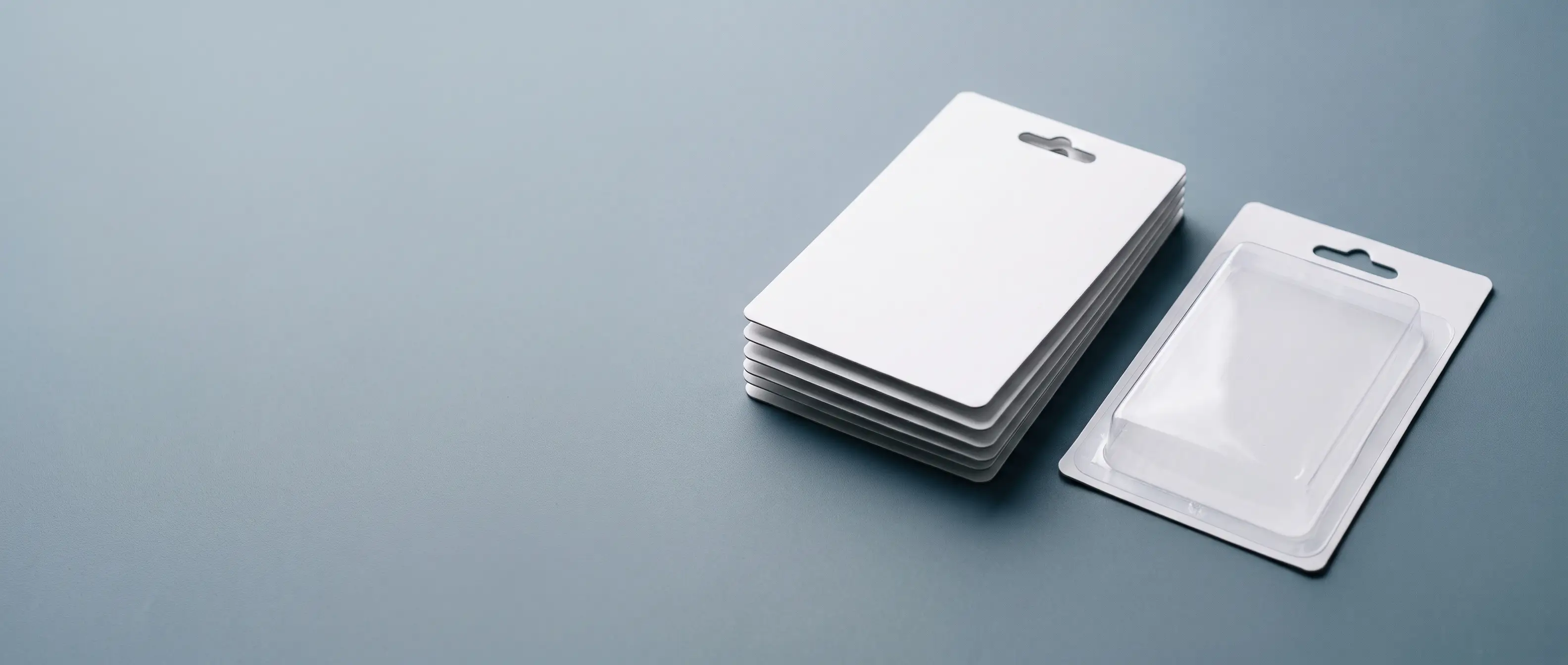
A blister card is the printed paperboard half of a retail blister pack — but it is doing two jobs at once, and that is the whole point. It is the branding: the flat, litho-printed face that carries the logo, product shot, claims, barcode and hang tab a shopper reads on the peg. And it is the seal partner: the surface a clear thermoformed blister is contact-welded to, so that the pack closes around the product without glue, staples or a second operation. The card is not a label stuck on afterward — it is a functional part of the seal.
That second job is engineered into the board. Blister card is a specially made, low-density solid bleached sulfate (SBS) paperboard, clay-coated on the print side to take sharp litho, then coated with a heat-seal blister coating — an aqueous urethane or acrylic layer that is dormant at room temperature and reactivates under a heated seal platen. When the coated card and the blister flange meet under heat, time and pressure, the coating turns to a hot, sticky mass ("hot tack") that grips the plastic and, as it cools, locks the blister to the board. A good bond fibre-tears: pull the blister off and the board's surface fibres come with it, not a clean release.
The card is the partner to a formed plastic blister, not a forming material itself. It never sees a forming tool — no draw, no cavity, no vacuum. The blister (PVC historically, increasingly PET/RPET for recyclability) is the formed component; the card is the flat backing that closes it. Which coating and which board you specify is decided by that blister: PVC seals cool and forgiving at lower platen temperatures, while PET needs a coating tuned for it, and the board caliper sets how much heat has to drive through the insulating paperboard to reactivate the coat.
The honest trade-offs are print, format and end-of-life. The card gives you a large, premium print surface and a rigid hang format at low cost — nothing beats a printed card for retail shelf impact per cent. But it is a mixed-material pack: card plus a plastic blister, and, on coated grades, a non-fibre seal coat. Uncoated or PET-compatible constructions can be steered toward a cleaner recycling story; a coated card sealed to a PVC blister is a harder one. For a specifier the card sorts by three questions: which seal format (face-seal, full-face or trapped), which blister plastic, and how recyclable the finished pack must be.
The heat-seal coating: how a blister actually welds to card
The heat-seal blister coating is what makes a blister card a seal partner rather than just a printed backing. It is a coating — typically an aqueous urethane or acrylic (solvent grades still exist) — applied over the board's print, dormant and dry-to-touch at room temperature, and engineered to reactivate at a defined temperature. When a heated seal platen presses the blister flange against the coated card, the coating softens into a hot, tacky mass that grips the plastic; as it cools under pressure the blister is locked to the board. Aqueous coatings typically reactivate around 190–205 °F, solvent grades a little lower.
Sealing is the classic time-temperature-pressure trio, and the blister plastic sets the window. Traditional PVC systems historically ran hot platens (around 350–375 °F at the tool) because PVC's clarity and low-temperature sealing dominated blister plastics for decades. Modern PET-compatible aqueous coatings are formulated to seal effectively at lower platen temperatures (roughly 250–300 °F), which reduces blister deformation and saves energy — a big part of why PET/RPET blisters are displacing PVC.
A defining constraint is that the board is an insulator. Seal heat is driven from the platen through the back of the paperboard to reach the coating, so the thicker the board, the higher the platen temperature and dwell needed to reactivate the coat without scorching. Caliper, coating and platen settings are therefore specified together — the card, the coating and the seal recipe are one system, validated as a whole, not three independent choices.
A correctly sealed card fibre-tears on peel: the coating's bond to the plastic is stronger than the board's own surface, so separating the blister lifts board fibres rather than releasing cleanly. That fibre tear is the visual proof of a real weld and the target the coating and board are engineered to hit — which is exactly why the board is a low-density SBS designed to give good fibre-tearing bonds.
Board grades and caliper: choosing the paperboard
Blister board is not general paperboard. It is a specialty, low-density solid bleached sulfate (SBS) engineered to fibre-tear cleanly when sealed to a plastic blister, and it is print-side clay-coated (coated-one-side, CIS) so it takes sharp litho on the show face while the reverse carries the seal coat. Low density matters because it is what lets the surface fibres release into the bond and give the tell-tale fibre tear of a good seal.
Caliper — board thickness in points (pt), one point being a thousandth of an inch — is the primary structural lever, and blister boards commonly run from about 16 to 24 pt. Thinner boards seal faster and cost less but flex more on the peg; heavier boards give a rigid, premium hang and survive rough handling, at the cost of higher seal temperatures and more material. The product's weight, the blister's size and the shelf's handling drive the choice.
Grade and coating are matched to the finished pack. The seal coating is specified to the blister plastic (a PVC coating versus a PET-compatible one), the print-side coating to the artwork's demands, and any over-lacquer or laminate to the desired finish and durability. Recycled-content and PET-compatible boards exist where a cleaner recycling story is wanted — the board is chosen as part of the pack's whole material and sustainability spec, not in isolation.
Print, finish and retail hang formats
Print is where the card earns its place. The clay-coated show face takes full litho CMYK plus spot colours, and the card is usually the pack's entire brand surface — logo, product photography, claims, instructions, barcode and regulatory copy all live here, at a scale and quality a formed plastic can't match. For most carded products the card, not the blister, is the pack.
Finishes build shelf appeal and durability on top of the print: aqueous or UV over-lacquer for gloss or matte, soft-touch coatings, foil stamping, embossing and spot UV are all standard on premium blister cards — with the one rule that finishes must not compromise the seal-coat area where the blister bonds. The show face is a print canvas; the seal zone is a functional surface, and the two are laid out deliberately.
The retail hang format is designed into the card. A euro-slot (euro-hole) — the standard delta/keyhole cut-out near the top — lets the pack hang straight on the pan-European hook systems every retailer shares, and it is the default hang feature. Alternatives include a round sombrero/hang-hole or a separate header card. The hang tab's reinforcement is a design decision, and it is one reason a full-face seal is chosen: the blister flange stiffens the tab and the card edges.
Tooling and the seal window: making it repeatable
Heat sealing a blister card needs a seal tool — a heated platen or sealing die shaped to press the blister flange against the coated card at the right places. Face-seal and full-face-seal formats both need this tooling and a machine that applies heat, time and pressure; trapped-blister and clamshell-insert formats avoid seal tooling entirely, which is a real cost lever at low volume. The format choice is partly a tooling-cost choice.
The seal window is the band of temperature, dwell and pressure that gives a full fibre-tearing bond without scorching the board or deforming the blister. Typical retail sealing runs platen temperatures set to reactivate the coating (with the board's insulation factored in), pressures in the tens of psi and dwell times of a couple of seconds — but the exact numbers belong to the specific board, coating and blister together, and are established by validation, not read off a chart.
Common seal defects map straight back to the window. Weak or non-fibre-tearing bonds mean too little heat, dwell or pressure (or a coating not reactivating through a heavy board); blister deformation or a wrinkled card mean too much heat; contamination on the coating — silicone or oils, a known risk with some recycled plastics — causes bond failures. A repeatable pack comes from locking the board, coating and platen recipe and controlling incoming material, exactly as any heat-seal process is validated.
Recyclability of a coated card-and-blister pack
A blister card pack is, by nature, a mixed-material construction: paperboard plus a plastic blister, and on sealed formats a non-fibre seal coating between them. That mix is what makes recyclability the honest weak point — a pack that combines card, coating and plastic generally has to be separated to recycle cleanly, and whether that happens depends on local collection and sorting rather than the pack alone.
The card itself, uncoated, would recover in the paper/fibre stream; the heat-seal coating complicates that, because it is a non-paper layer bonded into the board's surface. As with any coated paperboard, the coating is the caveat: it buys the sealing function, and it trades away some of the clean fibre-stream recyclability an uncoated card would keep. The greener the pack must be, the more the coating and format matter.
There are levers. PET-compatible coatings let the pack lean toward the PET recycling stream and can reduce the separation problem, recycled-content and fibre-based boards improve the card's story, and choosing a trapped or header format can cut the coating out entirely. For a specifier chasing lower impact, the seal format and the blister plastic carry an end-of-life consequence just as much as a cost one — the card is specified for recyclability, not only for shelf appeal.
Blister card seal defects: weak bonds, deformation and contamination
Weak or non-fibre-tearing bonds are the commonest defect and almost always mean too little energy at the seal: not enough platen heat, dwell or pressure, or a coating that cannot reactivate through a heavy board. The proof of a good seal is fibre tear — board fibres lifting when the blister is peeled — so a clean release means the coating never truly welded, and the fix is more heat, dwell or pressure within the board's window.
Blister deformation and a wrinkled or scorched card are the opposite failure: too much heat or dwell for the plastic and board. PVC tolerates hotter platens than PET, so a coating and recipe tuned for one will deform the other; matching the coating to the blister plastic and dialling the platen to the lowest reliable setting protects the pack's appearance while still fibre-tearing.
Contamination on the seal coating causes bond failures that look like a process problem but are a material one: silicone, oils or release agents on the coating or blister — a known risk when recycled plastics carry residues — stop the coating gripping. Controlling incoming board and blister, keeping the seal zone clean, and locking the validated board-coating-platen recipe is how a blister card pack is made repeatable, exactly as any heat-seal process is validated.
Blister cards and barrier: a display pack, not a barrier pack
A blister card pack is a display and containment pack, not an environmental barrier. The card is rigid, printable backing and the blister is a clear window that shows and holds the product; neither is engineered to keep oxygen or moisture out over shelf life the way a foil lid or a barrier film is. Where a product simply needs to be seen, held and hung, that is exactly right — and it is why the format dominates retail hook displays.
The seal's job is mechanical and tamper-evidence, not hermetic. A face- or full-face-seal welds the blister to the card so the pack cannot be opened and reclosed unnoticed and the product cannot fall out — a real, valuable function — but the paperboard back and the seal are not a gas or moisture barrier. A moisture- or oxygen-sensitive product needs a different construction (a barrier blister film, a foil-lidded pack) chosen for that job.
So barrier is a specification the blister card format simply does not claim. Where protection against the environment is required, it is added by the blister material or a separate barrier component, not by the card. The card earns its place on print, rigidity, hang and heat-seal partnering — and it is specified honestly for those, not as a barrier.
Face-seal, full-face, trapped and clamshell-insert compared
The blister card decision is really a seal-format decision, and it turns on cost, durability and openability. A face-seal card seals only the blister's flange to the front of a single card — the lowest-cost, most common retail format, with the card face left open around the blister. A full-face seal extends the blister's flange across the whole card face, sealing edge to edge: more durable, a reinforced hang tab and a more premium feel, at higher plastic and tooling cost. A trapped blister uses no heat seal at all — the formed blister is sandwiched between a folded card or two glued cards, so it needs no seal coating or seal tooling, ships robustly, but is harder for a shopper to open and less crisp on shelf. A clamshell-insert card is not a seal partner but a printed insert or header dropped into an all-plastic clamshell. Face-seal for lowest cost and best shelf show; full-face for durability and premium feel; trapped when heat-seal tooling is to be avoided; clamshell-insert when the plastic, not the card, is the structure.
Blister card recyclability and the coating caveat
A blister card pack is, by nature, a mixed-material construction: paperboard plus a plastic blister, and on sealed formats a non-fibre seal coating between them. That mix is what makes recyclability the honest weak point — a pack that combines card, coating and plastic generally has to be separated to recycle cleanly, and whether that happens depends on local collection and sorting rather than the pack alone.
The card itself, uncoated, would recover in the paper/fibre stream; the heat-seal coating complicates that, because it is a non-paper layer bonded into the board's surface. As with any coated paperboard, the coating is the caveat: it buys the sealing function, and it trades away some of the clean fibre-stream recyclability an uncoated card would keep. The greener the pack must be, the more the coating and format matter.
There are levers. PET-compatible coatings let the pack lean toward the PET recycling stream and can reduce the separation problem, recycled-content and fibre-based boards improve the card's story, and choosing a trapped or header format can cut the coating out entirely. For a specifier chasing lower impact, the seal format and the blister plastic carry an end-of-life consequence just as much as a cost one — the card is specified for recyclability, not only for shelf appeal.
What is a blister card?
A blister card is the printed paperboard backing of a retail blister pack - a flat, litho-printed card, coated with a heat-seal blister coating, that a clear thermoformed plastic blister is sealed to. It does two jobs at once: it carries the branding, barcode and hang tab a shopper reads on the shelf, and it is the seal partner the blister contact-welds to, closing the pack around the product without glue or staples.
How does a blister seal to the card?
Through a heat-seal coating on the card. The coating - usually an aqueous urethane or acrylic - is dormant at room temperature and reactivates under a heated seal platen. When the blister flange is pressed against the coated card with heat, time and pressure, the coating turns to a hot, sticky mass that grips the plastic and, as it cools, locks the blister to the board. A good bond fibre-tears: peeling the blister lifts board fibres rather than releasing cleanly.
What is the difference between face-seal, full-face and trapped blisters?
A face-seal card seals only the blister's flange to the front of a single card - lowest cost, card face left open around the blister. A full-face seal extends the flange across the whole card face, sealing edge to edge for more durability and a reinforced hang tab, at higher cost. A trapped blister uses no heat seal at all: the blister is sandwiched between a folded card or two glued cards, so it needs no seal coating or tooling but is harder to open.
Is a blister card thermoformed like the blister?
No. The card is never formed - no draw, no cavity, no vacuum. The clear plastic blister (PVC or PET) is the thermoformed component; the card is the flat, coated backing it seals to. The card is a heat-seal partner, not a forming material.
What board is used for blister cards?
A specialty, low-density solid bleached sulfate (SBS) paperboard, print-side clay-coated so it takes sharp litho and coated on the seal side with a heat-seal blister coating. The low density is deliberate - it lets the surface fibres release into the bond and give the fibre tear that proves a good seal. Caliper commonly runs from about 16 to 24 pt, chosen for the product's weight and shelf handling.
Can blister cards seal to both PVC and PET blisters?
Yes, but the coating is matched to the plastic. PVC historically dominated blister plastics and seals cool and forgiving at higher platen temperatures; PET (and RPET) needs a PET-compatible coating that seals at lower temperatures, reducing blister deformation and saving energy. You specify the seal coating to the blister you are sealing to - it is not one coating for everything.
What is a euro-slot on a blister card?
A euro-slot (euro-hole) is the standard delta/keyhole-shaped cut-out near the top of the card that lets the pack hang straight on the pan-European retail hook systems every store shares. It is the default hang feature for carded packs; alternatives include a round hang-hole or a separate header card. On a full-face-seal pack the blister flange can reinforce the tab around the slot.
Are blister card packs recyclable?
Only with caveats. A sealed blister card is a mixed-material pack - paperboard, plastic blister and a non-fibre seal coating - so it generally has to be separated to recycle cleanly, and whether that happens depends on local systems. Uncoated, the card recovers in the fibre stream, but the heat-seal coating complicates that. PET-compatible coatings, recycled-content boards and trapped/header formats are the levers that improve the story.
What seal temperature does a blister card need?
It depends on the blister plastic and the board caliper. Traditional PVC systems historically ran hot platens (around 350-375 F at the tool); modern PET-compatible aqueous coatings seal at lower platen temperatures (roughly 250-300 F). Because the board is an insulator, seal heat must drive through it to reactivate the coating, so a heavier caliper needs a higher setting. Exact numbers belong to the specific board, coating and blister, validated together - not read off a chart.