Alu-Alu: where the barrier ladder ends
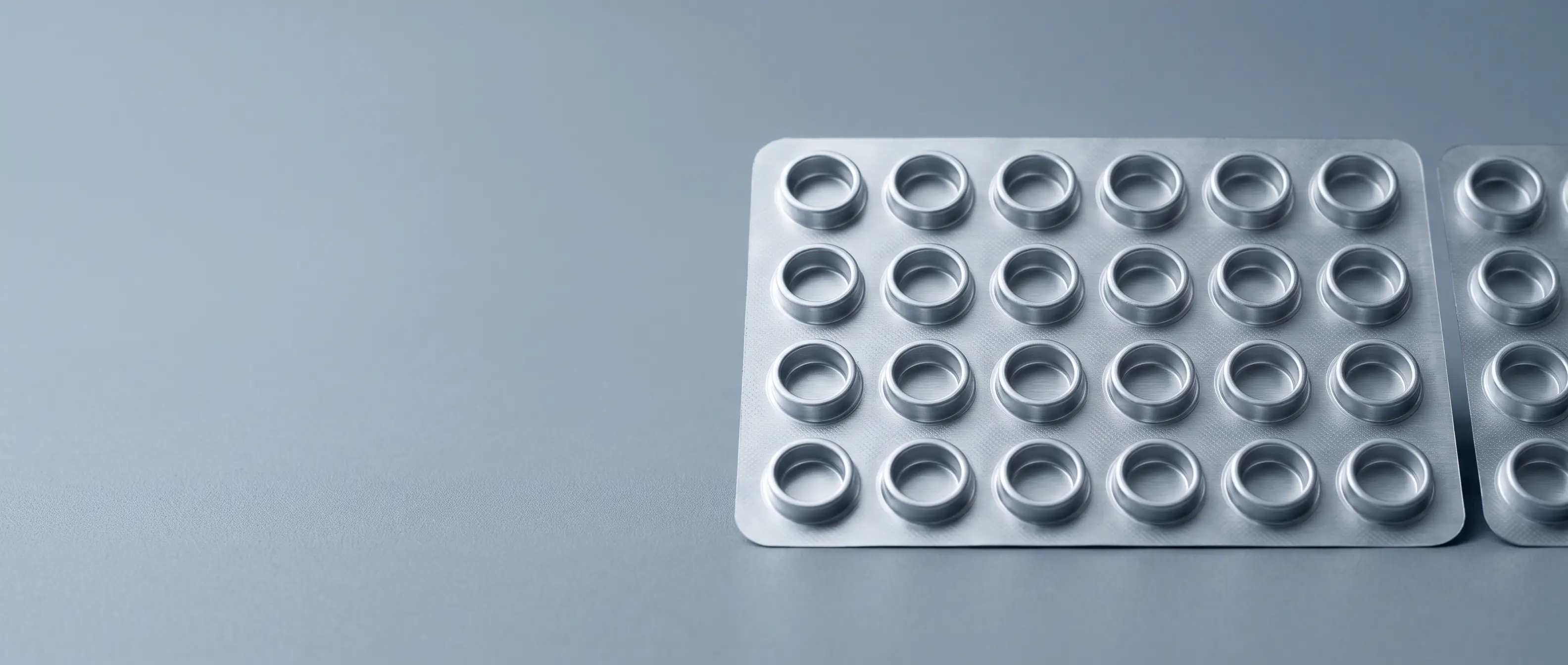
Alu-Alu — cold-form aluminium blister packaging — is where the barrier conversation stops. The forming web is a laminate built around a continuous aluminium foil core, classically ~25 µm oriented polyamide (OPA) on the outside, ~45–60 µm aluminium in the middle, and ~60 µm PVC on the product side; sealed with an aluminium lidding foil, the finished pack is metal-enclosed on every face. Transmission of moisture, oxygen and light is effectively zero — not low, not excellent: zero, for the shelf life of the product. No polymer film, coated, laminated or fluorinated, reaches this rung; Alu-Alu is not the best barrier film, it is the point at which barrier stops being a variable.
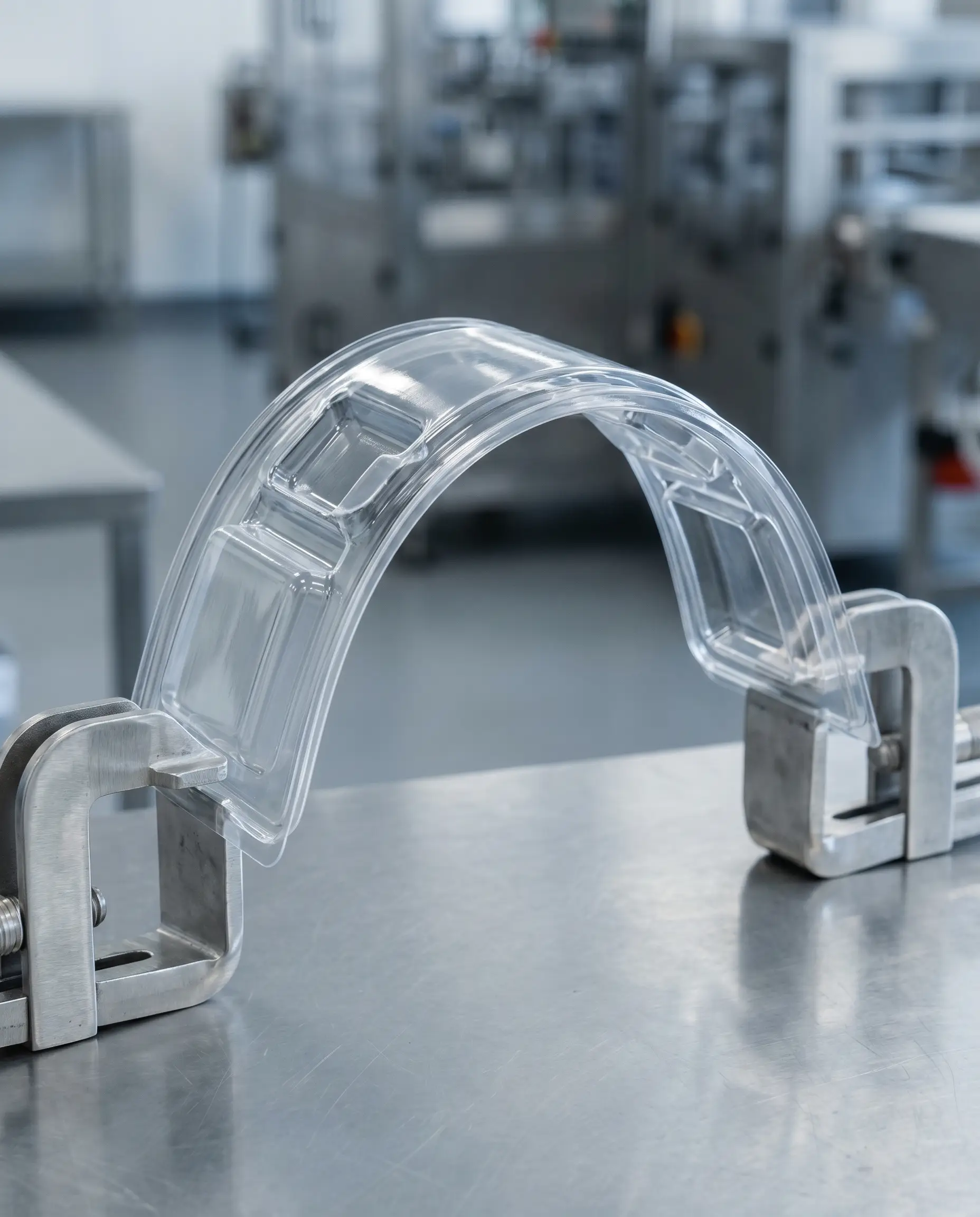
The second thing that makes Alu-Alu unique is how it forms: without heat. Metal does not thermoform — the cavity is pressed mechanically, a punch driving the laminate into a die at room temperature, the aluminium deforming plastically and keeping its shape. There is no heater bank, no forming window, no cooling stage; the OPA layer's job is to distribute the forming strain so the foil stretches without tearing, and the PVC layer's job is to be the heat-seal face for the lid. Every intuition from thermoforming — recipes, temperatures, plug timing — is replaced by one discipline: geometry.
Geometry is also the format's price. Aluminium's elongation is a fraction of a heated polymer's, so cavities must be generous: typically 30–50% larger than the product they hold, with shallow wall angles, large radii and gentle transitions — the deep, tight, product-hugging cavities of thermoformed blisters are simply unavailable. Packs are therefore larger per dose, fewer doses fit a card, and forming rates run slower than thermoform lines. Alu-Alu buys absolute protection with real-estate and speed.
The commercial identity follows directly: Alu-Alu is the specification of last resort and first choice at once — last resort because every cheaper, faster, smaller clear-film rung is tried first; first choice because when a product's stability data, light sensitivity or Zone IVb registration ends the clear-film discussion, nothing else is discussable. Extreme hygroscopics, oxidation-prone actives, photosensitive formulations and maximum-shelf-life strategies land here, and the pharmaceutical world's most protected products ship in it.
Alu-Alu structures and variants
Classic laminate (OPA 25 / Alu 45 / PVC 60) — The industry-standard build: the reference structure for tablet and capsule cold-form blisters, balancing formability, integrity and cost. The default starting point for any new Alu-Alu program.
High-gauge / deep-draw laminates (Alu 60+ µm) — Heavier aluminium cores (and matched OPA) for deeper cavities, larger products and demanding geometries — more forming robustness and pinhole margin, at more material cost and stiffness.
Tropical / high-integrity builds — Structures specified with added gauge or optimised layers for maximum-abuse distribution and Zone IVb registrations — where the pack's integrity margin, not just its nominal barrier, is the requirement.
Child-resistant & peel-push systems — Laminate-and-lidding systems engineered together for CR regulations: peel-then-push constructions, tear-guided openings and reinforced lidding — the opening mechanism is a designed system, specified with the base web.
Cold forming in practice: force, geometry and integrity
Cold forming replaces thermoforming's thermal recipe with a mechanical one: a polished punch descends into the laminate over a matched die, at controlled velocity, and the aluminium yields plastically into the cavity shape. The parameters that matter are punch geometry and profile, punch speed, die clearance and web tension — there is no temperature to set anywhere in forming. What thermoforming solves with heat and plug timing, cold forming must solve in tool design; the recipe is machined into the steel.
The OPA layer is the process's quiet hero: oriented polyamide is tough and stretchable, and bonded to the foil it distributes the forming strain, letting the aluminium thin evenly instead of necking and tearing at the punch's contact points. This is why the laminate cold-forms where bare foil would fail — and why laminate quality (bond strength, layer uniformity) is a forming variable. The PVC face, on the die side, must survive the same deformation unscratched: die polish and cleanliness are PVC-face cosmetics and seal-integrity variables at once.
Geometry limits are absolute, not advisory. Aluminium's elongation runs out where a heated polymer's is just warming up, so the design rules — cavities oversized ~30–50%, wall angles shallow, radii generous, depth conservative — are how tearing and pinholing are prevented, not how they are merely reduced. Punch profiles for deeper cavities are engineered (staged, radiused, sometimes supplier-co-developed) to spread strain; ambition beyond the foil's limits does not produce marginal parts, it produces holes.
Integrity verification is the format's QC centre of gravity: the entire value of Alu-Alu is a continuous metal envelope, so formed cavities are validated for pinholes (light-box or dye/helium methods) at development and sampled in production, concentrating on the deepest-drawn corners where thinning peaks. A cold-form pack with a pinhole is worse than a clear-film pack — it carries absolute-barrier claims it no longer meets — which is why integrity, not appearance, releases the format.
Sealing returns to familiar ground: the laminate's PVC face heat-seals to standard aluminium lidding foils with PVC-compatible lacquers, in conventional sealing stations at conventional temperatures (~140–200 °C system-dependent) — the one hot step in an otherwise cold process. Seal tooling must accommodate the formed cavities' generous flanges, and opening features (peel tabs, perforations, CR mechanisms) are executed here and at punching.
Where Alu-Alu leads: applications in depth
Alu-Alu is the specification the barrier ladder ends on, and its applications are all versions of one situation: a product whose stability data, photosensitivity or registration strategy defeats every clear film, leaving the absolute pack as the only remaining format.
Maximum-sensitivity drugs — Products whose stability data defeat every clear film — extreme hygroscopics, hydrolysis- and oxidation-prone APIs. Light-sensitive formulations — Photosensitive actives clear blisters cannot protect — aluminium blocks light totally, both faces, for the pack's life. Zone IVb / tropical registrations — Hot-humid-climate registrations where the barrier budget ends every clear-film discussion. Long-shelf-life & high-value packs — Products buying maximum shelf life, or high-value therapies where barrier risk is simply retired.
In each case the decision is made by the stability study, not preference. Where a product survives behind PVC or PVC/PVdC it stays there for the clarity, speed and cost; where its data, light sensitivity or Zone IVb registration defeat every clear rung, Alu-Alu is the one format left — and its oversized cavities, slower cold-form rate and non-recyclable multilaminate are the accepted price of retiring barrier risk entirely.
Alu-Alu troubleshooting: tears, pinholes and seal faults
Tears and splits at forming are the format's cardinal defect and always a strain problem: geometry beyond the foil's elongation, a punch profile concentrating contact, excessive punch speed, or a laminate batch below spec. Work the list in order — verify the geometry against the laminate's validated limits, inspect the punch for wear and profile damage, moderate velocity, and only then question the web (with bond-strength and elongation data from the supplier). Tearing is never fixed by 'forming harder'.
Pinholes — the invisible version of the same failure — concentrate at the deepest-drawn corners and transitions where thinning peaks. Because they defeat the pack's entire claim silently, the response is systemic: light-box or equivalent integrity testing at development, production sampling focused on worst-case cavities, and geometry or gauge revision (not process tweaking) when marginality appears. A cavity that pinholes occasionally is a geometry telling you its limit.
Cracked or scratched PVC face (the product-side seal layer) traces to die condition — polish, cleanliness, damage — or to forming abuse stressing the laminate's inner layer. Consequences arrive at sealing: a compromised PVC face seals weakly or leaks. Maintain die surfaces as seal-integrity tooling, because they are.
Weak seals or seal leaks against the lidding foil follow the familiar PVC-system logic: lacquer compatibility (PVC-matched lidding), clean flat flanges (forming must leave them undistorted), and validated temperature/pressure/dwell. On Alu-Alu the flange arrives from a mechanical process — check that forming is not warping or marking seal lands before adjusting the sealing station.
Delamination — OPA or PVC separating from the foil at formed corners or trim edges — indicates either forming beyond the structure's limits or a lamination-quality defect in the web. Pattern is diagnostic: geometry-correlated delamination points at strain; batch-correlated at the supplier. Bond strength is manufactured into the laminate, not recoverable on the line.
Barrier behaviour: absolute, by construction
Alu-Alu's barrier is categorical rather than comparative: a continuous aluminium foil transmits effectively nothing — no measurable water vapour, no oxygen, no light — and the finished pack, foil-formed and foil-lidded, encloses the dose in metal on every face. Where every clear film reports transmission rates, Alu-Alu reports an integrity requirement: the barrier is absolute wherever the envelope is intact, which is why pinhole verification, not permeation testing, is the format's quality science.
The corollary deserves emphasis: the barrier is binary. A clear film with 20% extra transmission degrades protection proportionally; an Alu-Alu cavity with one pinhole has no absolute barrier at all — it has a hole, plus claims. This is the deep reason geometry conservatism, integrity sampling and worst-case-corner focus dominate cold-form practice: the format's value exists entirely on one side of a pass/fail line.
Light protection completes the trio and is often the deciding specification: total opacity, both faces, for the pack's life — protection no clear or tinted film approaches and no coating provides. For photosensitive products the aluminium envelope solves in one structure what would otherwise demand secondary packaging workarounds, and it solves it permanently.
Sustainability: heavy material, honest accounting
Alu-Alu's sustainability ledger starts with an honest debit: it is the most material-intensive blister format — aluminium's production is energy-heavy, the laminate is a bonded multi-material (OPA/Alu/PVC) with no realistic mechanical recycling route, and the oversized geometry spends more material per dose than any thermoformed pack. No responsible presentation dresses this up; Alu-Alu is specified despite its footprint, for reasons the footprint does not touch. In most markets the packs end up in residual waste — incinerated, at best with energy and metal recovery.
The credit side is the protected product. The formulations that reach this rung are precisely those whose degradation — lost potency, failed batches, shortened shelf lives, wasted high-value therapies — carries environmental and human costs that dwarf grams of packaging. Lifecycle accounting that stops at the pack, ignoring what the pack prevents, mismeasures exactly the products Alu-Alu exists for.
System-level honesty also notes the consolidation effect: one global pack passing every climate zone replaces regional pack variants, duplicate stability programs and re-registration churn — efficiencies that never appear in per-pack comparisons but are real in a product's total footprint. For long-lived global products, the absolute pack can be the leaner system.
The forward agenda is incremental and worth tracking: gauge optimisation against validated integrity (thinner where data allow), take-back and incineration-with-metal-recovery routes for blister waste in markets building them, and supplier work on laminate structures with improved end-of-life profiles. None of it changes the fundamental trade; all of it narrows the debit on a format whose justification was never environmental — and should always be documented as the stability data's demand, not habit's.
Alu-Alu vs PVC vs PVC/PVdC for blister packaging
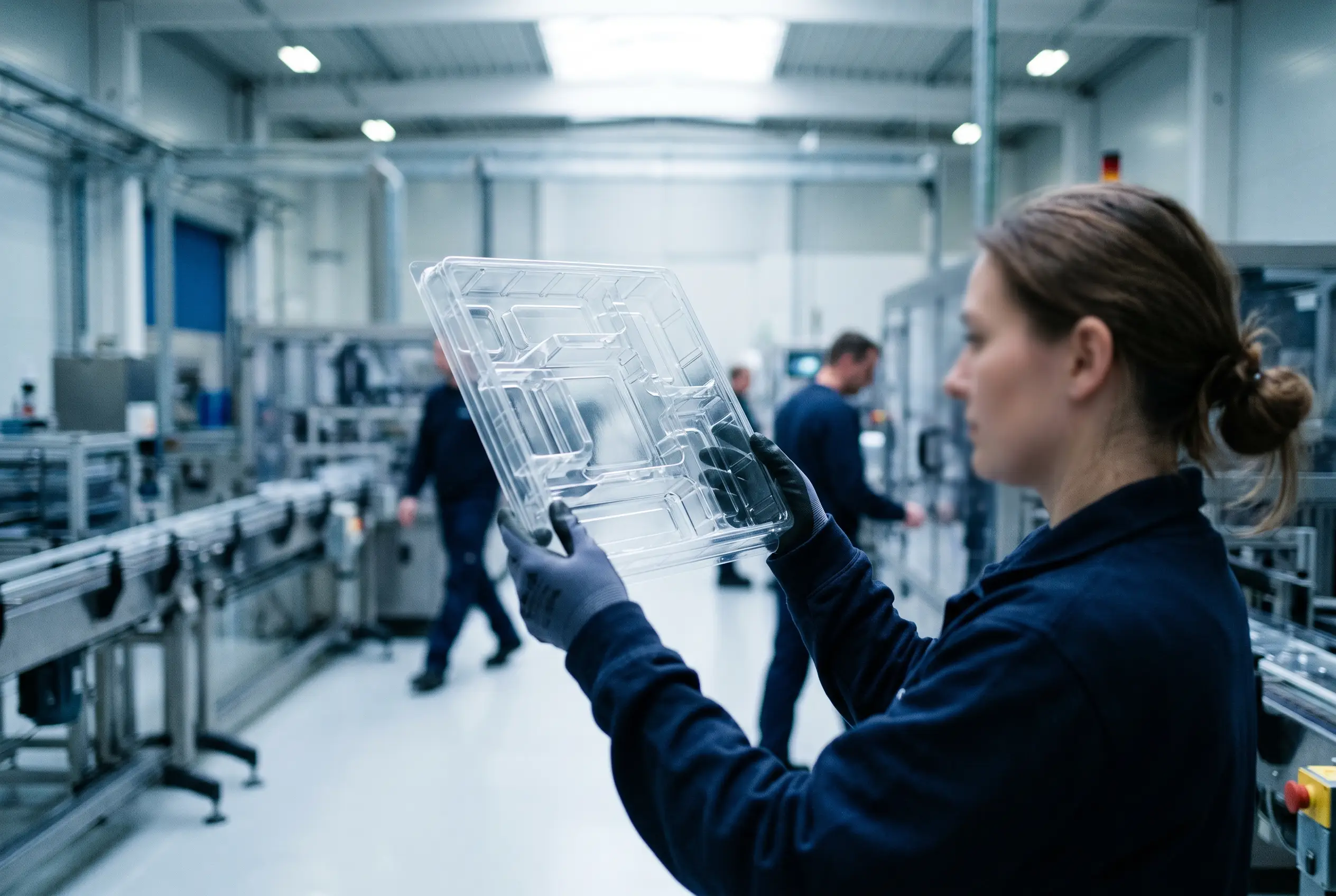
Alu-Alu vs PVC / PVdC (thermoformed) blisters. A plain PVC blister is the cheap, fast, geometry-liberal baseline: clear, thermoformed with heat, thumb-through push-through, tight product-hugging cavities and high doses-per-card — but its moisture and oxygen barrier is modest (WVTR roughly 3–8 g/m²/day), the reason sensitive products climb off it. PVC/PVdC (a PVDC coating on the PVC web) lifts the barrier substantially and stays clear, thermoformable and push-through, covering the large middle band of moisture-sensitive products at moderate cost. Alu-Alu is the categorical step beyond both: not a better clear barrier but the absolute one — a continuous aluminium foil that transmits effectively no moisture, oxygen or light (WVTR/OTR near zero), at the cost of visibility, thumb-through dispensing, forming speed and cavity size. The decision is set by the stability study, not preference: products that survive behind PVC or PVC/PVdC stay there for the clarity, speed and cost; products whose data, photosensitivity or Zone IVb registration defeat every clear rung have exactly one remaining format, and its geometry-governed cold forming and non-recyclable multilaminate are the price of retiring barrier risk entirely.
What does Alu-Alu mean in blister packaging?
Aluminium on both faces: a cold-formable OPA/aluminium/PVC laminate is pressed into cavities (no heat), filled, and sealed with an aluminium lidding foil — enclosing each dose in metal. The result is effectively zero transmission of moisture, oxygen and light for the pack's life: the end point of the blister barrier ladder.
How is cold forming different from thermoforming?
Thermoforming softens plastic with heat and shapes it with pressure and vacuum; cold forming presses an aluminium laminate into a die with a mechanical punch at room temperature — no heaters, no forming window, no cooling. Force and tooling geometry do everything heat does in thermoforming, which is why geometry rules replace temperature recipes.
Why are Alu-Alu cavities so much bigger than the tablets?
Because aluminium barely stretches: the foil's elongation is a fraction of a heated polymer's, so cavities must be oversized — typically 30–50% larger than the product — with shallow wall angles and generous radii to keep the strain inside what the laminate tolerates. Tight, product-hugging cavities are a thermoform luxury the metal cannot offer.
What is the standard Alu-Alu laminate structure?
The classic build is ~25 µm oriented polyamide (OPA) / ~45–60 µm aluminium / ~60 µm PVC. The OPA distributes forming strain so the foil stretches without tearing, the aluminium is the barrier, and the PVC is the heat-seal face for the lidding foil. Heavier-gauge builds serve deeper cavities and demanding geometries.
Can Alu-Alu blisters be push-through like PVC blisters?
Not in the classic sense — with foil on both faces, dispensing is by peel, peel-then-push or tear-open systems designed into the laminate-and-lidding combination. Opening features (and child resistance where required) are engineered and human-factors-validated as part of the pack, not left to chance.
Does Alu-Alu need any heating at all?
Not for forming — the cavity is pressed cold. The one hot step is sealing: the laminate's PVC face heat-seals to the aluminium lidding foil conventionally (roughly 140–200 °C, system-dependent). Everything upstream of the sealing station runs at room temperature.
Can a thermoforming blister machine run Alu-Alu?
Only if it has a cold-form station — mechanical punch-and-die forming is hardware, not a recipe. Many blister machines offer both thermoform and cold-form stations and change between formats; a heat-only line cannot form Alu-Alu regardless of settings. Machine capability is the first specification question.
How are Alu-Alu blisters tested for integrity?
Formed cavities are verified for pinholes — light-box inspection and dye or helium methods are standard — with attention concentrated on the deepest-drawn corners where the foil thins most. Because the format's claim is a continuous metal envelope, integrity testing (pass/fail), not permeation measurement, is its quality science.
When is Alu-Alu worth its cost over Aclar or COC?
When the stability study says so: products whose moisture sensitivity, oxidation risk or light sensitivity defeat the best clear films — or whose global registration strategy wants one pack passing every climate zone. Below that line, clear films win on cost, speed, pack size and product visibility; the ladder should be climbed exactly as far as the data demand.
Why did my Alu-Alu cavities tear or pinhole during forming?
Strain exceeded the laminate somewhere: geometry beyond validated limits, a worn or damaged punch profile, excessive punch speed, or a web batch below spec — in roughly that order of likelihood. Verify geometry and tooling first; pinholes clustering at deep corners are a cavity announcing its geometric limit, answered by design or gauge, not by process tweaks.
Is Alu-Alu recyclable?
Realistically no — the bonded OPA/Alu/PVC structure defeats mechanical recycling, and pharmaceutical blister waste largely incinerates (where energy-and-metal recovery routes are the practical end-of-life). The format's justification is product protection: it is specified where degradation losses would dwarf the packaging footprint, and that justification belongs documented in the file.
Does Alu-Alu protect against light as well as moisture?
Totally — the aluminium envelope blocks light completely on every face for the pack's life, alongside zero moisture and oxygen transmission. For photosensitive formulations this opacity is often the deciding specification, solving in one structure what clear films cannot address at all.