What AlOx and SiOx are: glass barriers a wavelength thin
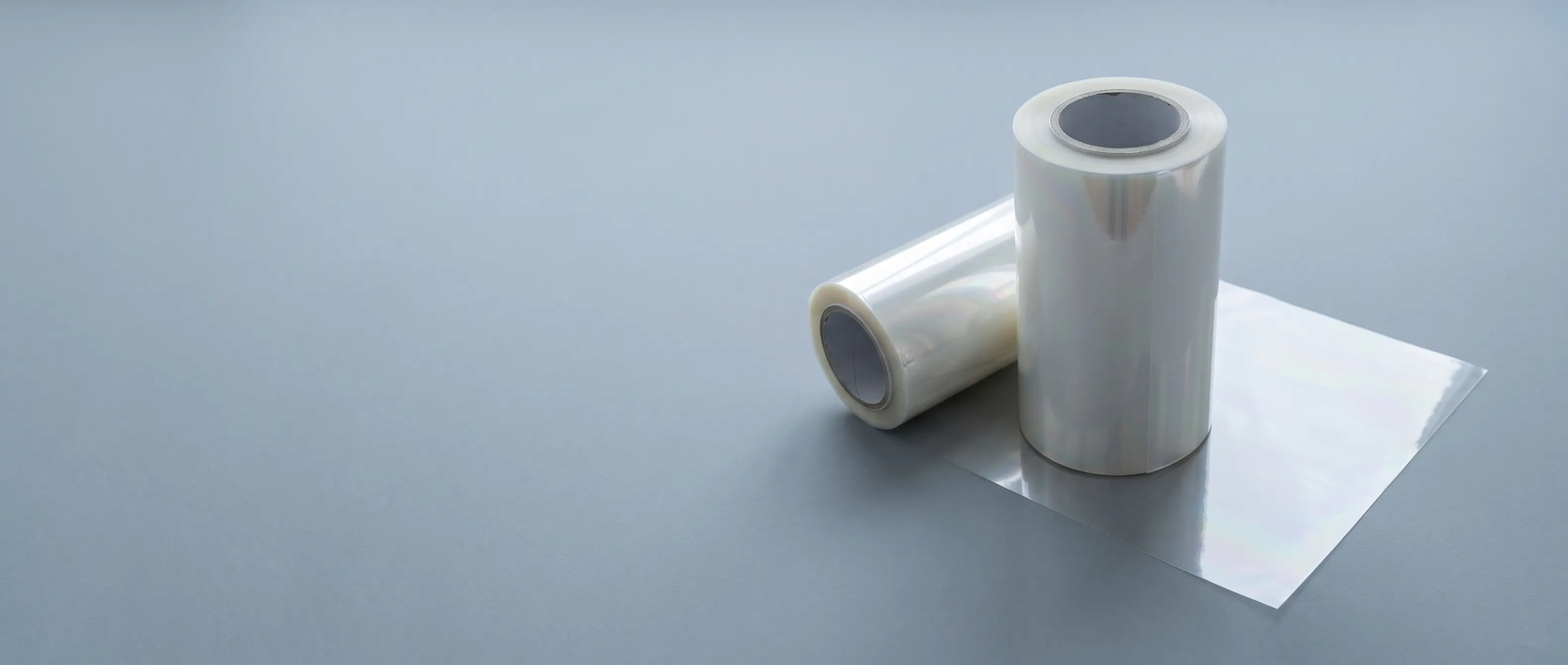
Take a clear PET web, run it through a vacuum chamber, and deposit onto it a layer of ceramic — aluminium oxide or silicon oxide — so thin that thousands of such layers would stack inside the web itself. What emerges still looks, weighs and handles like clear PET; but its oxygen and moisture transmission have dropped toward the neighbourhood of foil laminates. That is the oxide-coating proposition: glass-class barrier at nanometre mass, invisible to the eye, the scale, the microwave and — increasingly decisive — the recycling stream.
The physics is disarmingly simple: oxide ceramics are dense inorganic networks that gas molecules essentially cannot permeate, so even a layer tens of nanometres thick forces oxygen and water vapour to find defects rather than diffuse through bulk. Barrier is therefore defect-limited, not thickness-limited — the engineering lives in deposition quality, substrate smoothness and, above all, in never cracking the layer afterward. Oxide coatings serve flat: lidding plies, laminate components and pouch webs, converted gently, laminated coating-inward and sealed via a sealant layer. They are never thermoformed — a draw stretches the web by design, and percent-scale elongation micro-cracks a ceramic.
AlOx / SiOx grades and constructions
AlOx-coated PET is the contemporary volume choice: aluminium oxide deposited by reactive evaporation onto PET12-class webs — water-clear, cost-efficient at scale and a strong all-round barrier. It is the default oxide ply of food lamination and transparent lidding.
SiOx-coated PET is the speciality elder: silicon oxide by evaporation or plasma processes, with grade families tuned for retort survival, flex tolerance and demanding duty. Where the pack will be sterilised in-pack or the converting chain is harsh, SiOx heritage carries weight.
Topcoated / hybrid grades carry a thin protective organic topcoat over the oxide — sealing defects, adding handling robustness and stepping barrier into the premium band; the practical answer where converting chains are long or barrier targets tight. Retort-rated constructions qualify oxide plies and adhesive systems through sterilisation cycles — a construction-level claim validated as one, never inferred from the coating family alone.
Alternative substrates (PA, BOPP) put the same physics on nylon and polypropylene webs for pouch and flow-wrap constructions native to those families. Supply is either coated rolls for lamination, or finished lidding / pouch constructions with print webs and sealants already assembled — the finished-construction route outsources the handling risk to the party best equipped to control it, and is the sensible default for specifiers without vacuum-web experience.
Converting oxide webs: gentle hands, protected faces
Oxide-coated webs are not formed, so their process story is converting — printing, laminating, slitting, pouch-making, sealing — and the governing law is mechanical: the ceramic tolerates only percent-scale strain, ever. Every discipline follows from it. Web tensions run controlled and modest; rollers are generous-radius and clean; nips are set, not slammed. The classic converting injury is invisible at the machine — micro-cracks from a tight roller or a tension spike — and appears only as failed barrier on the finished laminate.
The coated face is sacred. It is identified, tracked and protected: laminated inward against the sealant web (the standard construction) or shielded under a topcoat before any further process touches it. Print goes on the other web; adhesive systems are chosen for oxide compatibility; and which face carries the coating is a controlled parameter with the same status web orientation has on PVdC and Aclar lines.
Sealing belongs to the sealant. The construction seals via its laminated sealant layer — PE, PP or PET-seal chemistry per the tray or pouch — at that sealant's ordinary windows. The oxide neither helps nor hinders the seal; it must simply survive the seal jaws' neighbourhood, which well-designed constructions ensure by keeping the ceramic away from the crush zone's worst strain.
Qualification happens at the end. Because converting sets the final barrier, acceptance lives on the finished construction: OTR/WVTR after lamination and pouch-making, flex-crack testing (Gelbo-type) where distribution abuse is real, and — for retort claims — barrier measured after the sterilisation cycle. Flat-web certificates are a supplier's starting point, never a pack's proof.
Where oxide coatings earn their place: applications in depth
Oxide coatings earn their place wherever a laminate needs foil-class protection without foil's opacity, weight or recycling penalty. What changes across applications is which of the family's four advantages — transparency, microwaveability, metal-detectability and mono-PET recyclability — is the deciding one.
Transparent high-barrier lidding: Coated-PET plies inside clear MAP lids on PET-family trays — near-foil barrier with the product in full view, and a mono-PET pack story. Mono-PET barrier laminates: Coffee, dried and oxygen-sensitive foods in all-PET laminates that recycle as one stream — the PPWR-era replacement for foil and metallised plies. Transparent retort pouches: SiOx's founding application: see-through shelf-stable pouches surviving in-pack sterilisation — with retort-rated AlOx grades now alongside. Microwaveable & inspectable packs: Barrier packs that go straight into the microwave and straight through metal detectors — the two duties foil and metallisation structurally fail.
Alongside these, transparent retort pouches remain SiOx's founding showcase — shelf-stable wet foods in see-through pouches surviving in-pack sterilisation, the family's toughest exam — while high-care food and pharmaceutical lines value that metal detection passes straight through a ceramic, keeping full foreign-body inspection with barrier in place. Clear pharma and medical laminates take the oxide ply for halogen-free transparent barrier with clean regulatory paperwork. In every case the same physics does the work: a defect-free nanometre layer rivals far heavier chemistries, and the application is won on the pack-level penalties the oxide avoids rather than on barrier alone.
Specifying oxide barriers: construction first, coating second
A responsible oxide-barrier specification puts construction first, coating second. Start from the finished-construction barrier target: derive the pack-level OTR/WVTR from the product and shelf life, then specify it on the finished, converted construction — the number the supplier must meet after lamination, not on the coated roll. This single clause prevents the family's most common dispute.
Choose the coating by duty and supply. Retort or harsh-process duty weighs SiOx heritage and qualified retort constructions; cost-led transparent barrier at volume is AlOx's market. For most chilled and ambient duties either serves — let supplier qualification data and construction availability decide rather than chemistry loyalty. Then specify the protection, not just the coating: topcoat or bare; laminated coating-inward (state it); an oxide-compatible adhesive system; print on the far web. The construction drawing should make the ceramic's protected position explicit — it is the specification's real barrier engineering.
Write the handling window into the supply chain. Tension limits, roller radii and flex budget from the supplier's handling guidance become part of the converting specification, and any converter in the chain signs up to it — a coated web that changes hands without its handling window changes hands without its barrier. Close with verification clauses: OTR/WVTR on finished constructions; flex-crack (Gelbo-type) performance where distribution is rough; retort-cycle barrier for sterilised packs; and the recyclability claim verified on the complete construction against the destination protocol. Four tests, and the specification stands on ground the physics respects.
Designing with oxide barriers: flat, protected, unbent
Design flat or design out. The first architectural decision is geometric: any component that will be drawn, stretched or deep-embossed cannot carry an oxide barrier — formed cavities take EVOH or foil, and the oxide serves the flat mating component. Packs that respect this split (EVOH tray, oxide lid) get the best of both chemistries.
Bury the ceramic. The coating rides inside the laminate, faces away from abrasion, and never meets a fold line, gusset crease or dead-fold feature head-on. Pouch formats with hard creases budget for them explicitly — flex-crack data at the crease, or a construction that moves the barrier ply away from it. And mind the crush zones: seal jaws, notch punches and tear features concentrate strain, so keep the barrier ply's worst loading outside the barrier-critical area and validate barrier on packs that have been through the real sealing tools, not laboratory laminates.
Exploit the invisibility. No weight, no stiffness change, no optical penalty — the oxide ply frees designers to treat barrier as orthogonal to structure and appearance. Display windows, full-transparency packs and lightweighting programs all proceed as if the barrier were not there; mechanically, it is not. Finally, claim what the construction earns: mono-PET recyclability, microwaveability and metal-detectability are construction-level claims, so the sealant, adhesives and print system must uphold what the oxide enables. Design reviews check the whole stack against each claim — the ceramic is necessary, never sufficient.
Oxide-barrier troubleshooting: the crack hunt
Finished laminate fails barrier; coated roll passed. The family's signature complaint, and almost always converting stress: tension spikes, tight rollers, nip abuse or handling flex micro-cracked the layer between certificate and laminate. Audit the converting chain against the handling window step by step; the fix is mechanical discipline, occasionally a topcoated grade where the chain cannot be tamed.
Barrier degrades through distribution — flex-cracking in the field from transit vibration, pouch flexing or crease propagation. Reproduce with Gelbo-type flex testing, then either armour the construction (topcoat, stiffer outer web, crease relocation) or accept a measured barrier-after-abuse figure in the shelf-life math. Field barrier is flat-web barrier only for packs that travel like laboratory samples.
Retorted packs lose barrier when the construction is not genuinely retort-qualified: adhesive softening, web movement or steam stress cracked the layer during the cycle. Move to a retort-rated construction and re-verify barrier after the cycle as the acceptance test — the coating family name never carried the qualification.
Localised failures / pinhole clusters point either at deposition-side defects (substrate contamination, coating faults) or point-abuse in handling: random scatter points at deposition quality — a supplier conversation with roll data; clustered or edge-biased patterns point at slitting, winding or a specific machine station. Seal-zone leaks mean the crush zone cracked the ceramic where the jaws land — confirm the construction keeps the oxide ply off the worst strain path, moderate the jaw pressure profile, and test barrier on production-sealed packs.
Barrier behaviour: defect-limited, humidity-calm
Oxide barriers obey different mathematics from polymer barriers. A polymer layer's transmission scales with thickness — double the microns, halve the flow. A ceramic layer's transmission is set by its defects: pinholes, particles, micro-cracks. Past the thickness needed for a continuous layer, extra nanometres buy little; deposition quality and post-coating mechanical history buy everything. This is why the family's data always carries the construction caveat, and why two identically specified webs can perform an order of magnitude apart after different converting chains.
Fresh coated PET12 lands broadly in the high-barrier band — the 0.1–1 unit class for both OTR and WVTR, with topcoated and premium grades stepping below — positioned squarely between plain PET and foil laminates, and overlapping the territory PVdC coatings and heavy EVOH structures occupy. Uniquely among the clear barriers at this level, the performance is dual (both gases from one layer) and humidity-calm: ceramics do not plasticise in moisture, so the EVOH-style RH-derating exercise does not apply, and hot-humid duty reads from broadly the same data as temperate duty (SiOx grades are the most humidity-stable; AlOx shows a modest rise at high humidity).
The honest boundaries: this is not foil — absolute-barrier and total-light-protection duties still end at metal; light protection specifically is zero (transparent is the point); and the barrier is only as durable as the pack's mechanical life allows — the flex-crack budget is a genuine shelf-life parameter for rough-travelling formats. Within those boundaries, the oxide ply delivers the strongest barrier-per-consequence ratio in the clear catalogue: near-foil numbers with none of foil's pack-level penalties.
Sustainability: the barrier the recycling stream doesn't notice
The oxide family's PPWR position is the strongest in the barrier catalogue, for a physical reason: the barrier layer is nanometres of inert mineral — negligible mass, no halogens, no fluorochemistry, nothing for a recycling process to object to. Design-for-recycling guidance broadly treats oxide-coated PET as mono-PET, so coated-PET lids on PET trays and all-PET barrier pouches hold recyclability grades that foil laminates, metallised constructions and EVOH multilayers cannot reach. Where the previous generation's barrier decisions traded shelf life against recyclability, the oxide ply largely dissolves the trade.
The discipline is the usual one, sharpened: the claim belongs to the whole construction. Adhesives, inks, topcoats and above all the sealant web decide the stream as much as the coating does — a PE-sealant lid on a PET tray is a design choice with stream consequences, and mono-PET sealant systems exist precisely for this. Verification against the destination protocol (RecyClass and national equivalents), on the finished laminate, is the specification's closing clause.
The wider ledger is favourable too: vacuum deposition adds modest energy per square metre against the barrier delivered; the constructions it replaces (foil, metallised, chlorinated coatings) carry heavier footprints or end-of-life penalties; and the shelf-life extension economics — grams of coating against kilograms of saved food — run as strongly here as anywhere in the barrier chapter. Honest debits: the coated web's barrier durability depends on mechanical care through its whole life, and recyclate-quality conversations around coated fractions continue in the background of DfR guidance — cite current protocol versions rather than folklore in either direction. Strategically, this is the barrier technology the regulation is pulling rather than pushing: every mono-material mandate and recyclability-grade tightening converts another foil or metallised specification into an oxide one.
AlOx / SiOx vs metallised, EVOH, PVdC, Aclar and foil
The oxide family is best placed against its closest relatives. Versus metallised PET — both vacuum-deposited nanolayers on PET — the split is what the layer is made of: metal blocks light and costs less at scale but is opaque, arcs in the microwave, blinds metal detectors and muddies the recycling optics, while oxides are transparent, microwave- and inspection-compatible and read cleaner in mono-PET streams. Three questions usually decide it: must the product be seen, reheated in-pack, or metal-inspected? Any yes points oxide; three noes and a cost focus point to metal. Versus EVOH, geometry decides first — formed components are EVOH's (the ceramic cannot survive a draw), while flat webs are the oxides' home ground with better humidity stability and a cleaner mono-PET story; in a tray-plus-lid pack the two are teammates, EVOH core below and oxide ply above. Versus PVdC, both are dual, humidity-calm barriers, but one is chlorinated coating chemistry in managed decline and the other is inert ceramic with a PPWR tailwind — in food lamination the succession is effectively decided, while in pharmaceutical forming films PVdC persists only because oxides cannot follow into the thermoformed cavity. And versus aluminium foil, the ladder's end remains metal: absolute barrier, total light block and dead-fold — foil concedes transparency, microwave, inspection and the mono-material claim, which is exactly why the modern brief 'as close to foil as recyclable transparency allows' is the oxide family's job description.
What are AlOx and SiOx coatings in packaging?
Glass-thin ceramic barrier layers — aluminium oxide or silicon oxide — vacuum-deposited onto polymer webs (classically 12 µm PET) at nanometre thickness. They give a clear film near-foil-class oxygen and moisture barrier while keeping it transparent, microwaveable, metal-detector compatible and effectively mono-material for recycling. The coated web is converted into lidding and laminates — it is a barrier component, not a forming film.
How thick is an AlOx or SiOx layer?
Tens of nanometres — thousands of times thinner than the PET web carrying it, and orders of magnitude thinner than an EVOH core or a PVdC coating. At that scale the layer adds no measurable weight, stiffness or opacity; the entire barrier performance lives in a coating thinner than the wavelength of visible light.
How good is the barrier really?
Freshly coated PET12 typically lands in the high-barrier band — broadly the 0.1–1 g or cm³/m²/day class for WVTR and OTR, structure- and grade-dependent — with topcoated and premium grades reaching below it. That is between plain PET and aluminium foil: enough for coffee, dried foods, retort pouches and demanding MAP lids. The number that matters is measured AFTER converting, because handling sets the final value.
What is the difference between AlOx and SiOx?
Same idea, different ceramics and economics. AlOx (aluminium oxide, typically reactive evaporation) has become the food-packaging volume choice — cost-efficient, clear, strong all-round barrier. SiOx (silicon oxide, evaporation or PECVD) is the older speciality: its established stronghold is retortable transparent pouches and demanding sterilisation duty, with grades prized for flex and process tolerance. Many applications could use either; retort heritage leans SiOx, cost-led transparent barrier leans AlOx.
Can AlOx/SiOx coated film be thermoformed?
No — and this is the defining constraint. The coating is a ceramic: it tolerates only very small elongation before micro-cracking, and thermoforming stretches the web by design. A drawn cavity in coated film has already destroyed its own barrier. Oxide coatings serve FLAT applications — lidding, laminate plies, pouch webs; formed cavities take their barrier from EVOH cores or foil instead.
Why is the coating so sensitive to flexing and stretching?
Because glass does not stretch: beyond roughly a percent-scale strain the ceramic layer micro-cracks, and every crack is a permanent barrier leak. Converting therefore treats the coated web gently — controlled tensions, generous rollers, no dead-folds, no gusset abuse — and finished constructions protect the layer inside a laminate or under a topcoat. Flex-crack resistance data (e.g. Gelbo-type testing) is part of serious specifications.
Are oxide-coated films microwave and retort safe?
Microwave: yes — the signature advantage over metallised film and foil; a nanometre ceramic neither arcs nor heats, so barrier packs can go straight into the microwave. Retort: yes with retort-rated grades — SiOx built its reputation in transparent retort pouches, and modern AlOx retort grades exist; retortability is a grade-and-construction claim to verify, not a family default.
Do oxide coatings survive high humidity like PVdC, or fade like EVOH?
Closer to PVdC: a ceramic layer's barrier is broadly humidity-stable — it does not plasticise and open like EVOH in wet conditions (SiOx is the most stable; AlOx shows a modest rise at high humidity). Real constructions show some environmental dependence via defects and the polymer around the coating, which is one more reason to specify from finished-construction data; but the RH-derating exercise EVOH demands is not the oxide story.
Are AlOx/SiOx coated PET films recyclable?
This is their PPWR headline: a nanometre inorganic layer is negligible mass and design-for-recycling guidance broadly treats oxide-coated PET as mono-PET — unlike EVOH multilayers or foil laminates. A coated-PET lid on a PET tray is a genuine single-stream pack. As always the claim belongs to the finished construction (adhesives, sealants and inks included) verified against the destination protocol.
AlOx/SiOx or metallised PET — which should I choose?
Oxides when you need transparency, microwave capability or metal-detector inspection — the three things metallisation structurally cannot offer — or a cleaner mono-PET recycling story. Metallised PET answers with lower cost at scale, light blocking and a more converting-tolerant layer. Products sold on visibility or reheated in-pack lean oxide; light-sensitive, cost-led ambient products lean metal (see the metallisation card).
AlOx/SiOx or EVOH — when does each win?
Geometry decides first: anything thermoformed is EVOH territory (the coating cannot survive a draw), while flat high-barrier webs — lidding, laminate plies, pouches — are where oxides shine with better humidity stability and a cleaner mono-PET story. Inside a single tray-plus-lid pack the two are frequent teammates: EVOH core in the formed tray, oxide-coated PET in the flat lid.
Does an oxide coating affect clarity or appearance?
Barely — the layer is thinner than visible light's wavelength, so coated film reads as clear PET; SiOx grades can carry a very faint tint at heavier deposits, AlOx is essentially water-clear. This invisibility is commercial: full product display with near-foil barrier, no window compromises.
Are oxide coatings food-safe and PFAS-free?
Yes — aluminium oxide and silicon oxide are inert inorganic layers with food-contact clearance in standard constructions, no halogens, no fluorochemistry, and no plasticiser story. Regulatory cleanliness is part of their rise: they answer barrier questions without joining the PVdC, PFAS or BPA conversations.
What applications use AlOx/SiOx coatings today?
Transparent high-barrier lidding on PET-family trays; mono-PET laminates for coffee, dried and oxygen-sensitive foods; transparent retort pouches (SiOx's founding application); microwaveable barrier packs; and pharmaceutical and medical laminates wanting clear, halogen-free barrier. Wherever a laminate needs foil-class protection without foil's opacity, weight or recycling penalty, an oxide ply is now the default candidate.