
Packaging Sealing Dies & Toolsets
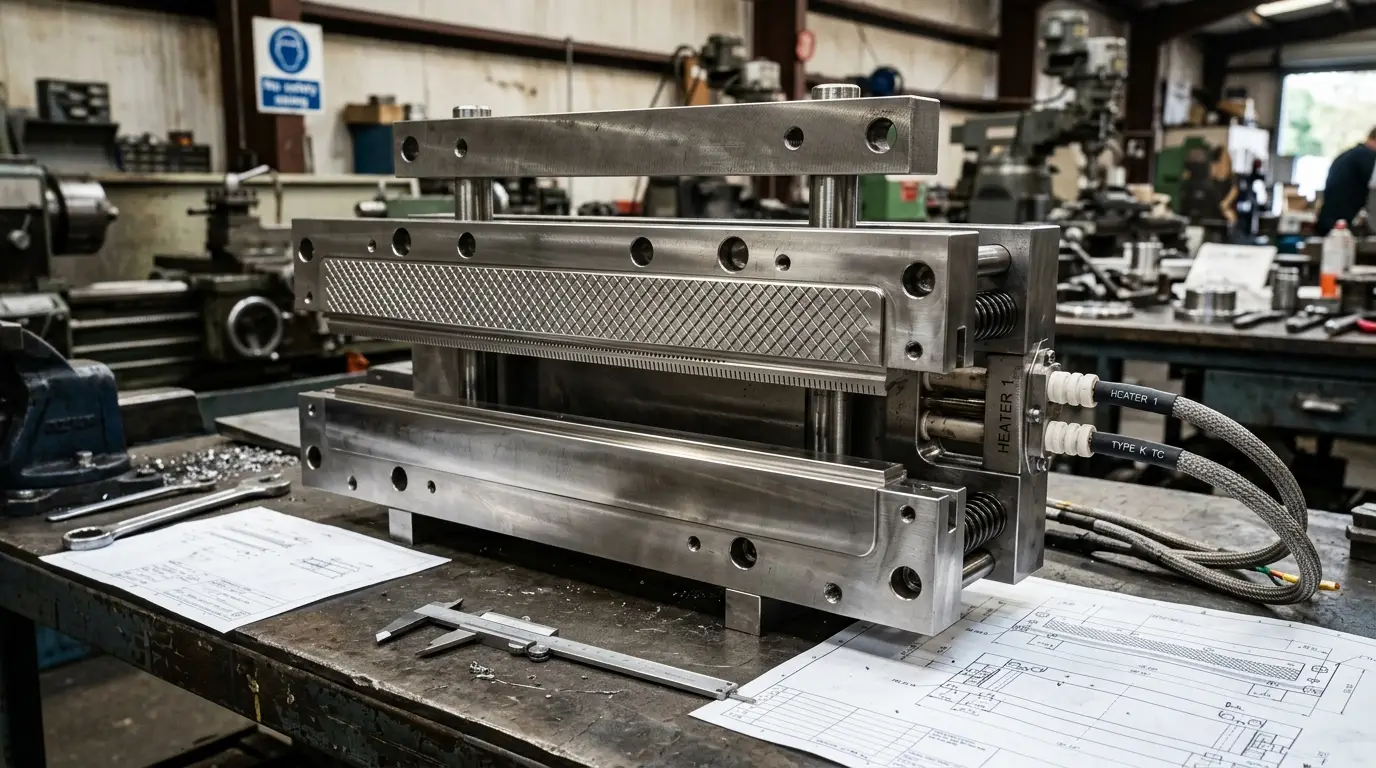
Packaging Sealing Dies & Toolsets
Sealing die design and material selection directly determine seal quality, line speed, and total cost of ownership across millions of cycles.
The Role of Sealing Dies in Packaging
Sealing dies (also called sealing jaws, sealing tools, or sealing plates) are the heated tooling components that apply heat and pressure to form the hermetic seals that hold a package together. They are the most wear-critical tooling element on any heat-seal packaging line — directly determining seal strength consistency, seal appearance, and line uptime. Die design, material, coating, and maintenance regime together determine whether a sealing system achieves the 50–200 million cycles typical in modern food packaging.
Sealing Die Types
Flat-bed (Platen) Sealing Dies
Reciprocating heated platens that clamp together to form seals in a dwell-and-release cycle. Standard on tray sealers, thermoformers, and blister lines. Offer precise temperature control and uniform pressure distribution across large seal areas. Cycle rates typically 10–60 strokes/min depending on dwell time requirement.
Rotary Sealing Dies
Continuous-motion heated rollers or rotary jaw sets that seal product in-motion without stopping the film web. Used on high-speed FFS (vertical and horizontal) and flow-wrap lines achieving 100–400 packs/min. Lower dwell time requires higher sealing temperature and precise film/temperature matching.
Ultrasonic Sealing Tools (Sonotrodes)
Vibrating titanium or steel horns operating at 20–40 kHz convert electrical energy to frictional heat at the seal interface — no external heat required. Advantages: seals through contamination (fat, moisture, product), very short cycle time (<100 ms), no heated tooling to manage. Ideal for difficult-to-seal films and contaminated seal areas in fresh produce and protein lines.
Impulse Sealing Bars
Unheated jaws containing a resistance heating wire that heats rapidly on contact and cools before the jaw opens. Eliminates continuous heat, reducing energy consumption and film distortion risk. Standard for polyethylene bag and pouch sealing at lower throughput rates (<40/min).
Die Materials and Coatings
| Material | Hardness | Typical Life (cycles) | Best For |
|---|---|---|---|
| Aluminium (hard-anodised) | 55–60 HRC surface | 5–20M | Standard FFS, low-abrasion films |
| Steel (tool steel) | 58–62 HRC | 20–80M | High-speed rotary, abrasive films |
| PTFE-coated steel | 58 HRC base | 10–30M | Anti-stick for PE/PP at high temp |
| Ceramic-coated | 70+ HRC | 50–150M | Premium high-speed lines, EVOH films |
Seal Pattern Design
The pattern engraved or textured into the die face determines seal appearance and, to a lesser extent, seal strength. Standard patterns include: crosshatch (universal, good strength, moderate appearance), serrated linear (high strength, common for retort and sterile), smooth (premium appearance, lower strength — typically combined with wider seal width), and custom branded patterns incorporating logos or tamper-evidence features. Pattern depth of 0.3–0.8 mm provides good material displacement without die-cutting through the film.
Frequently Asked Questions
How often should sealing dies be replaced?
Die replacement intervals depend on material, coating, film type, and line speed. As a guideline, aluminium dies typically require replacement or refurbishment at 5–15M cycles; hardened steel dies at 20–60M cycles; ceramic-coated dies at 50–150M cycles. Seal quality monitoring — tracking peel force distribution and visual inspection of seals — is the most reliable indicator that a die requires attention, regardless of cycle count.
What causes uneven seal strength across the die width?
The most common causes are: uneven die temperature (thermocouple or heater failure), die face wear creating non-uniform pressure, contamination build-up on the die face, and film web tracking inconsistency causing variable film presentation to the die. Regular die face cleaning, temperature profiling across the full die width, and incoming film gauge verification address most root causes.
Can one sealing die work for multiple film types?
A single die can seal multiple film types within a compatible temperature range (typically ±20°C window). However, films with very different seal initiation temperatures (e.g., PE at 120°C vs. CPET at 200°C) require either separate dies or a programmable temperature sealing system. Ultrasonic sealing is the most film-agnostic approach for mixed-film production environments.