
Packaging Changeover & Format Parts
Packaging Changeover & Format Parts
Every minute of changeover is a minute of lost production — format part design and SMED methodology directly determine how much of your capacity serves customers.
What Are Format Parts?
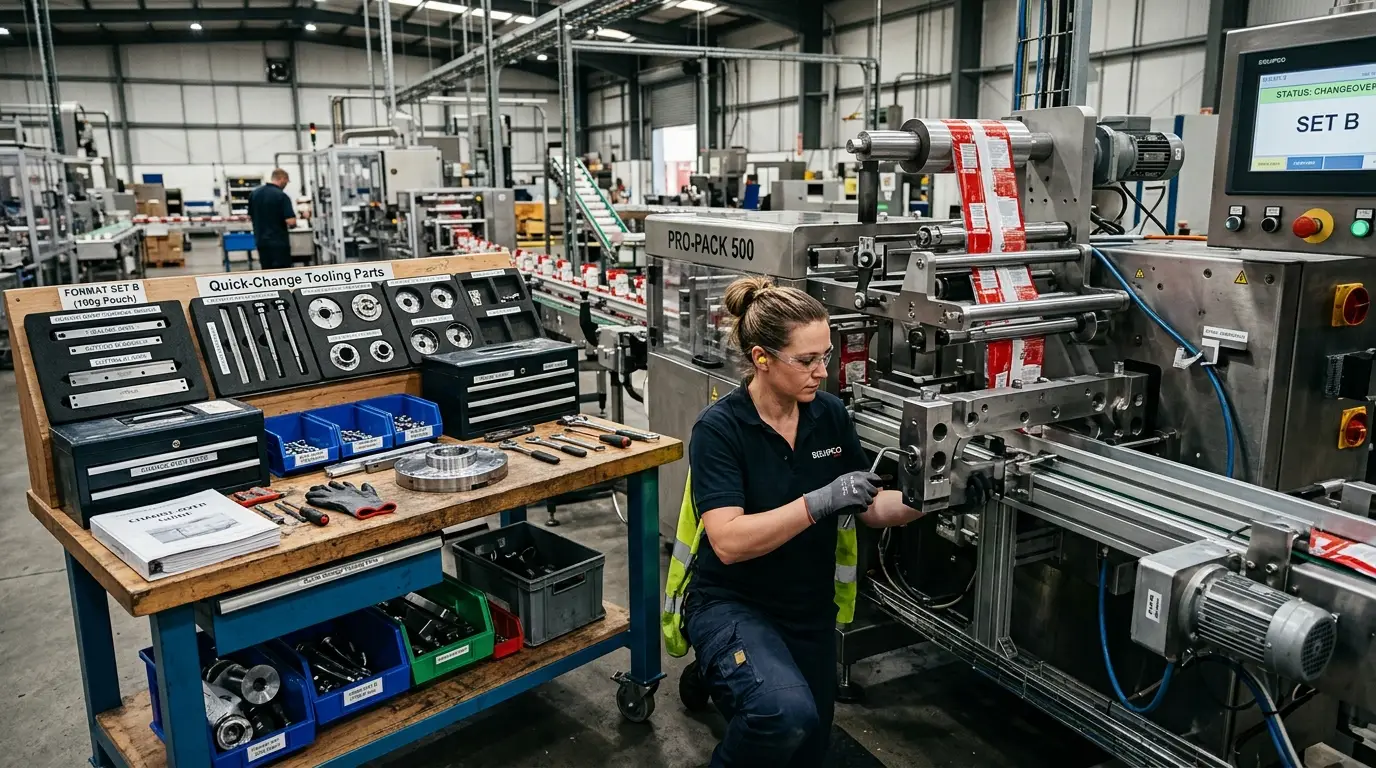
Format parts (also called format sets, change parts, or conversion kits) are the machine-specific components replaced during a product changeover to adapt the packaging line to a different product size, shape, or packaging format. On a typical food packaging line, format parts include: forming tooling, sealing dies, film guide rollers, filling guides, conveyor lane dividers, and date/lot coding templates. A complete format set for a thermoformer-sealer line may comprise 40–120 individual components.
SMED — Single-Minute Exchange of Die
SMED is the lean manufacturing methodology developed by Shigeo Shingo targeting changeover times below 10 minutes. Its core principle is converting internal activities (done while the machine is stopped) into external activities (done while the machine is still running the previous format). Applied to packaging lines:
Internal → External Conversions
Pre-assemble the incoming format set on a trolley while the current format runs. Pre-heat sealing dies off-machine. Pre-stage film rolls at correct tension. Pre-position date coders with the new lot data. Move all documentation sign-off to before the stop signal.
Simplification of Internal Activities
Quick-release clamps replace bolted connections (saves 3–8 min). Colour-coded parts eliminate misidentification errors. Dedicated changeover trolleys with shadow boards ensure all components are present before the stop. Single-wrench or tool-free adjustments for guide rails and film paths.
Format Part Design Principles
| Design Feature | Benefit | Typical Time Saving |
|---|---|---|
| Bayonet/quarter-turn fasteners | Replaces bolts on frequent-change components | 2–5 min/changeover |
| Datum pin location | Eliminates adjustment after installation | 3–10 min/changeover |
| Integrated thermocouple connectors | Tool identification + temperature auto-load | 1–3 min/changeover |
| Colour coding by format | Eliminates wrong-part errors | Reduces rework by 80–90% |
| Weight optimisation | Single-operator handling (<12 kg) | Eliminates 2-person requirement |
Format Part Management Systems
As format libraries grow (10–30 sets is common on flexible lines), systematic management becomes critical. Best-practice systems include: individual part serialisation with QR/RFID tracking, tooling management software linking parts to products and machines, condition-based maintenance schedules triggered by cycle counts, and centralised storage with shadow boards showing what is in use vs. in storage. These systems prevent the common failure modes of missing parts at changeover, installing worn tooling without inspection, and losing track of where format sets are located across multiple production sites.
Frequently Asked Questions
What is a realistic changeover time target for a packaging line?
World-class changeover times for packaging lines range from 15–30 minutes for high-runner formats on well-optimised lines, to 45–90 minutes for complex multi-format machines with many format parts. SMED implementations typically achieve 30–60% reduction from baseline. The key metric is not absolute time but changeover time as a percentage of the production run length — if runs average 4 hours, a 30-minute changeover (12.5% loss) is acceptable; if runs average 45 minutes, the same changeover (40% loss) is a major OEE problem.
How should format parts be stored?
Format parts should be stored in dedicated racking or trolleys in a clean, dry area close to the machine (reduces transport time). Each position should be clearly labelled with product/format identity. Shadow boards make missing parts immediately visible. Temperature-sensitive tooling (sealing dies) should be stored away from extreme heat or cold. Precision components (forming dies, cutting punches) should be stored with protective covers on machined surfaces to prevent handling damage.
When should format parts be refurbished vs. replaced?
Refurbishment (regrinding cutting tools, re-coating worn sealing dies, re-boring worn guide bushings) is cost-effective when the base component is dimensionally sound but surface wear has degraded performance. Replace when: dimensional wear exceeds tolerance (typically >0.1 mm on sealing faces, >0.05 mm on forming cavities), base material is cracked or deformed, or refurbishment cost exceeds 40–50% of new part cost. Track refurbishment history per part to identify chronic wear components for design improvement.