
Paper & Paperboard Packaging Materials
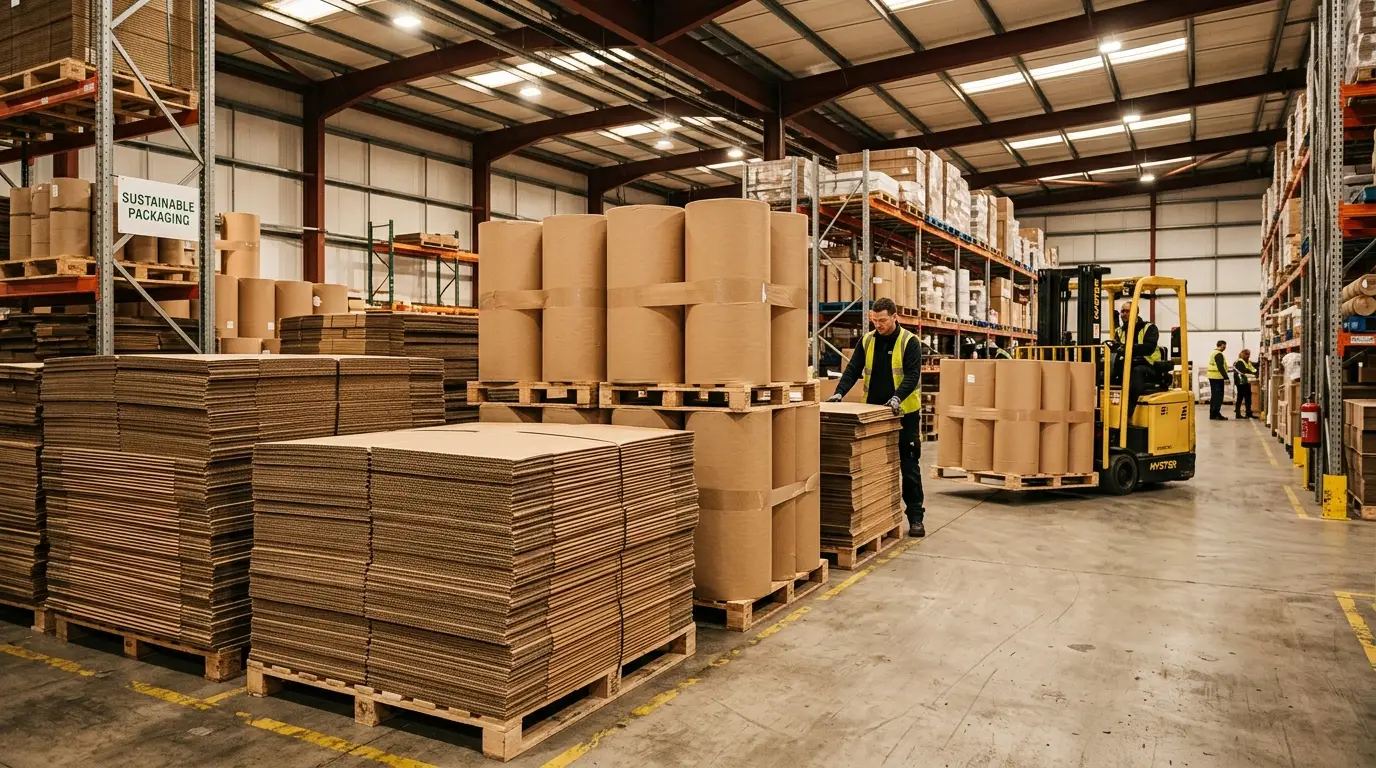
Paper & Paperboard Packaging Materials
The world's most established renewable packaging substrate — from kraft sacks to high-barrier fibre-based alternatives to plastic.
Paper and Paperboard Overview
Paper and paperboard are the dominant packaging materials by volume globally, used in applications ranging from corrugated transit cases to folding cartons to coated flexible papers. As sustainability pressures drive substitution away from plastic, fibre-based materials are seeing renewed innovation — particularly in barrier coatings, mouldable fibre, and paper-based flexible packaging that can replace plastic pouches and wraps.
The distinction between paper and paperboard is grading by grammage: materials below 150 g/m² are classified as paper; above 150 g/m² as board. Most packaging applications use boards in the 200–450 g/m² range.
Key Paperboard Grades
Corrugated Board
Fluted medium sandwiched between liner boards (typically 125–200 g/m² each). Available in single-face, single-wall (BC/C/B/E/F flute), double-wall, and triple-wall grades. BCT (Box Compression Test) strength is the primary structural parameter. Kraft liner (virgin fibre) or testliner (recycled fibre) determines food-contact and printing suitability.
Folding Boxboard (FBB)
Multi-ply virgin fibre board with coated white outer surface, providing excellent printability and stiffness-to-weight ratio. The dominant substrate for pharmaceutical cartons, cereal boxes, and premium consumer goods packaging. GD2/GC2 and NN grades are standard pharmaceutical grades per Ph.Eur. requirements.
White-lined Chipboard (WLC)
Recycled-content board with white coated top layer. Lower cost than FBB, suitable for non-food secondary packaging, shoe boxes, and general retail cartons. Limited food-contact suitability due to recycled fibre mineral oil concerns (MOSH/MOAH migration).
Kraft Paper
Unbleached (brown) or bleached (white) sulphate-process paper known for high tear strength and tensile properties. Used for bags, sacks, interleaving, and as a component in paper-laminate flexible packaging structures. SOS (self-opening sack) and multi-wall bags are standard kraft applications for dry food and industrial products.
Barrier Paper — Replacing Plastic Films
Traditional paper has minimal barrier properties (OTR >10,000 cc/m²/day, WVTR >200 g/m²/day). Barrier coatings applied by dispersion coating, extrusion coating, or vapour deposition transform paper into a functional barrier substrate:
| Coating Type | OTR Reduction | WVTR Reduction | Recyclable? |
|---|---|---|---|
| PE extrusion coating | 50–80% | 90–95% | No (mixed) |
| Dispersion barrier (PVOH/starch) | 90–99% | 60–80% | Yes (repulpable) |
| SiOx/AlOx vapour coating | 95–99% | 85–95% | Yes (repulpable) |
| Wax or aqueous wax | 30–60% | 70–90% | Conditionally |
Repulpable barrier papers — where the barrier coating disperses during the recycling pulping process — are the fastest-growing segment, enabling paper packaging to enter standard paper recycling streams while providing functional barrier for dry food, fast-food wraps, and moulded fibre lids.
Moulded Fibre
Moulded pulp forms produced from virgin or recycled fibre are replacing expanded polystyrene (EPS) in electronics, fresh produce, and foodservice applications. Dry-press moulded fibre achieves surface quality suitable for printing and can be barrier-coated for direct food contact, making it viable as a tray or cup alternative to PP or PET in quick-service restaurant formats.
Frequently Asked Questions
Is paperboard suitable for direct food contact?
Virgin fibre paperboard (kraft, FBB) is generally suitable for direct dry and fatty food contact with appropriate surface coatings. Recycled fibre boards may contain MOSH/MOAH (mineral oil hydrocarbons) that can migrate into food — these are subject to ongoing regulatory action in the EU. A functional barrier between recycled board and food is required under current EFSA guidance.
What is the ECT and BCT of corrugated board?
ECT (Edge Crush Test) measures the in-plane compressive strength of the combined board, typically 6–12 kN/m for standard e-commerce and retail grades. BCT (Box Compression Test) measures the top-to-bottom load-bearing capacity of the finished box and is the parameter directly relevant to stacking performance in distribution. BCT is determined by ECT, box dimensions, and perimeter according to the McKee formula.
Can paper replace plastic in flexible packaging?
Paper can replace plastic in many dry and low-moisture applications using barrier-coated papers. However, it cannot yet match the puncture resistance, transparency, or moisture barrier of PE or foil in demanding applications such as fresh protein, dairy, and liquid packaging. The most successful plastic-to-paper conversions are in confectionery, dry snack, and fast-food wrap formats where moisture barrier requirements are moderate.