
Flexible Packaging: Films, Laminates & Pouches
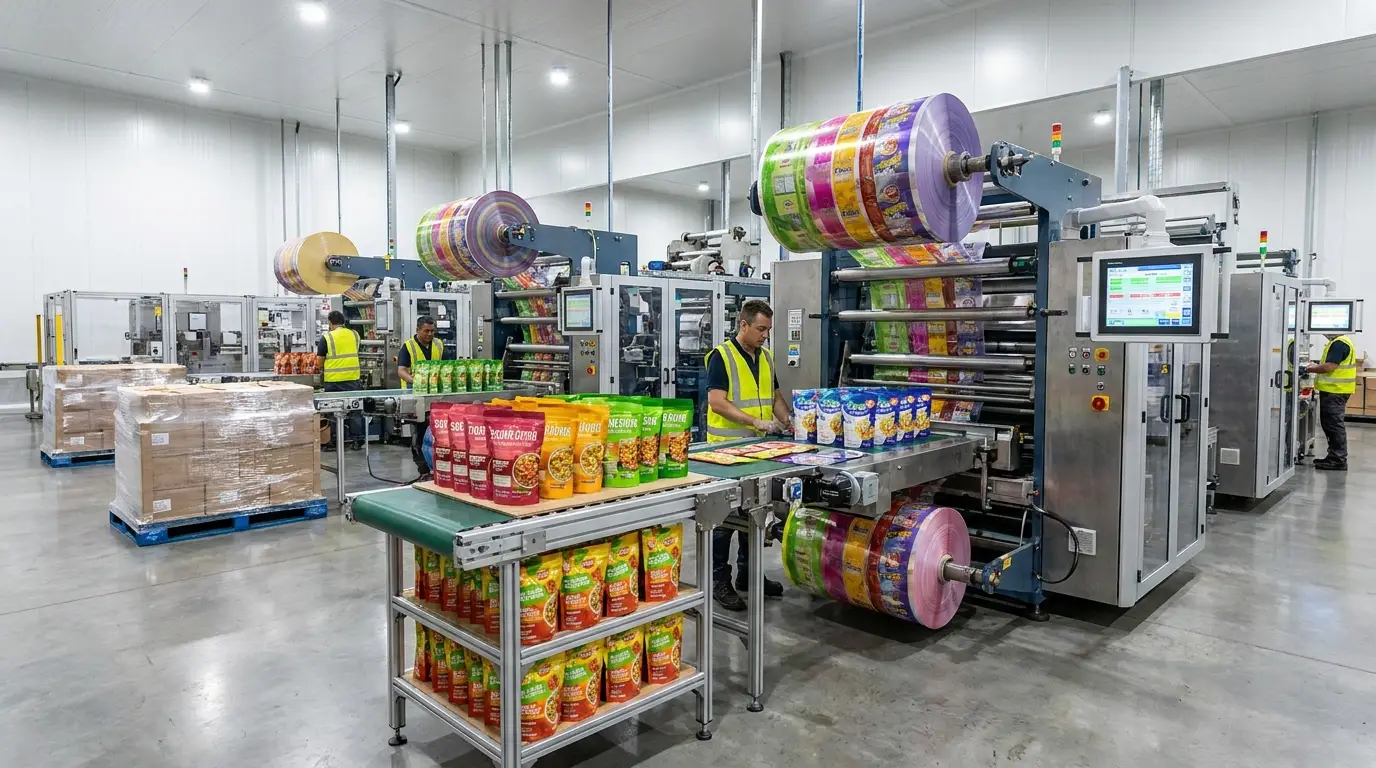
Flexible Packaging: Films, Laminates, Pouches and Structures
The complete guide to flexible packaging formats, barrier film structures, laminate design, and sustainable flexible packaging solutions
What Is Flexible Packaging?
Flexible packaging refers to any package or part of a package whose shape can be readily changed — typically made from films, foils, papers, and their laminates, as distinct from rigid formats like glass, metal cans, or rigid plastic containers. It encompasses pouches, sachets, bags, wraps, flow packs, lidding films, shrink sleeves, and flexible tubes across food, beverage, personal care, household, pet food, and industrial markets.
Flexible packaging is one of the largest and fastest-growing packaging sectors globally, driven by its superior material efficiency (typically 60–70% less plastic by weight than equivalent rigid packaging), high-quality print capabilities across the full package surface, and adaptability to virtually every filling technology and product category.
The term 'flexible packaging' is sometimes used loosely to mean any non-rigid pack, but in industry usage it specifically refers to structures where the packaging film itself provides the primary structural element — distinguishing it from semi-rigid thermoformed trays or blister packs, which have a defined rigid or semi-rigid cavity.
Flexible Packaging Formats
Stand-Up Pouches (SUP)
Stand-up pouches have a gusseted base that allows them to stand upright on shelf, providing excellent retail visibility. Available with or without resealable zippers, spouts (for liquids), and hang holes. Used across sauces, beverages, pet food, baby food, dried food, and personal care. The Doypack® is the archetypal SUP format.
Flat Pouches (3SS and 4SS)
Three-side seal (3SS) and four-side seal (4SS) flat pouches are produced from flat film web, sealed on multiple sides to create a flat, low-profile pack. Used for sliced meat and cheese, confectionery, medical devices, and industrial components. The compact format minimises headspace and is highly efficient for pallet stacking and logistics.
Pillow Packs (Flow Packs)
Produced by HFFS or VFFS flow wrapping machines, pillow packs are the dominant flexible format for confectionery, bakery, snacks, and fresh food. See our Flow Wrap guide for full detail.
Sachets
Single-serve or unit-dose sachets for condiments, sugar, pharmaceuticals, cosmetics, and industrial samples. Produced by VFFS or sachet machines from multi-layer films including foil laminates, paper/PE, and coated structures.
Flexible Tubes
Laminated tubes made from flexible film for toothpaste, cosmetics, pharmaceutical creams, and food condiments. Multi-layer coextrusions or laminates provide the required barrier and printability.
Flexible Packaging Film Structures and Laminates
Most flexible packaging is not a single film but a multi-layer laminate engineered to combine the properties of different materials. A typical food pouch laminate might comprise:
- Outer layer (print substrate): Reverse-printed BOPP or PET for high gloss, excellent ink adhesion, and dimensional stability
- Barrier layer: EVOH co-extrusion, metallised OPP/PET, or aluminium foil — providing the required oxygen, moisture, and light barrier
- Sealant layer: LDPE, LLDPE, or CPP — provides the heat-seal interface and product-contact surface
Adhesive lamination (solvent or solvent-free) or extrusion lamination bonds these layers into a coherent structure. The laminate design is driven by the product's shelf life requirements, the filling process, and end-of-life recyclability targets.
Barrier performance is quantified by Oxygen Transmission Rate (OTR) in cm³/m²/day and Water Vapour Transmission Rate (WVTR) in g/m²/day — the lower the value, the more effective the barrier. High-barrier laminates with EVOH or aluminium foil achieve OTR values below 0.5 cm³/m²/day.
Sustainable Flexible Packaging
Flexible packaging faces a fundamental sustainability challenge: its multi-layer, multi-material construction delivers superior material efficiency (less plastic per unit of product) but creates significant recyclability difficulties. A PET/PE/EVOH/PE laminate is technically superior packaging but essentially non-recyclable in current waste streams.
The industry response is structured around three strategies:
- Mono-material structures: All-PE or all-PP laminates that maintain adequate barrier performance while enabling recycling in polyolefin streams. Several major brands have already transitioned to certified recyclable mono-material pouches for dry food products.
- Paper-based flexible packaging: Paper/PE or paper/metallised laminates for applications where paper recyclability can be maintained (requires thin PE layers that don't prevent paper recycling in appropriate paper mills)
- Compostable flexible packaging: PLA and cellulose-based films for applications where industrial composting infrastructure exists — currently limited to specific markets and product categories
The EU Packaging and Packaging Waste Regulation (PPWR) mandates recyclability by design for all packaging by 2030, making mono-material flexible packaging structures a commercial necessity rather than a differentiating feature within the European market.
Frequently Asked Questions
Biaxially Oriented Polypropylene (BOPP) is the most widely used flexible packaging film by volume, primarily as the outer print layer in laminates for snack, confectionery, bakery, and personal care packaging. Polyethylene (LDPE, LLDPE, HDPE) is the most widely used polymer in flexible packaging overall, appearing as the sealant layer in most food laminates and as the sole layer in bags and wraps.
Flexible packaging uses films, foils, and papers — materials that readily change shape under normal handling. Rigid packaging (glass, metal cans, rigid HDPE/PP/PET containers) maintains a fixed shape independently of the product inside. Semi-rigid packaging (thermoformed trays, blister packs) has defined cavity geometry but limited flexibility. The distinction matters for recyclability, material efficiency, logistics (flexible packs compress for return logistics), and product protection requirements.
It depends entirely on the structure. Single-material PE bags and HDPE grocery bags are recyclable in PE streams where collection exists. Multi-layer laminates (OPP/PE, PET/PE/EVOH) are generally not recyclable in standard household recycling. Certified recyclable flexible packaging (RecyClass, How2Recycle) uses simplified structures that can be processed. Aluminium foil laminates are not recyclable in standard streams.
Flexible packaging films and laminates are engineered to provide specific combinations of oxygen barrier (preventing oxidative degradation), moisture barrier (preventing drying or hydration), CO₂ barrier (for MAP applications), light barrier (preventing UV oxidation — requires metallisation or foil), and aroma barrier (preventing flavour loss or contamination). The required performance is specified by OTR and WVTR values.
Rotogravure printing is the dominant method for high-volume flexible packaging — excellent colour consistency, sharp detail, but high tooling cost. Flexographic printing is used for medium-volume and corrugated applications with lower tooling cost. Digital printing is growing for short runs, personalisation, and versioning — no tooling required but higher cost per metre. Most flexible packaging is reverse-printed on the outer layer, with the print protected between laminate layers.
Flexible Packaging SolutionsDiscuss laminate design, pouch formats, barrier requirements, and sustainable film options for your product.
Get in Touch →