
Thermoforming Packaging
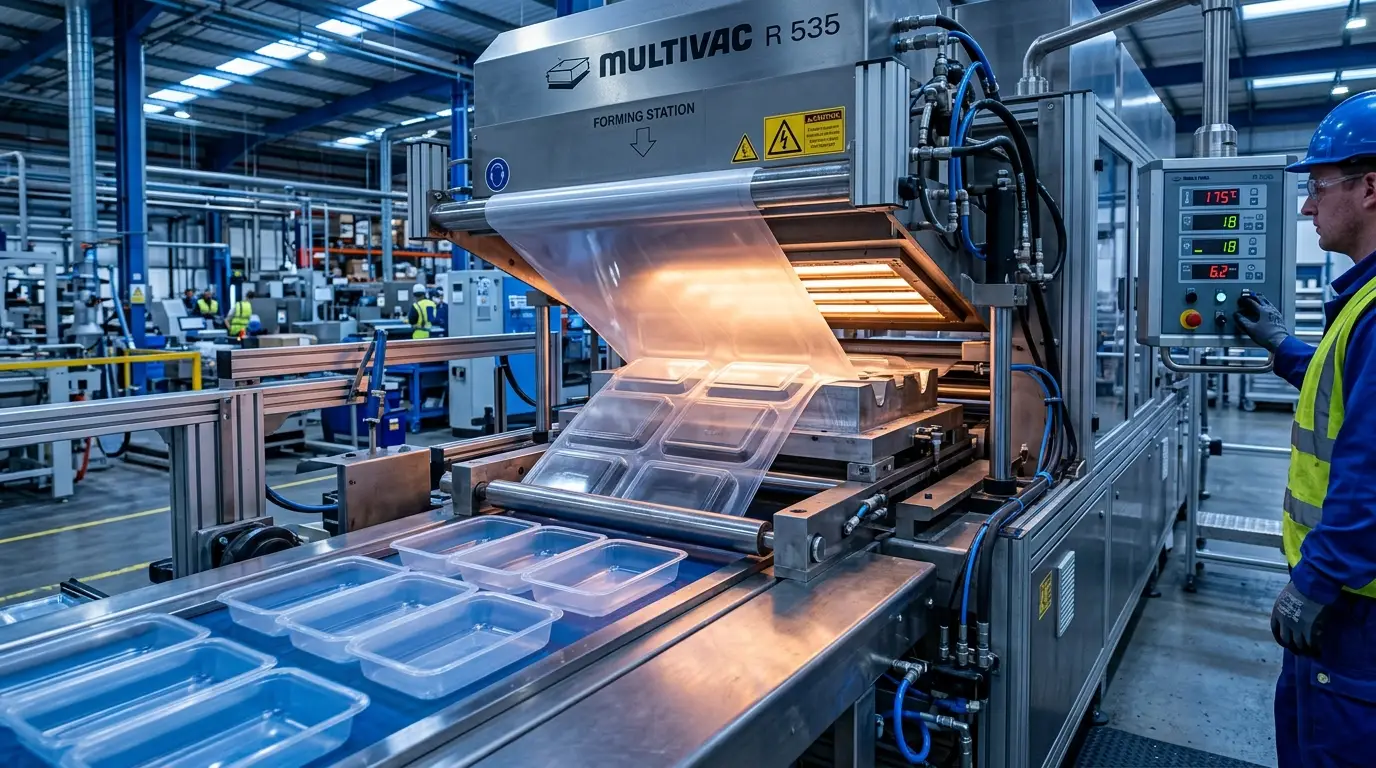
Thermoforming Packaging
Heat-forming thermoplastic sheet into trays, clamshells, and cavity inserts — the dominant rigid packaging process across food, pharmaceutical, and industrial sectors.
What Is Thermoforming Packaging?
Thermoforming packaging is a manufacturing process in which thermoplastic sheet material is heated to its softening point and formed into a three-dimensional shape using vacuum, pressure, or mechanical assistance. The resulting parts — trays, clamshells, blisters, skin packs, and cavity inserts — protect and present products throughout the supply chain across food manufacturing, pharmaceutical, electronics, and industrial sectors.
Two principal equipment configurations exist. Roll-fed thermoformers process material from a continuous reel and are standard in high-volume food and pharmaceutical production. Cut-sheet thermoformers handle pre-cut blanks for lower volumes, larger formats, and thicker gauge materials.
Key standard: ISO 11607 governs thermoformed trays used as sterile barrier systems for medical devices. For food contact, EU Regulation 10/2011 applies to plastic materials and articles. See thermoforming in medical device packaging →
Thermoforming Materials
Material selection determines the performance envelope of the formed part — clarity, stiffness, barrier, seal compatibility, and recyclability.
- PET / APET / CPET — dominant for food trays. Excellent clarity and recyclability. CPET withstands oven temperatures up to 220°C for dual-ovenable ready meals.
- PP (polypropylene) — microwave-compatible, chemical-resistant. Standard for soups, sauces, and prepared meals. Steam-sterilisable grades used in medical packaging.
- PVC — high clarity, excellent forming characteristics. Standard pharmaceutical blister substrate. Displaced in some segments by PVC-free alternatives.
- HDPE — robust, chemical-resistant. Used for industrial parts trays and transit packaging applications.
- rPET / bio-PET — PCR and bio-derived variants meeting extended producer responsibility (EPR) and retailer sustainability commitments.
Tooling and Mould Design
Mould design directly determines dimensional accuracy, wall thickness distribution, and cycle time. Key parameters include draw ratio, draft angles (minimum 1–3° for reliable release), corner radii, and vent hole placement. Aluminium tooling is standard for production; epoxy tooling is used for prototyping and short runs. Multi-cavity tools maximise throughput constrained by sheet width and press capacity.
Reference standard for mould qualification: ISO 11607-2 (medical) · ASTM F2132 (orientation).
Frequently Asked Questions
Vacuum forming draws the heated sheet against the mould by applying negative pressure (vacuum) below the sheet. Pressure forming pushes the sheet into the mould using positive air pressure above. Pressure forming achieves sharper detail and better wall thickness distribution, at higher tooling and equipment cost. Most high-volume food packaging uses a combination of plug assist with vacuum.
PET (including APET and CPET) is recyclable in established PET streams and is the most widely collected thermoformed packaging material in Europe. PP is recyclable in PP streams but collection infrastructure is less comprehensive. PVC is technically recyclable but is not accepted in most municipal streams. rPET trays (recycled content) close the material loop and meet EPR recyclability criteria in most EU member states.
Minimum achievable wall thickness depends on material, draw ratio, and forming method. For food-grade PET trays, wall thickness of 0.2–0.3 mm is achievable on modern equipment. High draw-ratio areas (deep corners, edges) will be thinner than flatter sections — wall thickness distribution is a key quality parameter measured by ultrasonic gauge during qualification.
Thermoforming uses flat sheet stock and is suited to thin-walled, high-volume parts with relatively large footprints — trays, clamshells, lids. Tooling cost is lower than injection moulding. Injection moulding is preferred for thick-walled parts, complex geometry, precise tolerances, and integrated features (snap fits, living hinges) that thermoforming cannot achieve. For food trays at volume, thermoforming is almost always more cost-effective.
EU Regulation 10/2011 on plastic materials and articles in contact with food applies to thermoformed trays and clamshells. In the UK, equivalent retained EU law applies post-Brexit. For migration testing, EN 1186 series provides test methods. For thermoformed trays used as sterile barrier systems in medical device packaging, ISO 11607 applies — covered in depth on MedicoPax.com.
Looking for more detail?The InnovaPax knowledge base covers thermoforming processes, materials, and equipment selection in depth.
Read the full guide →